1-Week Emergency Food Supply: The 14,000-Calorie Math
Learn why 1-week emergency food supplies must meet 2,000 calories/day. Calorie math, storage specs, and a grab-and-go solution for sudden evacuations.
A 1-week emergency food supply is not about eating gourmet meals during a crisis—it's about preventing metabolic failure when you cannot leave your home or reach a store. The math is simple: one adult needs approximately 2,000 calories per day to maintain basic function during stress and physical demand. Seven days × 2,000 calories = 14,000 calories minimum. Miss that target by even 20%, and fatigue, impaired decision-making, and immune collapse follow within days.
Most people guess wrong about what "1 week" actually requires. They buy three days of snacks and call it prepared. This article breaks down the calorie calculation, storage realities that degrade shelf life, and why a grab-and-go container beats scattered boxes in a real evacuation.
Why 14,000 Calories Matters More Than You Think
An emergency food supply is not a camping trip. During an actual disruption—power loss, water contamination, road closure, medical quarantine—your body burns calories faster than in normal life. You move more (no car), think harder (stress), and your metabolism stays elevated.
A 2,000-calorie baseline assumes:
- Adult, average activity during crisis: 2,000 cal/day
- Active adult or teenager: 2,500 cal/day
- Child, ages 4–8: 1,400 cal/day
- Pregnancy or nursing: 2,500–2,800 cal/day
The mechanism is straightforward: carbohydrates and fats metabolize into ATP (cellular energy). Protein preserves muscle mass under stress. Without sufficient calorie density, your brain fog increases, fine motor control deteriorates, and you become a liability to your family—not an asset.
One week is the minimum viable interval because:
- Supply chains take 3–7 days to restore after most localized disruptions (weather, utility failure, road damage).
- Evacuation orders are often lifted or rescission begins by day 5–7.
- One week is psychologically manageable—it doesn't feel like doomsday prepping; it feels like insurance.
The Calorie Density Problem in Emergency Meals
Not all calories are equal in storage. A fresh apple has 95 calories but rots in two weeks. A freeze-dried apple slice weighs 0.3 ounces and holds 50 calories—the same macronutrient density in 1/50th the weight and space.
This is why an ammo can (a 5.56 metal ammunition container, 5¼" × 3⅜" × 2½") is so efficient: it constrains volume to roughly 30 cubic inches, forcing you to pack only calorie-dense, shelf-stable foods. No water weight, no fragile packaging, no air gaps that accelerate spoilage.
Emergency meal packets (freeze-dried rice, pasta, vegetables, whey protein isolate) are designed specifically for this constraint. One serving packet:
- Weighs 2–3 ounces
- Contains 200–280 calories
- Requires only boiling water (or cold reconstitution in some formulations)
- Has a 25-year shelf life if kept below 70°F and under 15% humidity
The math: 58 servings × 240 calories (conservative average) = 13,920 calories. That's 6,960 calories per person for a two-adult household, or exactly seven days for one person at 2,000 cal/day.
Storage Reality: What Actually Degrades Shelf Life
The advertised "25-year shelf life" assumes perfect conditions. Real homes do not maintain perfect conditions. Here is what actually shortens that span:
| Condition | Impact | Reality |
|---|---|---|
| Temperature 70–75°F | Baseline (25 years) | Most homes in fall/winter; basements/pantries in summer hit 75–80°F |
| Temperature 80–90°F | ~50% of shelf life (~12–13 years) | Attics, garages, uninsulated closets in summer |
| Humidity above 15% | Oxidation, mold risk | Basements and kitchens near dishwashers/sinks often run 50–60% RH |
| Opened container | 6–12 months maximum | Oxygen exposure triggers rancidity in fats and oxidative loss in vitamins |
| Light exposure (direct or filtered) | Accelerates degradation of fats and fat-soluble vitamins | Window sills, clear storage containers in lit rooms |
An ammo can solves two of these: it is opaque (blocks light) and weathertight when sealed (resists humidity). But temperature and the location you choose still matter. A basement corner stays closer to 55–65°F than a garage shelf in July.
Practical shelf life for most American homes: 15–18 years for sealed ammo-can supplies stored in a cool, dry closet or basement corner—not 25 years, but still decades beyond any reasonable emergency.

1-Week Food Supply Ammo Can (2,000+ calories/day)
- ✓Freeze-dried meals deliver 240–280 calories per serving with only water required—no fuel or cooking skills needed
- ✓58 servings = 13,920 calories = exactly 7 days at 2,000 cal/day for one adult
- ✓Sealed metal ammo can blocks light and resists humidity; survives a vehicle evacuation without opened boxes
- ✓Meals account for protein (whey isolate, textured soy), carbs (rice, pasta), and micronutrients (freeze-dried vegetables retain 90% of vitamins after rehydration)
- ✓Store in a 55–70°F space; even in a warm garage, the sealed container protects contents for 15+ years
The Grab-and-Go Advantage During Real Evacuations
An evacuation order gives you 20 minutes to an hour. Not four hours. You will not systematically load five cardboard boxes from a pantry closet. You will grab what is visually accessible and head for the car.
An ammo can has three advantages in this scenario:
-
Single object, known weight (~35 lbs with food and water for one person). You can heft it one-handed. You know it fits your backpack or car floor.
-
Self-contained inventory. You do not open it at home to check contents and accidentally expose the food to humidity. You know exactly what is inside because the manifest is fixed at purchase.
-
Sealed against contamination during transit. If your car floods, the ammo can keeps water out (15 minutes submerged is survivable; hours is not). If you are trapped in dust or smoke, it does not absorb particulates.
Scattered boxes, even in labeled storage bins, create decision paralysis. "Do I grab this? How much does it weigh? Is this one expiring?" In an actual crisis, you run out of time and leave food behind.
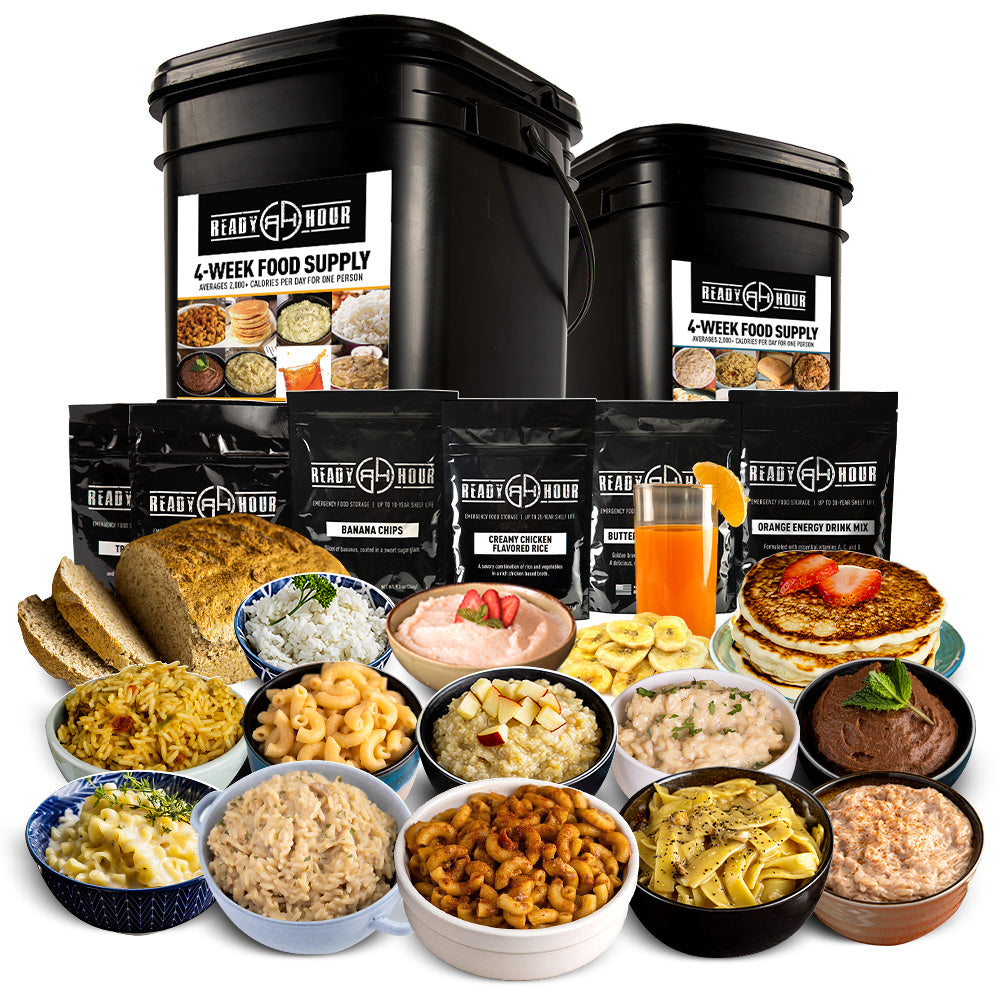
4-Week Emergency Food Supply (2,000+ calories/day)
- ✓232 servings (58 servings × 4 weeks) = 55,680 calories, covering a full month at 2,000 cal/day for one person
- ✓Extends preparedness to utility failures, quarantines, and supply chain disruptions lasting longer than one week
- ✓Same freeze-dried formula and 25-year potential shelf life; scales to multi-ammo-can or larger container storage
- ✓Meets FEMA's one-month emergency supply recommendation for complete household coverage
- ✓Easier to deploy than four separate 1-week cans if you have basement storage; harder to grab and evacuate in one trip
Honest Limitations: What This Supply Cannot Do
A 1-week emergency food supply is not insurance against every scenario. Understand its boundaries.
It does not account for dependents. A family of four needs 4 × 14,000 = 56,000 calories for one week. One ammo can feeds one person or supplements a family of four for two days. Plan accordingly.
It is calories, not nutrition balanced for disease or allergy. A person with Type 2 diabetes on a strict low-glycemic diet will find freeze-dried pasta and rice problematic. Someone with severe peanut allergies must verify every ingredient (most brands are safe, but co-manufacturing happens). Celiac disease excludes any product with wheat-derived thickeners.
It does not replace water or water purification. The math: one gallon (3.8 liters) per person per day. Rehydrating 58 servings requires roughly 15–20 gallons of water for the week—a logistical problem on its own. If your water supply is compromised, you cannot prepare the meals.
It fails in truly long-duration disruptions (8+ weeks). A 1-week supply is a bridge, not a foundation. If you live in an area prone to hurricanes, winter storms, or grid instability, this is step one. Proceed to a 1-month supply (three additional ammo cans or a larger container).
It assumes you can boil water or have an alternative heat source. If a wildfire evacuation forces you to shelter in a parking lot, or a flood traps you without electricity, you cannot rehydrate meals. Cold-water reconstitution works for some brands (check the label), but most require 160°F+ water for the full nutrient release and safe microbe destruction.
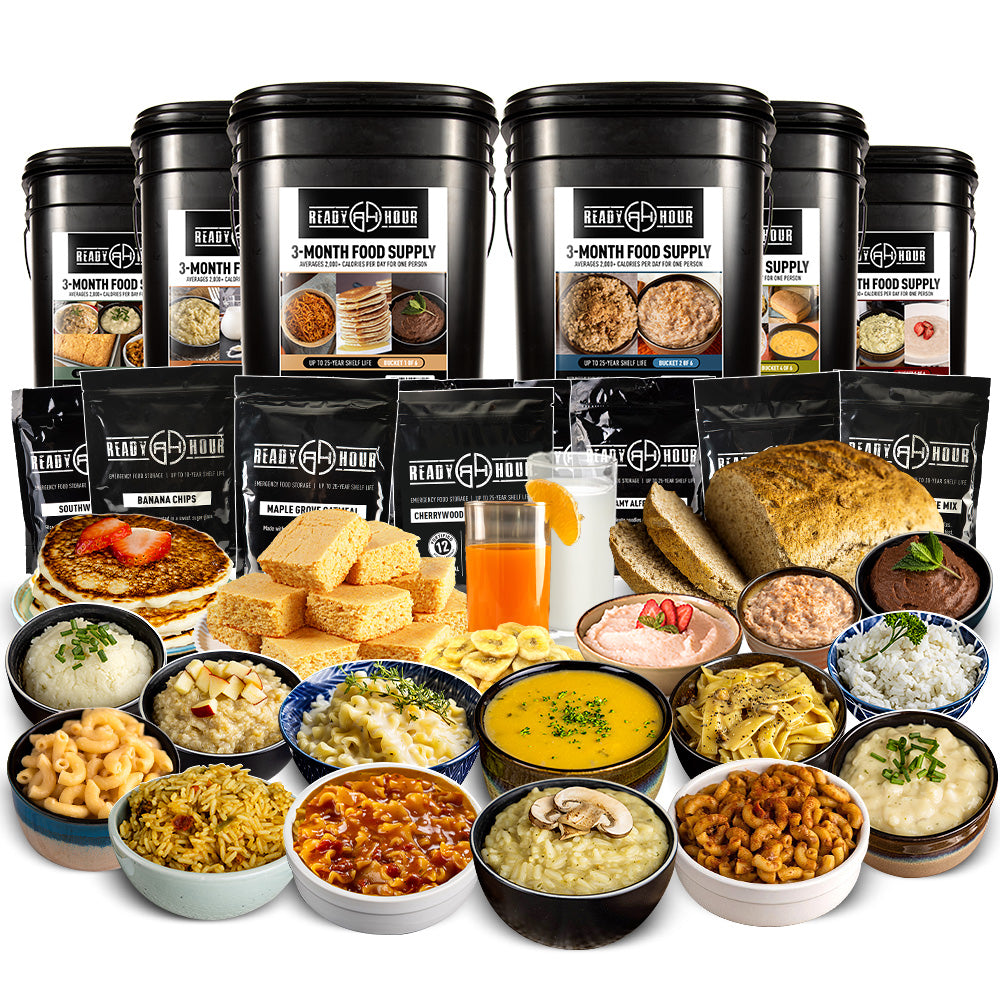
3-Month Emergency Food Supply (2,000+ calories/day)
- ✓696 servings over 12 weeks (incremental ammo-can stacking or single 5-gallon bucket) = 166,560 calories per person
- ✓Covers extended supply-chain breaks, regional power grid failures, and quarantine scenarios lasting 6–8 weeks or longer
- ✓Same freeze-dried macronutrient profile; easier to store than six separate 1-week cans due to bulk economies of scale
- ✓Meets CDC and FEMA three-month supply target for high-risk regions (earthquake zones, tornado alleys, rural areas distant from supply centers)
- ✓Requires dedicated cool, dry storage space (two 5-gallon buckets occupy roughly 2 cubic feet)
Frequently Asked Questions
Q: How many calories do I actually need for a 1-week emergency food supply?
A: A minimum of 14,000 calories for one adult (2,000 cal/day × 7 days). If anyone in your household is active, pregnant, or a teenager, add 500 calories per person per day. A two-adult household should have at least 21,000 calories (or roughly 1.5 ammo cans). The math is simple, but the actual consumption is often higher because stress and physical demand increase calorie burn.
Q: What's the difference between a 1-week and 4-week emergency food supply?
A: Duration and household coverage. One 1-week ammo can supplies one person for seven days or bridges a family of four through two days. A 4-week supply (four ammo cans or equivalent) covers one person for 28 days—long enough to outlast most utility failures, supply-chain breaks, and evacuation orders in your region. Choose 1-week if you have reliable evacuation routes and stable utility recovery patterns; choose 4-week if you live in a flood zone, earthquake region, or remote area where rescue takes longer than 72 hours.
Q: How long does emergency food actually last in storage?
A: The advertised 25-year shelf life assumes storage at 50–70°F and under 15% humidity. Most home basements and pantry closets run 55–75°F and 40–60% humidity. In those conditions, expect 15–18 years of safe consumption. Opened containers degrade within 6–12 months. The ammo-can seal buys you time by blocking light and moisture, but temperature and humidity of your storage location are the real life-limit factors.
Next Steps
Start with one ammo can. If you have a family of three or more, buy two. Store one in a cool basement corner or pantry, and keep one in your vehicle or near your evacuation exit. Test one meal packet this month—boil water, rehydrate, and eat it. Not to save it, but to know exactly what your emergency food tastes like and how fast it rehydrates. A surprise texture or unexpected saltiness during an actual crisis adds stress you do not need.
After the first month, decide whether to expand to a 4-week supply based on your household size and regional risk. An evacuation plan without food is a plan that fails at the first hard choice.
Sources & Official Guidance
Authoritative further reading
This guide is for general informational purposes only and is not professional, medical, or safety advice. Always follow official guidance and, in a life-threatening emergency, call your local emergency number (911 in the US).
Mark Sutton, Lead Editor
Mark runs the editorial side of DoomsDayPreps. He digs into the research on emergency prep and survival gear, and checks anything safety-related against FEMA, CDC, and Red Cross guidance before it goes live.