2-Week Emergency Food Supply: Calorie Math for 1 Person
Emergency food supply for 2 weeks feeds one person 2,000 calories daily. Learn calorie math, storage rules, and which kit fits your household.
When a weather event, job loss, or supply chain disruption hits, you have hours—not days—to act. A 2-week emergency food supply removes that panic. You stop calculating, stop shopping, and start eating. This article shows you how to calculate the calories your household actually needs, why a 2-week baseline matters, and how to build a system that works across multiple people and scenarios.
Why Calorie Math Changes Everything
Most people guess at emergency food needs. They grab a week's worth and hope it covers three months. Then they discover they've fed one person, not the family.
The math is simple: 1 person × 2,000 calories/day × 14 days = 28,000 calories total. But your household probably isn't one person.
Here's the breakdown by age and activity level:
| Person Type | Calories/Day | 2-Week Total |
|---|---|---|
| Adult (sedentary) | 1,800–2,000 | 25,200–28,000 |
| Adult (active) | 2,400–2,600 | 33,600–36,400 |
| Teenager (age 14+) | 2,400–2,600 | 33,600–36,400 |
| Child (age 9–13) | 1,600–2,000 | 22,400–28,000 |
| Child (age 4–8) | 1,400–1,600 | 19,600–22,400 |
An average household of four (two adults, one teenager, one 10-year-old) needs approximately 104,000 calories for 14 days. That's four separate 2-week kits—not one. Write this number down. It is the baseline for your actual household.
Building Your Calorie Buffer
Emergency food works differently than regular meals. You're not choosing what to eat. You're eating what you have. This means actual calories delivered from shelf-stable food are lower than advertised if the food requires water, cooking fuel, or preparation time you don't have.
A standard emergency meal bucket contains breakfast, lunch, and dinner servings. Breakfast is typically a dried grain or oatmeal-base. Lunch is freeze-dried meat and vegetable entrée. Dinner is a heavier entrée. The math assumes you can boil water and mix ingredients.
If you lose power or water access, this calculation breaks. You'll either skip meals, ration unexpectedly, or fall short by 20–30% of stated calories.
This is why a 2-week supply for one person is a minimum baseline, not a comfortable margin. If you have dependents, elderly household members, or anyone with increased caloric needs (pregnancy, nursing, illness recovery, or physical labor during the crisis), add 15–20% extra calories.
For a household of two adults: 2,000 cal/person/day × 2 × 14 days = 56,000 calories. Add 20% for safety and unexpected needs: 67,200 calories = roughly three 2-week kits, or one 4-week kit plus supplements.
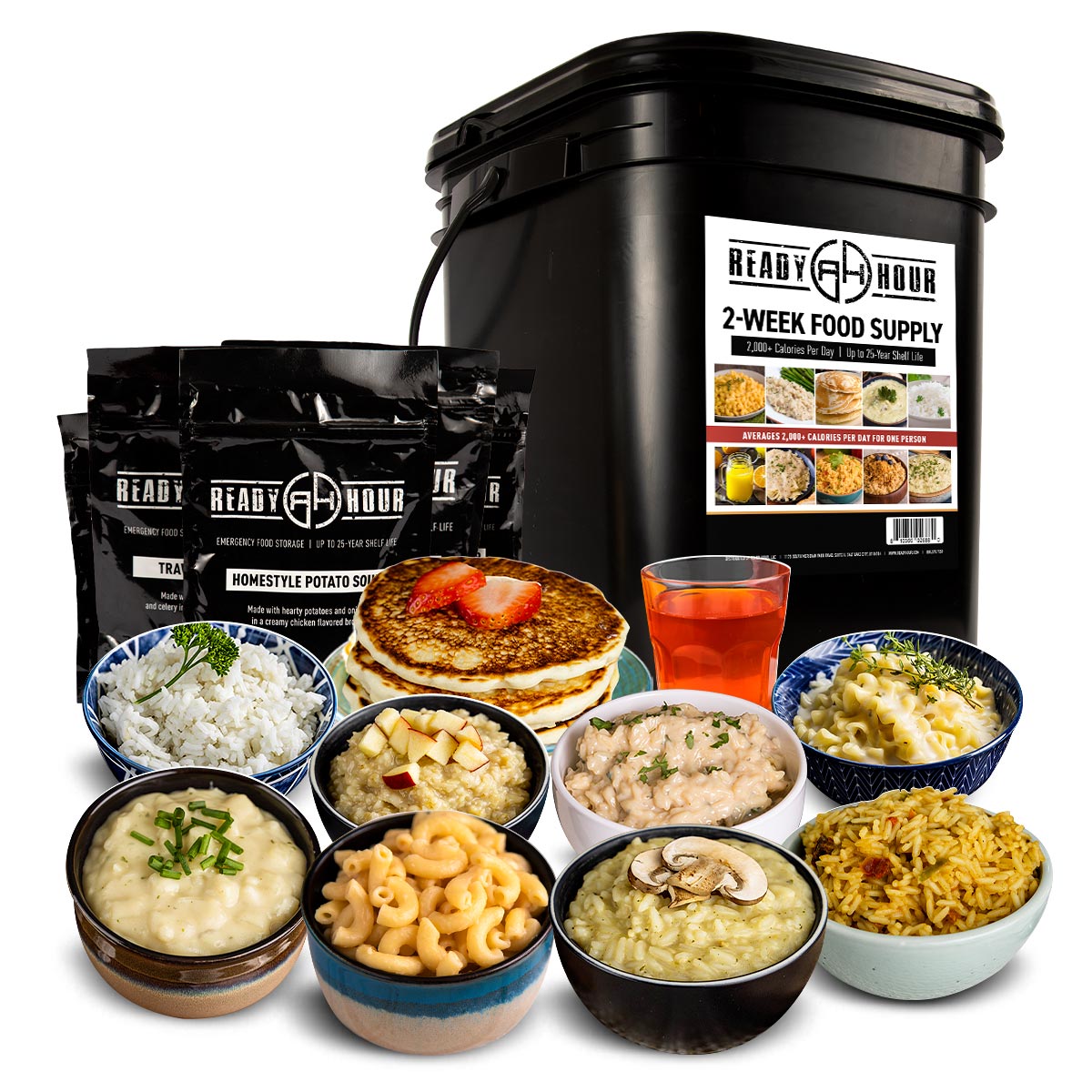
2-Week Emergency Food Supply (2,000 calories/day)
- ✓Delivers 118 servings (breakfast, lunch, dinner) across 14 days without resupply
- ✓2,000+ calories daily as stated; bucket stays sealed until needed, no expiration math to track weekly
- ✓Single-person baseline for job loss, supply disruption, or weather event—one container, grab-and-go
- ✓Freeze-dried portions prepare with hot water only; no stove or fuel required if you pre-boil water or use stored hot water
- ✓Sealed bucket protects from moisture, insects, and light; stackable for closet or basement storage
How to Store Emergency Food Correctly
Shelf-stable food only stays shelf-stable if you control the environment. Temperature and humidity are the two variables that collapse shelf life.
Temperature: Store at 50–70°F. Every 18°F rise above 70°F cuts shelf life roughly in half. A bucket stored in an attic (120°F in summer) loses 1–2 years of viability per single hot season. A basement at steady 60°F extends shelf life noticeably. Choose your storage location before buying—this decision matters more than the brand.
Humidity: Keep below 15%. Moisture enters through seals, cracks in the bucket, and condensation. A bucket stored in a damp basement or garage may see mold or staleness after 12 months, even if the seal is intact. Open and reseal containers only when you're using them. Once a seal breaks, consume within 2–3 weeks.
Light: Store in darkness. Sunlight and fluorescent light degrade fat-soluble vitamins (A, D, E, K) and accelerate rancidity in grain products. A closet or cabinet beats open shelving.
The stated shelf life on most emergency food buckets is 20–25 years under ideal conditions—meaning cool, dark, consistently dry. Real-world shelf life is more conservative. Plan to rotate stock every 10 years and check seals annually. A bucket stored in a stable basement will realistically stay nutritious for 15–20 years. A bucket stored in a garage, attic, or humid space may degrade to poor taste and lower nutrition within 5–7 years.

1-Week Food Supply Ammo Can (2,000+ calories/day)
- ✓Sealed metal ammo can protects from humidity and light better than plastic; ideal for damp climates or shared storage
- ✓1-week quantity (700 calories × 7 days) fits budget-building or rotation schedules
- ✓Ammo cans stack efficiently and resist crushing; portable if you need to grab-and-go or shelter away from home
- ✓Metal construction maintains airtight seal longer than plastic; desiccant pack prevents internal condensation
- ✓Compact enough to store in vehicle emergency kit or bug-out bag alongside water and shelter supplies
Honest Limitations: When This Approach Falls Short
A 2-week emergency food supply is a bridge, not a long-term solution.
What it does NOT do:
- It does not address hydration. 2,000 calories means nothing without water. Plan 1 gallon per person per day minimum—a 14-day supply for one person requires 14 gallons of water stored separately. This is 112 pounds of weight. Most households drastically underestimate water need.
- It does not replace a cooking fuel plan. If your bucket requires hot water and you lose gas, electricity, and water pressure, you need a secondary heat source: a camp stove with fuel, a rocket mass heater, or pre-boiled and insulated water containers. Test this before the emergency.
- It does not account for dietary restrictions, allergies, or medical diet needs. Emergency food buckets contain common allergens (gluten, soy, dairy, tree nuts depending on brand). If anyone in your household has nut allergies, celiac disease, or kidney disease requiring low-sodium meals, a standard bucket is a supplement, not a solution. Research brands that match your household's medical and dietary profile.
- It does not sustain high activity or recovery. 2,000 calories is baseline sedentary intake. If you're clearing debris, securing shelter, or managing illness recovery, actual need rises to 2,600–3,000+ calories. A single 2-week kit feeds one sedentary adult. It starves one active person or teenager.
- It fails if you lose access to clean water for mixing. Many emergency food packets require hot water and 5–10 minutes of rehydration. If your water is contaminated or you have no heat source, the food becomes waste. Pair your bucket with a water filter (gravity filter, boiling capacity, or filtration tablets).
A 2-week supply works best as the first layer of a multi-month plan, not as standalone insurance.
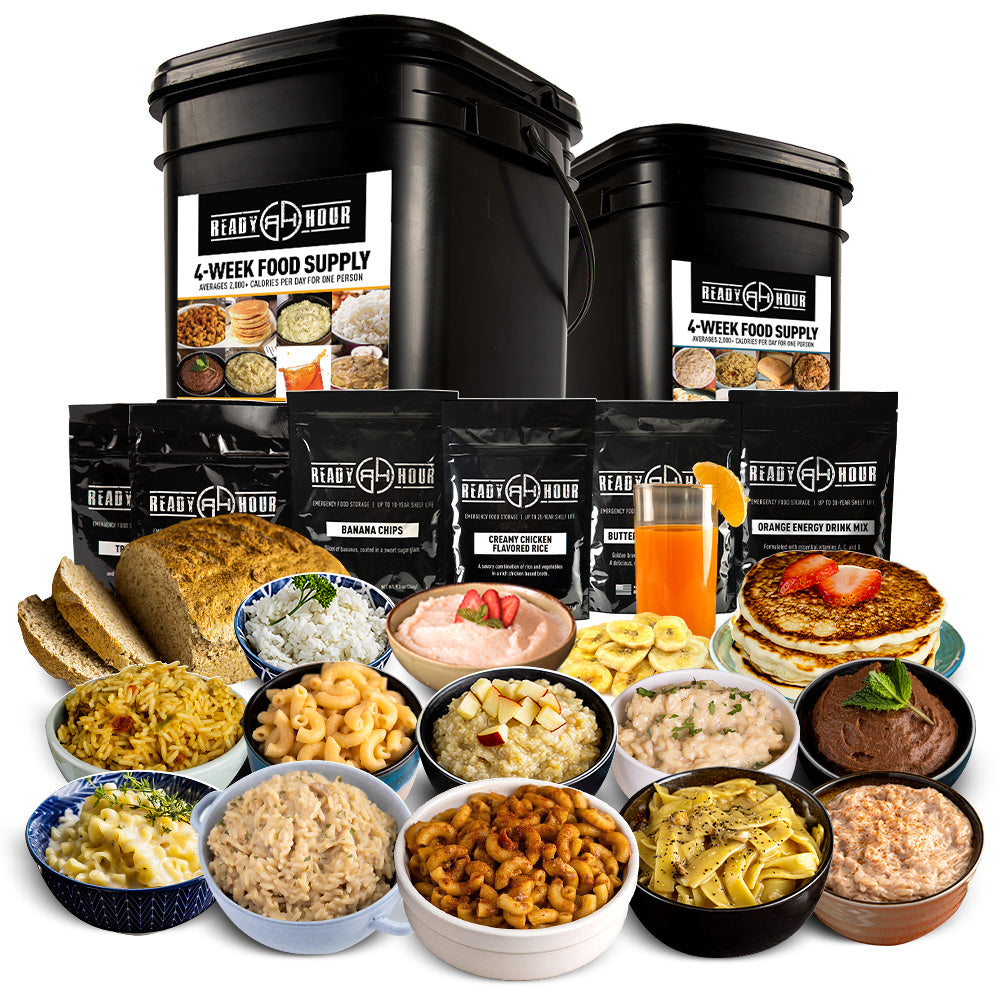
4-Week Emergency Food Supply (2,000+ calories/day)
- ✓Double the duration of a 2-week kit; one person consumes 56,000 calories without resupply across 28 days
- ✓Reduces per-day cost when comparing multi-bucket purchases; buying a 4-week kit is cheaper per unit than stacking two 2-week kits
- ✓Single large bucket or two buckets; check product specs before purchase to confirm your storage space
- ✓Covers job loss, prolonged supply disruption, or regional weather event without requiring immediate resupply
- ✓Pairs with one 2-week kit for two-person household baseline; rotate larger kit every 10 years for shelf-life management
Frequency Asked Questions
Q: How many calories do I need per day in an emergency food supply?
A: Start with 2,000 calories/day as a baseline for a sedentary adult. If you're active, pregnant, nursing, or a teenager, add 400–600 calories/day. A child ages 9–13 needs 1,600–2,000 calories/day; a child ages 4–8 needs 1,400–1,600. Don't guess. Write down your household composition, look up each person's category, multiply daily need by 14, and sum across your family. That's your real 2-week requirement.
Q: How long does emergency food last once you open it?
A: Once a sealed bucket is opened, consume the contents within 2–3 weeks. Exposure to air and humidity begins degradation immediately. If you open a bucket for a single meal, reseal it tightly and store in a cool, dry place—you may get another 2–3 weeks before taste and nutrition decline. Do not open a bucket and store it open for months; it becomes stale and loses caloric density as fats oxidize.
Q: What's the difference between a 2-week and 4-week emergency food supply?
A: A 2-week kit feeds one person 28,000 calories (2,000 cal/day × 14 days). A 4-week kit feeds one person 56,000 calories (2,000 cal/day × 28 days)—double the duration at a lower per-unit cost. For a household of two adults, buy one 4-week kit plus one 2-week kit, or two 2-week kits. For a family of four, you need the calorie equivalent of four 2-week kits minimum. Choose based on your household size and storage space, not on marketing claims about feeding a family.
Your Next Step
Calculate your household's actual 14-day calorie need using the table above. Multiply that number by the price per kit and determine how many buckets fit your budget and storage space. Buy that quantity now, store it in a cool, dark, dry location, and label it with the storage date. In one year, inspect the seal. In ten years, rotate to fresh stock. This single action—buying based on real math, not guesswork—makes the difference between rationing through a crisis and eating normally while everything else falls apart.
Sources & Official Guidance
Authoritative further reading
This guide is for general informational purposes only and is not professional, medical, or safety advice. Always follow official guidance and, in a life-threatening emergency, call your local emergency number (911 in the US).
Mark Sutton, Lead Editor
Mark runs the editorial side of DoomsDayPreps. He digs into the research on emergency prep and survival gear, and checks anything safety-related against FEMA, CDC, and Red Cross guidance before it goes live.