72-Hour Emergency Food Kit: How to Calculate Your Actual Needs
Learn why 72-hour food kits work, how to calculate your household needs, and what makes them different from regular supplies. Practical emergency preparedness g
A 72-hour emergency food kit isn't an insurance policy you hope never to use—it's the bare minimum to get your household through the most common local disruptions: extended power outages, weather events, supply-chain delays, or temporary evacuation. Most people either skip this step or grab random canned goods without doing the math. This article teaches you the exact calculation method so you can build a kit matched to your actual household, not a generic template.
Why 72 Hours Matters—The Calorie Math
The 72-hour window exists because most utility disruptions, public assistance responses, and logistics systems stabilize within three days. That doesn't mean emergencies last exactly three days—it means that three days is the realistic window where you're genuinely on your own, and after that, relief supplies, generators, or normal supply chains typically resume partial function.
The core principle is simple: a person at rest needs roughly 2,000 calories per day to maintain basic function. This is not a theoretical number—it's based on the basal metabolic rate of a typical adult. Children ages 4–8 require approximately 1,400 calories daily; teenagers and active adults require 2,500 or more. During an actual emergency, you're usually doing more than sitting still: you're moving supplies, potentially walking to gather water or supplies, managing stress, and maintaining body heat. Real-world caloric demand can climb 500–1,000 calories above baseline, especially in cold or physically demanding scenarios.
The math is straightforward: multiply your household's daily caloric requirement by three days.
Example household:
- 2 adults × 2,000 cal/day = 4,000 calories/day
- 1 child (age 6) × 1,400 cal/day = 1,400 calories/day
- Household total: 5,400 calories/day
- 72-hour requirement: 5,400 × 3 = 16,200 calories
This is the target. Every calorie you can store is margin against an actual disruption.
How to Choose Foods That Actually Store and Satisfy Hunger
Most people's first instinct is to grab canned vegetables. This is a mistake. In a 72-hour emergency, you need calories and satiety, not vitamins. Canned vegetables are low-calorie filler that makes you feel like you've eaten something without actually fueling your body.
The foods that work are calorie-dense and require minimal preparation:
Peanut butter and similar spreads (roughly 190 calories per 2-tablespoon serving, 30g total fat per serving). Pairs with crackers, bread, or eaten straight. One jar covers roughly 950 calories.
Whole-grain crackers (120–150 calories per ounce). More calorie-dense than most bread, shelf-stable for 1–2 years in a sealed container, and pairs with spreads.
Canned fish and poultry (tuna, chicken, salmon: 110–180 calories per 3oz can, depending on oil content). The oil or brine adds calories. Eat directly or mix with crackers.
Nuts and seeds (roughly 160–200 calories per ounce). Densest real-food option. Almonds, walnuts, sunflower seeds all store well in cool, dry conditions.
Dried fruit (roughly 240 calories per 2oz serving, less dense than nuts but palatable). Figs, raisins, and apricots sustain appetite without requiring water for rehydration.
Meal-replacement or survival bars (200–400 calories per bar, designed for 20–25 year shelf life). These exist because calorie-dense, minimal-prep foods that stay stable for decades are difficult to source from conventional grocery stores. They taste bland by design—which means they're not going to spoil before you use them in a real emergency.
The key trade-off: real food is more satisfying and morale-boosting; commercial survival bars trade taste for guaranteed long-term shelf stability. A kit that includes both is stronger than either alone.
Storage Conditions and Shelf-Life Reality
Every calorie you store will degrade over time. The rate depends on three factors: temperature, humidity, and whether the container is opened.
Temperature: Ideally 50–70°F. For every 18°F rise above 70°F, shelf life is cut roughly in half. A sealed can stored at 70°F in darkness will keep roughly twice as long as one stored at 85°F. In a basement or closet (55–65°F), you gain years.
Humidity: Below 15% relative humidity is stable. Above 20%, moisture begins to degrade seals and create environments where mold can grow. In humid climates, oxygen-absorbing packets or vacuum-sealed containers are not optional—they are required.
Container integrity: Once opened, a can stays safe for 2–3 days if covered; other foods depend on packaging. A box of crackers opened and re-sealed with a clip will go stale within weeks. This means your kit should include single-serve portions or small cans, not bulk sizes you'll crack open and partially consume.
Commercial 72-hour food kits typically include individually wrapped bars and freeze-dried meals specifically because individual wrapping preserves each portion's shelf life independently.
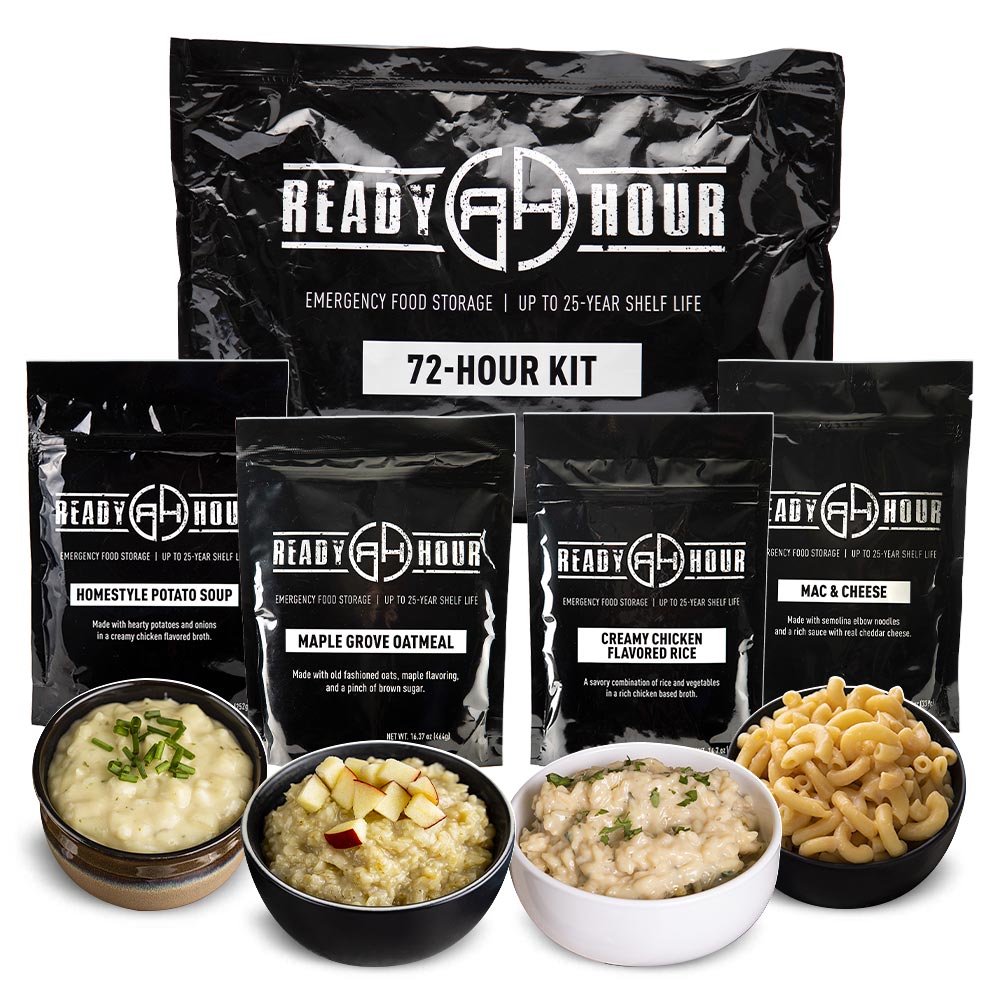
72-Hour Food Kit Sample Pack (2,000+ calories/day)
- ✓Combines freeze-dried meals and calorie-dense bars in individually sealed portions, preventing cross-contamination and extending shelf life of each item
- ✓2,000+ calories per day = 6,000+ calories total over 72 hours; multiply by household size to reach your actual target
- ✓Go-bag, vehicle, or home cache: compact and weight-optimized for grab-and-go scenarios or fixed-location backup
- ✓Pre-made sample pack removes the guesswork of portion planning and ingredient sourcing that delays most people's kits by months
- ✓25-year shelf life when stored at 70°F in darkness; survival bars tolerate temperature swings better than fresh food
The Honest Limitations: What a 72-Hour Kit Cannot Do
A 72-hour food kit is not a complete solution. It solves the immediate caloric need for a defined window—nothing more.
It cannot sustain you beyond 72 hours without resupply. If your scenario requires 2 weeks off-grid, this kit covers only the first three days. Plan accordingly: either build a longer-term supply in stages, or accept that after day three you are depending on foraged foods, hunting, or external supply.
It does not address medical or special dietary needs. If anyone in your household requires specific medications, foods for allergies, formula for infants, or foods for medical conditions (diabetic diets, low-sodium for cardiac patients, soft foods for dental work), a generic 72-hour pack will not substitute. Build a secondary layer of these items first.
It fails if you cannot access it. A kit stored in a basement during a flood or in a vehicle during a carjacking is useless. Location matters as much as contents.
It does not include water. You need one gallon per person per day minimum—72 hours means at least 3 gallons per adult, 2 gallons per child. Store water separately; food kits prioritize calories, not hydration.
It works best for adults who can tolerate texture and flavor of commercial survival foods without significant complaint. Picky children or those with genuine food aversions may not eat enough to meet caloric targets under stress.

1-Week Food Supply Ammo Can (2,000+ calories/day)
- ✓Extends the 72-hour baseline to seven days (14,000 calories total per person) in a single water-tight, crushproof metal can
- ✓Metal construction protects against moisture, rodents, and temperature fluctuation better than cardboard or plastic in long-term storage
- ✓Ammo can format fits under a bed, in a vehicle trunk, or behind furniture without consuming shelf space like boxed supplies
- ✓Bridges the gap between "just 72 hours" and "full three-month supply," providing realistic progression for household building
- ✓Single-unit format simplifies inventory: one can per person for one week, scaled to your family size
Building Beyond 72 Hours: The Scaling Question
Once you've covered 72 hours per person, the next step is deciding how far ahead to plan. The math determines feasibility.
A single-week supply (7 days) requires 14,000 calories per adult. Two weeks is 28,000. A full month is 60,000 per adult. A household of four adults storing one month of food must account for 240,000 calories—roughly 60 pounds of shelf-stable food if optimized for density (nuts, seeds, bars, freeze-dried meals), or 100+ pounds if including heavier items like canned goods.
Most households benefit from a tier approach: 72-hour emergency kit at home, one at work, one in vehicles. Then scale to one-week for the primary household. Only after that is three-month supply justified.
This progression also tests consumption and preference before committing thousands of dollars to large supplies of foods you've never actually eaten under stress. A 72-hour trial is a pilot test.
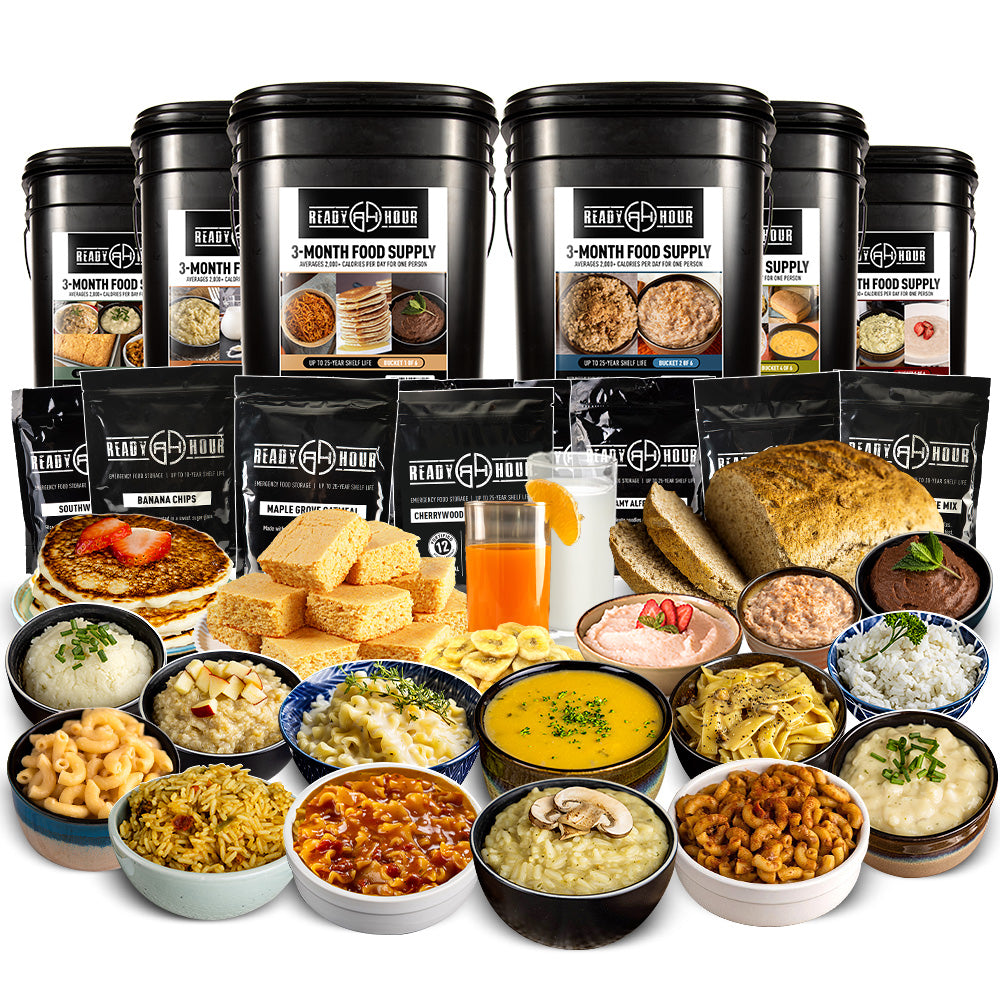
3-Month Emergency Food Supply (2,000+ calories/day)
- ✓180,000 calories per adult (2,000 cal/day × 90 days); multiply by household count to confirm total matches your family size
- ✓Freeze-dried components maintain nutritional profile better than canned foods over extended storage; removes need for cooking fuel
- ✓Intentionally varied meals prevent palate fatigue and psychological strain of eating the same items daily during prolonged disruption
- ✓Store in cool basement or dedicated closet (55–70°F) to maximize the advertised 25-year shelf life; 85°F storage cuts this in half
- ✓Rotation plan: establish an intake date, then annually sample one meal and replace it; this confirms edibility and updates stock
The Immediate Next Step
You now have the calculation method and know the limits. The decision point is not "which kit to buy"—it's "how many household members am I calculating for, and in which locations am I placing kits?"
Start with one 72-hour kit per person in your primary residence. Store it in a cool closet or basement, not a garage or attic where temperature swings accelerate degradation. Label it with the pack date. Once that's in place, add secondary kits to vehicles and workplaces. Only after those are stable should you consider scaling to one-week or longer supplies.
The point of doing the math first is that you know exactly why you're buying what you buy, not just following a prepper template. A calculated, phased approach beats a bulk purchase of random items that sit untouched for a decade.
Frequently Asked Questions
Q: How many calories does one person need per day in an emergency? A: An adult at rest requires roughly 2,000 calories per day. Children ages 4–8 need approximately 1,400 calories daily; teenagers and active adults need 2,500 or more. In actual emergencies involving physical exertion, stress, or cold exposure, add 500–1,000 calories to these baseline numbers. Calculate your household's specific need by summing individual requirements, then multiply by three to find your 72-hour target.
Q: What's the difference between a 72-hour kit and a long-term supply? A: A 72-hour kit solves the immediate window when normal supply chains are disrupted but before external help typically arrives—it's designed as temporary bridge, not sustenance. A long-term supply (one week to three months) is built assuming either prolonged disruption or gradual consumption to rotate stock. Practically, 72-hour kits use individual wrapping for shelf stability and portability; longer supplies prioritize variety and cost-per-calorie efficiency. Start with 72-hour coverage, then scale.
Q: Can you mix different brands or types of food in a 72-hour kit? A: Yes, as long as each item is shelf-stable, calorie-dense, and stored in a cool, dry location. The strongest kits combine commercial survival bars (guaranteed 20+ year shelf life) with real foods like nuts, crackers, and peanut butter (1–3 year shelf life in sealed containers). Individual wrapping prevents cross-contamination and lets each portion degrade independently. Avoid mixing items with different humidity tolerances in the same container without oxygen-absorbing packets.
Sources & Official Guidance
Authoritative further reading
This guide is for general informational purposes only and is not professional, medical, or safety advice. Always follow official guidance and, in a life-threatening emergency, call your local emergency number (911 in the US).
Mark Sutton, Lead Editor
Mark runs the editorial side of DoomsDayPreps. He digs into the research on emergency prep and survival gear, and checks anything safety-related against FEMA, CDC, and Red Cross guidance before it goes live.