Biomass Stove for Outdoor Cooking: How Vortex Technology Works
Biomass stove for outdoor cooking uses natural fuel to reach 1,200°F. Learn how vortex combustion works and why preppers choose it over butane camp stoves.
Most preppers choose between butane lighters and open flame cooking, missing a middle ground: a biomass stove that burns natural fuel at high enough temperature to boil water in minutes and cook a full meal outdoors with materials you find on the ground. Understanding how a biomass stove works—and why the combustion design matters—will change how you approach camp cooking and emergency heat.
How Biomass Combustion Works
A biomass stove operates on a principle called secondary combustion, enhanced by a design feature called vortex technology. Here's the mechanism: as fuel burns in the primary chamber, the heat creates rising hot gases. A traditional stove lets these gases escape directly into the air, wasting energy. A vortex-designed stove redirects those rising gases in a spiraling motion—the vortex—which forces them to mix with fresh oxygen and ignite again before exiting. This second burn extracts far more heat energy from the same amount of fuel.
The result is measurable: a biomass stove can reach 1,200 degrees Fahrenheit, which is hot enough to ignite dry wood and kindling within seconds, boil water for purification or cooking, and cook food over sustained flame without needing lighter fluid, butane cartridges, or chemical accelerants. The stove accepts any natural fuel—dry twigs, bark, small branches, pine needles, even paper—making it a true biomass converter rather than a device dependent on pre-packaged fuel.
The vortex design also reduces smoke because more complete combustion occurs. Incomplete combustion creates heavy smoke; complete combustion (where fuel fully oxidizes) produces mostly heat and water vapor. This matters in survival scenarios where smoke signals your location or creates visibility hazards.

Inferno Pro Outdoor Biomass Stove by InstaFire
- ✓Vortex combustion technology forces hot gases into a secondary burn cycle, extracting maximum heat from minimal fuel
- ✓Reaches 1,200°F, hot enough to ignite tinder, boil water, and cook a full meal using sticks, bark, and natural materials found on-site
- ✓Eliminates dependence on butane cartridges or lighter fluid—accepts any dry biomass fuel for true off-grid cooking
- ✓Compact design fits backpacks and bug-out bags while delivering performance equivalent to larger camp stoves
- ✓Works outdoors in rain and wind; sealed combustion chamber protects the flame from weather interference
Real-World Cooking Math
A functional outdoor stove must translate heat into usable work. Let's calculate what 1,200°F means in practice.
Water boils at 212°F at sea level. The temperature differential between the flame (1,200°F) and boiling water (212°F) is 988 degrees—more than enough to achieve a rolling boil in roughly 5–10 minutes depending on water volume and ambient conditions. A quart of water (32 ounces) in a metal pot or can will reach boiling temperature significantly faster than on a butane camp stove at lower BTU output because the thermal energy transfer is steeper.
For a survival scenario, this matters: if you need to purify water, prepare emergency food rations, or make herbal tea for warmth, the time from "fire lit" to "water ready" determines how efficiently you use daylight and fuel in an emergency.
Fuel consumption depends on burn rate. A biomass stove burning small, dry twigs will consume fuel faster than a butane stove at low heat, but the per-unit-cost of fuel is zero because it comes from the ground. In a 72-hour outdoor scenario, the ability to walk 50 feet, gather fallen wood, and return to your stove without rationing pre-packaged fuel is a decisive advantage.
| Fuel Type | Burn Time | Heat Output | Availability |
|---|---|---|---|
| Small twigs (pencil-thin) | 15–20 min | High (1,200°F achieved) | Ground; unlimited |
| Bark pieces | 20–30 min | High | Ground; unlimited |
| Larger branches | 30–45 min | High (sustained) | Ground; limited by effort |
| Butane cartridge | 60+ min (at lower heat) | Low–Medium | Pre-packed; finite supply |
Biomass vs. Butane: The Real Trade-Off
Butane camp stoves are lightweight, compact, and foolproof—strike a match, turn a dial, cook. A biomass stove requires you to gather and prepare fuel, manage ignition, and adjust burn rate by adding or removing material. Why choose the harder option?
Reliability in cold. Butane loses vapor pressure in temperatures below 32°F, meaning the stove may not light reliably in winter or high-altitude conditions. A biomass stove ignites at any temperature as long as you have dry fuel and air.
Fuel independence. A butane cartridge lasts 60+ minutes of cooking at medium heat. After that, you carry dead weight. A biomass stove works as long as fuel exists. In a 30-day wilderness scenario or grid-down situation, butane becomes useless; biomass stoves remain functional indefinitely.
Skill transfer. Learning to build and manage a biomass fire teaches skills that apply to all outdoor survival—shelter insulation, water purification, food preservation, and signaling. A butane stove teaches only how to use that one device.
Butane is superior for car camping where weight doesn't matter and you want convenience. Biomass is superior for survival and extended off-grid use where fuel availability and cold-weather reliability are non-negotiable.
Honest Limitations
A biomass stove will NOT work indoors without ventilation. Burning any fuel in an enclosed space depletes oxygen and produces carbon monoxide, a colorless, odorless poison that causes unconsciousness and death within hours. This is not a design flaw—it is fundamental to all combustion. Use biomass stoves only outdoors or in tents with open venting.
Rain and soaked fuel make ignition difficult. A biomass stove can light wet wood if you have very fine, dry tinder and patience, but a butane lighter will consistently fail where a biomass stove struggles. If you're caught in sustained rain with no dry kindling, neither device will start a fire until you find dry material.
Users who cannot gather or process small fuel—the elderly, injured, or those with severe arthritis—may find a biomass stove more physically demanding than a butane alternative that requires only hand coordination to ignite.
The stove itself, when hot, is a severe burn hazard. A 1,200°F surface will cause third-degree burns on contact. Keep children and pets at safe distance, and never touch the stove during or immediately after use.
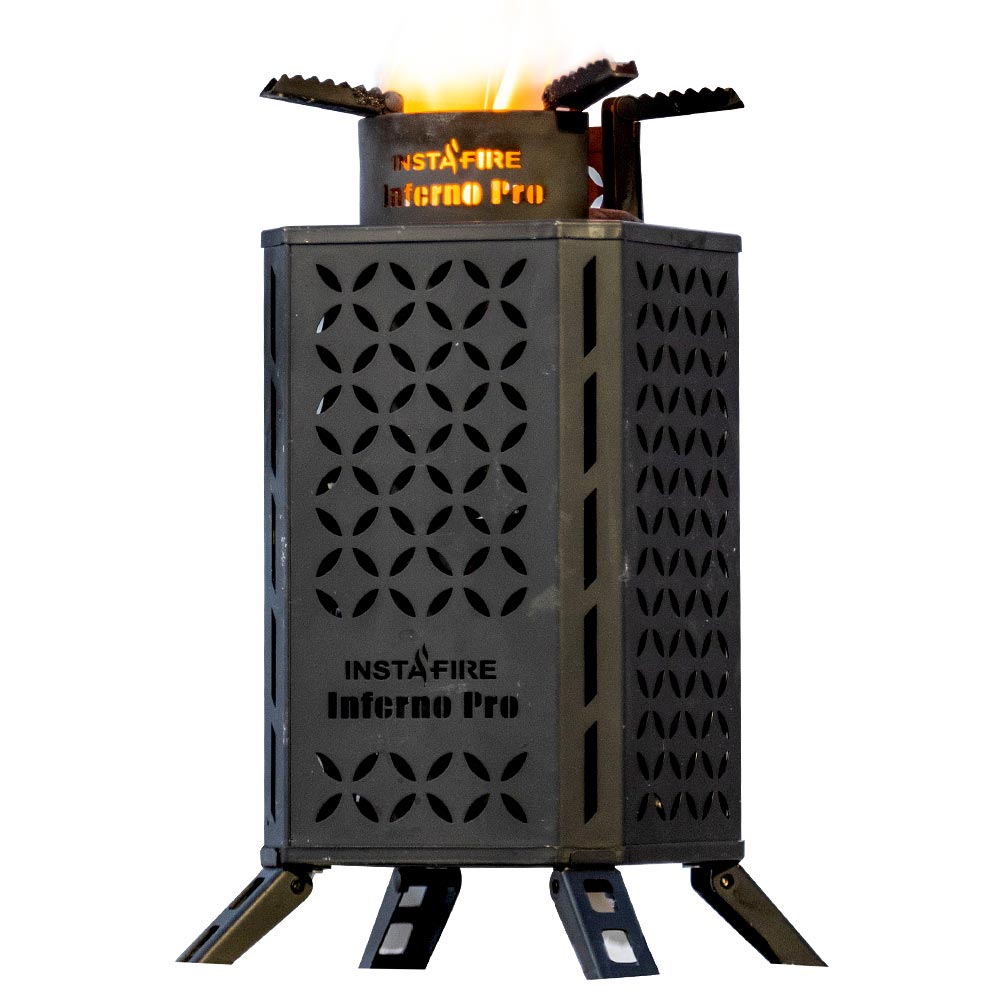
Inferno PRO Outdoor Biomass Stove by InstaFire
- ✓Secondary combustion and vortex design maximize energy extraction from natural fuel, reaching cooking temperature with minimal wood
- ✓Functions at freezing temperatures where butane cartridges lose vapor pressure and fail to ignite reliably
- ✓Accepts any dry biomass—twigs, bark, paper—eliminating fuel supply chain dependency in long-term scenarios
- ✓Compact footprint with high thermal output; outperforms full-size camp stoves in weight-to-BTU ratio for backpack survival kits
- ✓Designed for outdoor-only use with weather-sealed combustion chamber, no cartridge refills or fuel canisters to track
Frequently Asked Questions
Q: What temperature does a biomass stove actually reach and why does that matter for cooking?
A: A properly designed biomass stove reaches approximately 1,200°F in the combustion chamber. This temperature is far higher than water's boiling point (212°F), so the thermal energy difference drives heat rapidly into cookware. In practical terms, a quart of water will reach boiling in 5–10 minutes depending on pot material and ambient wind—fast enough for emergency water purification or food preparation without fuel waste. The high temperature also ignites damp tinder when other fire-starting methods fail, making it reliable in wet conditions.
Q: How does a biomass stove compare to a butane camp stove for long-term survival?
A: Butane stoves are lightweight and convenient but become dead weight once the cartridge depletes—typically after 60+ minutes of cooking. Biomass stoves accept unlimited natural fuel gathered from the ground, so they function indefinitely in outdoor environments. Butane also fails in cold below freezing, while biomass stoves work at any temperature. The trade-off: biomass requires fuel preparation and management, while butane requires only ignition. For car camping, choose butane. For wilderness survival or grid-down scenarios lasting days or weeks, biomass is the reliable choice.
Q: Can you use a biomass stove indoors or only outside?
A: Biomass stoves must be used outdoors only. Any fuel combustion consumes oxygen and produces carbon monoxide, an odorless, deadly gas that causes unconsciousness and death in enclosed spaces. Even a tent requires open venting if a biomass stove is inside. Never use one in a closed cabin, garage, or sealed room under any circumstance. This is a non-negotiable safety rule for all biomass-burning devices.
Next Steps
Your first action is to test a biomass stove in your yard or a safe outdoor location before relying on it in an emergency. Gather different types of fuel—dry twigs, bark, small branches—and practice the ignition and heat management process. This 20-minute experiment will show you exactly how long it takes to boil water, how much fuel you actually need, and how to adjust burn rate by managing oxygen flow. You will build confidence and muscle memory that could save time and fuel in a real survival scenario.
Sources & Official Guidance
Sources referenced
- https://www.campingsurvival.com/products/instafire-inferno-outdoor-biomass-stove
- https://www.amazon.com/InstaFire-Fahrenheit-Survival-Portable-Off-Grid/dp/B0C84X287T
- https://www.tiktok.com/@cast_iron_deputy/video/7348219754592750891
Authoritative further reading
This guide is for general informational purposes only and is not professional, medical, or safety advice. Always follow official guidance and, in a life-threatening emergency, call your local emergency number (911 in the US).
Mark Sutton, Lead Editor
Mark runs the editorial side of DoomsDayPreps. He digs into the research on emergency prep and survival gear, and checks anything safety-related against FEMA, CDC, and Red Cross guidance before it goes live.

