Emergency First Aid Kit Sizing for 6 People: Contents & Calculations
Emergency first aid kit sizing for families: calculate contents by household size, injury scenarios, and storage duration. Learn what a 6-person kit actually ne
When medical services are delayed—whether by weather, distance, or infrastructure failure—the first aid supplies in your home become your only immediate care option. Most preppers reach for a first aid kit without understanding what size kit their household actually requires or why the contents matter more than the brand. An undersized kit creates a false sense of security; an oversized kit wastes money on duplicate items that expire unused.
This article teaches you how to calculate first aid kit capacity by household composition, injury scenario, and storage duration—then shows you what a properly sized 6-person kit looks like in practice.
How First Aid Kit Sizing Works: The Injury-Based Calculation
First aid kit sizing is not arbitrary. It's built on a fundamental principle: the number and severity of simultaneous injuries your household could realistically face, times the number of days you might be without resupply.
Here's the mechanism: in a typical household injury, one person uses a bandage, antiseptic, and perhaps a pain reliever—a modest draw from supplies. But in a multi-casualty scenario (vehicle accident, fire, mass event), you might have 3–4 people needing care at once. Over 7 days, minor injuries compound—a cut redressed daily, a blister managed through healing, a minor burn treated through two weeks of dressing changes.
A household of 6 people over 7 days without resupply faces:
- Minor injuries (cuts, scrapes, blisters): assume 1–2 per person over the week = 6–12 minor wounds requiring bandages, antiseptic, pain relief
- One moderate injury per household: 1 person with a sprain, burn, or laceration needing more intensive dressing, immobilization, or pain management
- Chronic medication gaps: if anyone takes prescription medication, a 7-day isolation means first aid supplies must stretch to cover basic pain, fever, or inflammation while awaiting resupply
This math tells you why a kit for 1 person won't serve 6, and why a generic "family kit" without specific quantities fails in a real scenario.
Building Your 6-Person Kit: The Core Item Categories
Your first aid kit must address four injury categories: wound management, infection control, pain/fever management, and immobilization.
Wound Management (Bandages & Dressings)
A 6-person household over 7 days needs:
- 30–40 adhesive bandages (assorted sizes): one per minor cut/scrape per person, plus repeats for cuts that need fresh dressing daily
- 6–8 larger sterile gauze pads (2"×2" or larger): for moderate cuts, scrapes, or the blister that won't close
- 3–4 elastic bandages or flexible wraps: one per family member for sprains or securing dressings on larger wounds
The mechanism here is simple—wounds don't heal in one day. A scraped knee might need a new bandage twice daily for 3 days. A household without enough dressings runs out mid-healing and either improvises (cloth, duct tape) or stops treating the wound, risking infection.
Infection Control (Antiseptic & Antibiotic Ointments)
You need:
- 2–3 antiseptic wipes or alcohol-prep pads: for initial cleaning before bandaging
- 1–2 small tubes of antibiotic ointment (e.g., neomycin-based): 30–40 applications per 0.5-oz tube. At 6–12 minor wounds over 7 days, one tube per household is the baseline; a second provides margin if any wound shows early signs of infection
The active agent in topical antibiotics (neomycin, bacitracin, polymyxin B) reduces bacterial colonization in the first 24–48 hours post-injury, the window when infection risk is highest. Without ointment, a household treating 6–12 minor cuts with water alone increases infection risk significantly—and infection in a no-resupply scenario means fever, immobility, and depletion of pain/fever medications that were meant for other injuries.
Pain & Fever Management
A household of 6 over 7 days needs:
- 30–50 doses of pain reliever (ibuprofen or acetaminophen): at 1–2 doses per person for common injuries (headache, minor fracture pain, fever from infection), a family of 6 burns through 6–12 doses per day at peak use
- 1–2 doses of stronger analgesic (prescription-strength ibuprofen or similar, if available): for the one moderate injury you're almost certain to face
Without enough pain relief, a person cannot immobilize an injury (lying still hurts), cannot rest (rest accelerates healing), and becomes psychologically stressed—a liability in an already disrupted situation.
Immobilization (Sprains, Fractures)
You need:
- 2–3 elastic wraps or compression bandages (2"–3" width): for ankle or wrist sprains
- 1 triangular bandage or sling: for arm immobilization
The biomechanical principle: an immobilized joint heals faster and with less pain than a mobile one. A 7-day kit without wraps means someone nursing a sprained ankle will bear weight on it, re-injuring it daily and extending the healing timeline indefinitely.

Adventure Medical Kits Sportsman Series 300 First Aid Kit - Accommodates 6 people for 7 days
- ✓Orthopedic wraps and elastic bandages distribute load across joints, reducing re-injury risk during healing
- ✓Includes 30+ adhesive bandages, 2+ antibiotic ointment tubes, multiple gauze pads, and pain reliever tablets—sufficient for 6 people over 7 days without resupply
- ✓Pre-assembled in a compact case, suitable for home storage (bedroom closet, vehicle) or portable transport during evacuation
- ✓Scaled specifically for household injury distribution, not just wilderness minor cuts—includes immobilization for sprains and compression for larger wounds
- ✓Durable plastic case resists moisture; check expiration dates annually (adhesive loses stick after 3 years; ointments degrade by year 4)
The 7-Day Duration Math: How Supply Quantities Scale
Here's a concrete calculation showing why kit size matters over time.
Single-day minor injury load: Assume 2 injuries per day for a 6-person household (realistic—someone gets a kitchen cut, another a blister from new shoes, someone bumps a shin). That's 14 minor injuries over 7 days.
| Item | Per Injury | Total for 7 Days | Kit Requirement |
|---|---|---|---|
| Adhesive bandage | 1 (initial) + 1 (refresh) = 2 | 28 bandages | 30–40 in kit |
| Antiseptic wipe | 1 | 14 wipes | 15–20 in kit |
| Antibiotic ointment doses | 1–2 per day for 2–3 days = 3–6 per injury | 42–84 applications | 60–100 applications (1.5–2 tubes) in kit |
Now add one moderate injury (sprain, burn, deeper cut):
- 7–14 days of dressing changes = 7–14 gauze pads (vs. 2–3 in a wilderness kit)
- 7–14 days of antibiotic ointment = 14–28 additional applications
- Elastic wrap + pain reliever for immobilization = 7–14 days of ibuprofen
Total result: A 6-person 7-day kit needs roughly:
- 30–40 adhesive bandages (not 20)
- 2 antibiotic ointment tubes (not one small packet)
- 10–15 gauze pads in multiple sizes (not 2–3)
- 3–4 elastic or compression wraps
- 40–60 pain reliever tablets (not 12)
If your kit has half these quantities, you'll run out by day 4–5 and be forced to improvise or ration—both of which compromise wound care and increase infection risk.
Wilderness Kit vs. Home Emergency Kit: The Critical Difference
Many preppers buy a wilderness first aid kit and assume it covers home emergencies. It doesn't.
A wilderness kit is built for:
- Short exposure (1–3 days)
- Healthy young adults
- Prevention of infection during evacuation
- Low likelihood of repeat injuries
A home emergency kit must address:
- Extended sheltering (7+ days)
- Mixed ages (children, elderly, people with chronic illness)
- Multiple simultaneous injuries
- Wound care beyond initial stabilization
The key difference: wound depth and duration of care. A wilderness cut is cleaned, sealed with antibiotic ointment, and covered with a simple bandage—the hiker walks out in 12 hours. A household member with a kitchen burn or dog bite must live with that wound for 7 days, changing dressing, managing pain, and monitoring for infection while staying home.
This is why a 6-person home kit requires more gauze, more ointment, more pain relief, and more immobilization supplies than a wilderness kit of the same "capacity."

Arb Sportsman 400 First Aid Kit - Home Medical Supplies For up to 10 People
- ✓Expanded supply quantities for households with children, elderly, or chronic medication needs—more ointment and dressings per injury for extended healing
- ✓Accommodates up to 10 people for 7+ days; covers multi-casualty scenarios (3–4 simultaneous minor injuries) without immediate resupply
- ✓Includes pain reliever, antihistamine, and anti-diarrheal tablets—addresses systemic symptoms beyond wound care
- ✓Larger footprint than single-person kits but compact enough for home closet, vehicle, or evacuation bag
- ✓Built-in organization prevents supply loss and allows quick visual inventory of remaining items
Honest Limitations: What Your First Aid Kit Cannot Do
Your first aid kit is not emergency room care, and pretending it is creates dangerous gaps in your preparedness planning.
What the kit cannot treat:
- Severe bleeding (arterial or uncontrollable venous): a first aid kit provides gauze and pressure—but if bleeding doesn't stop in 10–15 minutes of direct pressure, you have a life-threatening wound and need hospital-level care (tourniquets, IV fluids, transfusion, surgical intervention). The kit buys time; it doesn't replace surgery.
- Bone fractures requiring realignment: a sprain kit wraps an ankle. A broken leg requires X-ray, realignment, and immobilization—a first aid kit cannot provide any of that. You can manage pain and prevent re-injury, but you cannot fix the underlying fracture.
- Deep infections or sepsis: antibiotic ointment prevents surface infection in the first 48 hours. If infection develops (fever, pus, red streaking), you need oral or IV antibiotics—prescriptions, not over-the-counter supplies.
- Anaphylaxis or severe allergic reactions: without an epinephrine auto-injector, a first aid kit cannot stop anaphylaxis. If your household includes anyone with severe allergies, the first aid kit is insufficient without an Epi-Pen (prescription) as well.
- Uncontrolled pain from major injury: a 6-person kit includes OTC pain reliever (ibuprofen ~200mg tablets). A person with a broken leg or severe burn needs opioid-level pain management—prescription-only.
Scenarios where the kit fails:
- Isolation longer than 7 days: your quantities assume 7 days; at 10–14 days, even a well-stocked kit depletes
- Household larger than 6: each additional person increases injury likelihood; math scales nonlinearly after about 8 people
- Elderly or immunocompromised household members: healing is slower, infection risk higher—the kit's quantities assume healthy young adults. Adjust upward by 25–50%.
- Pre-existing chronic wounds: if someone in the household has a diabetic ulcer or pressure wound, that wound alone consumes dressing supplies at 3–5x the rate of an acute injury
The decision point: If your household faces more than 7 days of isolation, add a second kit to your stockpile. If anyone is elderly, immunocompromised, or chronically injured, size up to a larger kit now rather than rationing mid-crisis.
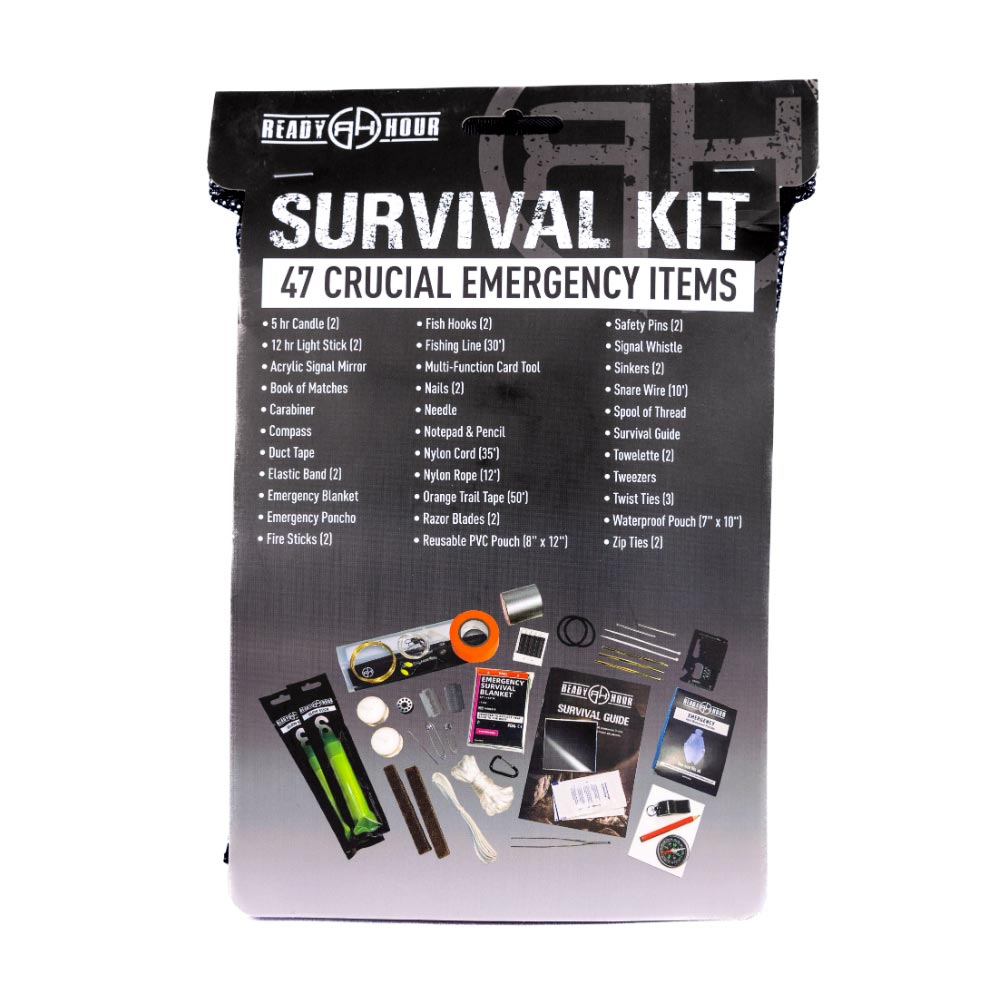
47-Piece Survival Kit of Emergency Items by Ready Hour
- ✓Includes tourniquet, emergency blanket, and whistle—address life threats (severe bleeding, hypothermia, signaling for rescue) that first aid kits don't cover
- ✓Complements a household first aid kit by handling pre-hospital stabilization (airway, severe bleeding, exposure) while the first aid kit manages ongoing wound care
- ✓47-piece modular design allows customization; remove items irrelevant to your household and add prescriptions, pet supplies, or regional-specific items
- ✓Fits in small backpack or vehicle storage; portable for evacuation or multi-location preparedness
- ✓Best used as *addition* to first aid kit, not replacement—covers different injury tiers
FAQ
Q: How many first aid supplies does a 6-person household actually need for a week?
A baseline: 30–40 adhesive bandages, 2 antibiotic ointment tubes, 10+ gauze pads, 3–4 elastic wraps, 40–60 pain reliever tablets, antiseptic wipes, and anti-diarrheal or antihistamine tablets. The exact count scales with age (children need smaller bandages and lower-dose pain relief) and health (elderly or immunocompromised household members need more ointment and gauze). A pre-assembled 6-person kit consolidates these; a DIY kit lets you adjust quantities by household specifics.
Q: What's the difference between a wilderness first aid kit and a home emergency kit?
Wilderness kits assume short exposure (1–3 days), mobile users, and simple wound stabilization before evacuation. Home emergency kits must sustain wound care for 7–14 days, accommodate all ages and health states, and handle multiple simultaneous injuries. A home kit needs 3–4× the gauze, ointment, and pain reliever of a wilderness kit of the same "capacity," because wounds are managed at home over days, not treated then transported out.
Q: How often should first aid kit supplies be rotated or replaced?
Adhesive bandages lose adhesive strength after 3 years; antiseptic wipes dry out by year 2; antibiotic ointment degrades by year 3–4. Pain reliever tablets remain stable in dry storage for 5+ years but potency decreases slowly. Check your kit annually: look for dried-out wipes, loose bandages, or discolored ointment. Replace them immediately. Restock after use—if you use 5 bandages treating a cut, replace those 5 before storing the kit again. A depleted kit gives false confidence.
Conclusion
A 6-person first aid kit sized correctly for 7 days of isolation isn't luxury—it's the baseline that prevents minor injuries from becoming serious ones. The math is simple: multiply the number of people by the types of injuries they're likely to face, then add duration. A kit that runs out on day 5 was never
Sources & Official Guidance
Authoritative further reading
- Ready.gov — Build A Kit
- FEMA — Emergency Preparedness
- American Red Cross — First Aid
- CDC — Emergency Preparedness & Response
This guide is for general informational purposes only and is not professional, medical, or safety advice. Always follow official guidance and, in a life-threatening emergency, call your local emergency number (911 in the US).
Mark Sutton, Lead Editor
Mark runs the editorial side of DoomsDayPreps. He digs into the research on emergency prep and survival gear, and checks anything safety-related against FEMA, CDC, and Red Cross guidance before it goes live.

