Emergency Food Calorie Calculation: Size Your 72-Hour Kit
Emergency food calorie calculation: how to size a 72-hour kit for your household. Learn the math that prevents starvation gaps.
An emergency lasting 72 hours without food is survivable. An emergency lasting five days on insufficient calories is dangerous—your family's ability to stay alert, ration water, navigate, and make decisions collapses first. The difference between a functioning household and one in crisis often comes down to a single calculation you can verify yourself in 10 minutes.
This article teaches you the exact math to determine how many calories your household actually needs for a 72-hour emergency, why commercial ration bars exist as the fastest solution, and how to verify your own kit size against real caloric needs.
The Calorie Math: Who Needs How Much
Energy requirements vary drastically by age, activity level, and body composition. A universal "2,000 calories per person per day" treats a 6-year-old and a 200-pound adult as identical—exactly wrong in an emergency where miscalculation leaves someone hungry.
The baseline starts with the Mifflin-St Jeor equation, used by USDA and clinical nutrition to estimate resting metabolic rate—the calories your body burns at complete rest. In an emergency shelter scenario, most people sit, walk short distances, and manage light tasks. This is not resting, but it is low-activity.
Adults (19–50 years old): Sedentary adults burn approximately 1,600–2,000 calories per day at rest. Add minimal emergency activity (moving supplies, checking windows, light cleanup) and assume 2,000 calories as your baseline.
Adult males (51+ years): Approximately 1,800 calories baseline; with low activity, plan 2,000–2,200.
Adult females (51+ years): Approximately 1,600 calories baseline; with low activity, plan 1,800–2,000.
Children (9–13 years): Approximately 1,600–2,000 calories depending on size and activity. Plan 1,800 as mid-range.
Children (4–8 years): Approximately 1,200–1,400 calories. Plan 1,400.
Toddlers (2–3 years): Approximately 1,000 calories. Plan 1,000–1,200.
Infants (6–11 months): Breast milk or formula; solid food contributes 200–300 calories supplementally.
The critical insight: add 10–20% for stress and cold. An emergency is psychologically taxing and physically demanding in ways your daily life is not. Your nervous system burns extra calories during threat response. If your area loses heating in winter, metabolic demand climbs further. Use the upper range if your emergency scenario includes temperature stress or physical exertion.
The household calculation in action:
One adult (2,000 cal) + one adult female 55 years (1,900 cal) + one child 8 years (1,400 cal) = 5,300 calories per day for the household.
For a 72-hour (3-day) emergency: 5,300 × 3 = 15,900 calories total.
For a 5-day emergency: 5,300 × 5 = 26,500 calories total.
Write this number down. This is your target. Everything after this is just matching products to it.
Why Ration Bars Beat Loose Food in the First 72 Hours
Commercial emergency ration bars (unlike freeze-dried meals, canned goods, or bulk grains) are engineered for three specific constraints: minimal water required, minimal preparation, and caloric density in the smallest package.
A typical ration bar contains 400 calories in 2.4 ounces. Compare this to:
- Peanut butter (3,500 cal/lb): a 1-pound jar = 454g; at 3,500 cal/lb, you'd need 4.5 lbs to hit 15,900 calories—that's over 6 liters of volume and requires bread, water to swallow, and teeth to work
- Rice and beans (1,600 cal/lb combined): 10 lbs to hit 15,900 calories = high weight, water-dependent cooking, no shelf-stability without oxygen barriers
- Canned goods (300–500 cal/can): requires 30+ cans for a 72-hour kit, immense weight, water waste from liquid
Ration bars require zero water, zero preparation, zero utensils, and zero cooking heat. In the first 72 hours after an earthquake, flood, or power loss—when utilities are down and family stress is highest—this is not convenience; it is the only realistic food source many households will actually eat.
The mechanism is straightforward: caloric density (calories per unit weight and volume) reduces pack weight and lets your family carry their own food if evacuation is necessary. A 72-hour household food supply via ration bars fits into a small backpack. The same calories in canned goods requires a wheeled cart.
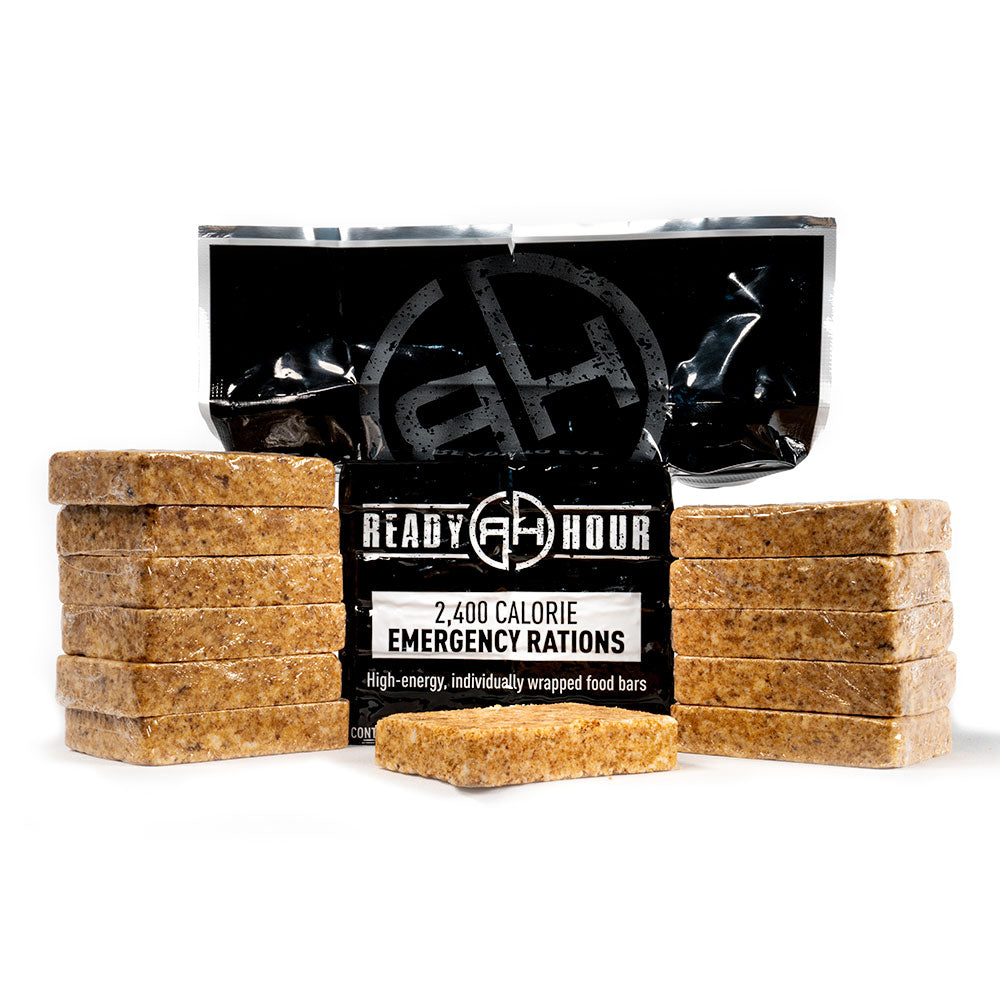
2,400 Calorie Emergency Ration Bars by Ready Hour
- ✓Each bar contains 400 calories in a 2.4-ounce wrapped package, eliminating water, cooking, and utensil dependencies in the first 72 hours
- ✓One 2,400-calorie box = six 400-calorie bars; feeds one adult for exactly one day or extends three people for one meal
- ✓Individually vacuum-sealed bars remain shelf-stable at room temperature (50–70°F) for 25+ years, surviving long-term storage outside temperature-controlled conditions
- ✓No added sugar, gluten-free formulation reduces nausea and digestive distress during high-stress emergency scenarios where gut function is already compromised
- ✓Stack multiple boxes in a small space: three boxes (7,200 calories) feeds a three-person household for one day—fits into a 12×10×4-inch shelf space or emergency bag
The 72-Hour Kit Sizing Calculation
Using the household calorie target calculated above (your household × days), divide by the calorie density of your chosen food:
Example: The same household (5,300 cal/day)
Target: 15,900 calories for 72 hours
Ration bar option: Each bar = 400 calories. 15,900 ÷ 400 = 39.75 bars ≈ 40 bars needed. That is 10 boxes of six-bar packs (if your bars come in six-bar units, as Ready Hour does). One 2,400-calorie box feeds one adult for exactly one day.
For the same household:
- 1 adult (2,000 cal/day) → 3 boxes for 72 hours
- 1 adult female (1,900 cal/day) → 2.85 boxes ≈ 3 boxes for 72 hours
- 1 child 8 years (1,400 cal/day) → 2.1 boxes ≈ 2 boxes for 72 hours
- Total: 8 boxes (10 additional boxes as safety margin)
This math prevents the "oops, we're two days in and out of food" scenario.
| Person | Daily Calories | Days | Total Calories | Boxes Needed |
|---|---|---|---|---|
| Adult 1 | 2,000 | 3 | 6,000 | 2.5 (round to 3) |
| Adult 2 (55+F) | 1,900 | 3 | 5,700 | 2.4 (round to 3) |
| Child (8 years) | 1,400 | 3 | 4,200 | 1.75 (round to 2) |
| Household Total | 5,300 | 3 | 15,900 | 8 boxes minimum |
Rotation and shelf life: If your household averages 5,300 calories per day under normal conditions, those 8 boxes—representing one day's food—are consumed within one year in most homes. Do not assume long-term storage is necessary; first assume you will use them. The 25-year shelf life is your insurance, not your plan.
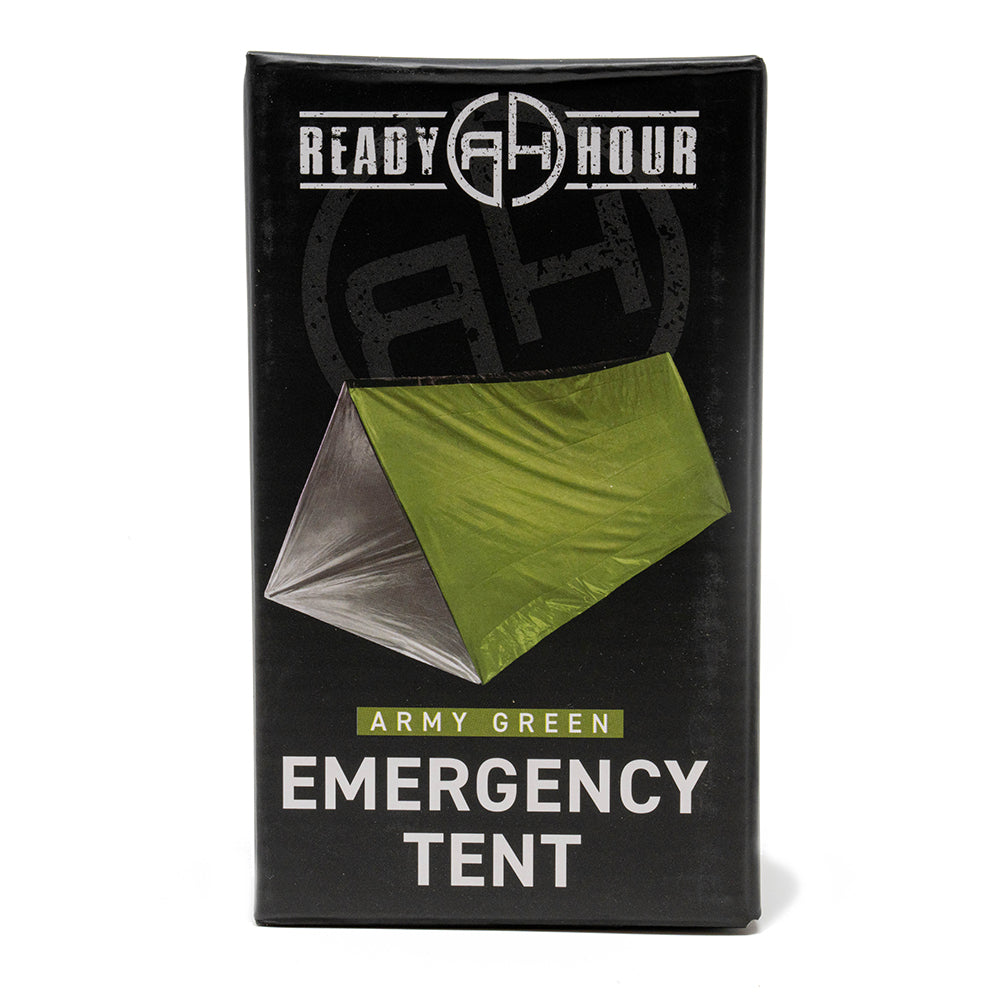
Army Green Nylon Emergency Tent with Survival Whistle by Ready Hour
- ✓Lightweight nylon construction with grommet anchor points provides shelter from wind and precipitation—critical for maintaining body heat and core temperature in the hours after a food ration is consumed
- ✓Two-person capacity (approximately 16 square feet) covers a family group during evacuation or outdoor emergency staging, reducing heat loss and allowing small group caloric sharing
- ✓Integrated survival whistle (120 decibels) signals rescuers from distance without voice—necessary when emergency rations support extended shelter-in-place or evacuation scenarios
- ✓Packs to 2 pounds and 8×6-inch footprint, allowing integration into a household emergency bag alongside ration box supplies without exceeding portable weight limits
- ✓Ripstop nylon resists tearing in brush evacuation scenarios; olive drab coloration blends with outdoor terrain and does not signal emergency status to outside observers
When Ration Bars Fall Short
Ration bars are engineered for fast calories, not for psychological comfort, flavor variety, or digestive ease over extended periods. If your emergency extends beyond 72 hours, gaps in food strategy emerge.
Monotony and morale: Six identical ration bars per household member per day, consumed day after day, creates flavor fatigue and reduces food consumption—meaning you eat less than you planned because the same texture and taste becomes aversive. After 72 hours, add variety: canned vegetables, peanut butter, instant oatmeal, or other familiar foods.
Digestive distress: High-calorie bars engineered for shelf stability contain elevated fat and fiber to minimize spoilage. Some people experience constipation or cramping on exclusive ration bar diet. Include fiber (dried fruit, canned vegetables) and water (minimum 1 gallon per person per day) to prevent this.
Dental and swallowing difficulty: Ration bars are dense and require thorough chewing. Elderly family members with dental issues, young children, or anyone with swallowing disorders may struggle. Soften bars in warm water (if available) or include alternate forms: peanut butter, condensed milk, honey packets.
Children under 4 years: Ration bars present choking hazard. The bar density and thickness exceed safe sizing for toddlers. Rely on formula (if infant), soft foods, and canned fruits/vegetables for this age group.
Allergy management: Ration bars vary by brand; many contain tree nuts, soy, or gluten. Verify ingredients against your household allergies before an emergency forces substitution.
Honest Limitations
Ration bars alone will not sustain a household for more than 5–7 days without supplementary food sources. They provide calories, not nutritional variety—minimal vitamins, fiber, fresh taste, or the psychological satisfaction of "normal" meals. If your emergency planning assumes self-sufficiency beyond one week, ration bars are only the foundation; add canned goods, dried foods, and other longer-duration sources.
Ration bars do not replace water. Each bar is calorie-dense and nutrient-concentrated, requiring additional water to digest properly. Assume 1 gallon per person per day minimum; more if exertion or heat is present. Dehydration reduces appetite and digestion, creating a compounding deficit.
A household eating only ration bars for 72 hours is stable. A household eating only ration bars for 14 days will experience fatigue, irritability, and nutrient deficiency—not starvation, but functional decline. Plan ration bars as the emergency floor, not the ceiling.
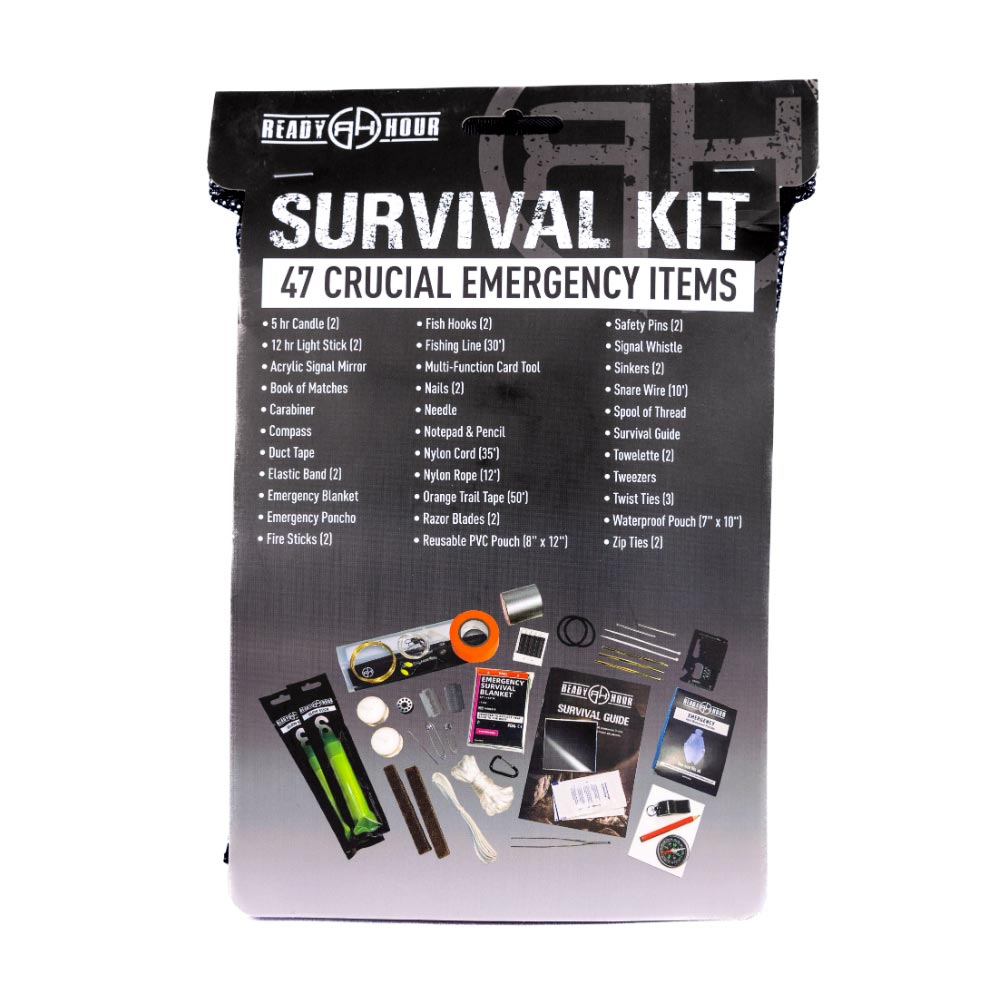
47-Piece Survival Kit of Emergency Items by Ready Hour
- ✓Includes first-aid supplies, signaling tools, and fire-starting materials integrated into a compact 12-item survival kit, addressing the non-food crisis gaps that ration bars cannot solve
- ✓47-piece modular design allows household members to carry matched kits (one per adult, one per older child) without exceeding backpack space when paired with ration bar boxes
- ✓Designed for 72-hour emergency scenarios—the exact timeframe your ration bar calculation covers—ensuring food, shelter, and survival tools operate as an integrated system
- ✓Fire-starting capability (waterproof matches, ferro rod) enables water heating and ration bar consumption without electricity or fuel dependence
- ✓Fits in a 10×6-inch space, making it stackable alongside emergency ration boxes and water storage in a home emergency closet or vehicle kit
Frequently Asked Questions
Q: How many calories does a person actually need per day in an emergency? A: A sedentary adult burns approximately 1,600–2,000 calories per day; add 10–20% for stress and cold. A 45-year-old female would plan 1,900 calories; a 35-year-old male would plan 2,100 calories. Children need 1,200–1,800 depending on age. The fastest way to find your household number is to calculate each person separately using their age, sex, and weight—do not assume a universal 2,000 calories.
Q: What's the difference between emergency ration bars and regular survival food? A: Ration bars are compressed, wrapped, and pre-portioned for immediate consumption without water or cooking—ideal for the first 72 hours when utilities are down. Freeze-dried meals require hot water and 10–15 minutes to prepare. Canned goods require utensils, cooking heat, and water for rinsing. Ration bars sacrifice taste and variety for speed and portability; they are not meant to replace varied meals beyond 3–5 days.
Q: How do you calculate total calories needed for a family emergency kit? A: List each household member's age and sex. For each person, use the baseline calorie needs (e.g., adult = 2,000 cal/day, child ages 4–8 = 1,400 cal/day). Add 10–20% for stress. Multiply by the number of days (72 hours = 3 days). Divide the total by the calories per unit of your chosen food (ration bars = 400 cal per bar). Example: 5,300 daily household calories × 3 days = 15,900 calories ÷ 400 cal/bar = 40 bars needed (approximately 7 boxes if bars come in six-bar packs).
Conclusion
The single most important action is to calculate your household's actual daily caloric need by age and sex, then write it down. Do not use 2,000 calories as a universal number. Once you know your target, size a 72-hour emergency food supply by dividing your total target by the calories per unit (400 for standard ration bars). Order one box more than the calculation suggests; the margin accounts for stress-driven appetite increase and ensures no one runs short on day three.
Emergency rations are not comfort food—they are calories on demand when all other sources are gone. The math ensures they are sufficient when you need them most.
Sources & Official Guidance
Authoritative further reading
This guide is for general informational purposes only and is not professional, medical, or safety advice. Always follow official guidance and, in a life-threatening emergency, call your local emergency number (911 in the US).
Mark Sutton, Lead Editor
Mark runs the editorial side of DoomsDayPreps. He digs into the research on emergency prep and survival gear, and checks anything safety-related against FEMA, CDC, and Red Cross guidance before it goes live.