Emergency Food Storage Calories: Calculate Your 30-Day Kit
Calculate emergency food storage needs by household size. Learn calorie math, shelf-life storage conditions, and protein gaps that freeze-dried meals don't cove
An adult needs roughly 2,000 calories per day to maintain energy and function during physical or mental stress. A family of four requires 8,000 calories daily—or 240,000 calories for a single month. Most people dramatically underestimate this number and end up with a 2-week kit they think will last 30 days. This article teaches you how to calculate your household's actual calorie requirement, how to verify shelf-life storage conditions, and the critical nutrition gaps that single-category emergency foods create—so you can build a kit that will actually sustain your family when you need it.
How to Calculate Your Household's Emergency Food Calories
Start with baseline daily calorie needs. An adult requires 2,000 calories per day at rest. Children ages 4–8 need approximately 1,400 calories daily. Teenagers (ages 13+) need roughly 2,500 calories daily. Pregnant or nursing adults require 2,500–2,800 calories daily.
Multiply by household size, then multiply by 30 days:
Example: Family of two adults + one 6-year-old
- Adult 1: 2,000 cal/day
- Adult 2: 2,000 cal/day
- Child (age 6): 1,400 cal/day
- Daily total: 5,400 calories
- 30-day total: 5,400 × 30 = 162,000 calories needed
This is your target. Most preppers discover they've purchased enough for 10–14 days and called it a month.
During high physical exertion—hauling water, clearing debris, or relocating—calorie needs spike 25–50% higher. Cold-weather survival can require 4,000+ calories per adult per day. Do not build your baseline kit to that peak; build it to 2,000/day, then add a separate high-exertion buffer.
Understanding Freeze-Dried Soup Serving Sizes and Calories
Freeze-dried meals are lightweight and compact, which makes them ideal for emergency kits. However, their serving sizes are deliberately smaller than fresh food equivalents. A single pouch of freeze-dried tomato soup typically contains 4–6 servings and provides 80–120 calories per serving.
Let's work with real numbers. ABC Tomato Soup comes in a 6-pouch case with 24 total servings. That is 4 servings per pouch. If each serving is 100 calories, then:
- 1 pouch = 4 servings × 100 cal = 400 calories
- 6-pouch case = 24 servings × 100 cal = 2,400 calories total
A single case covers 1.2 days of a 2,000-calorie diet for one adult. To cover 30 days, one adult needs 25 cases. A family of four needs 100 cases.
This is not a criticism—it is simply the math that reveals why soup alone cannot be your entire food storage strategy. Soup is calorie-light and requires water (which you must store separately). It is best used as a foundation food plus a protein/carbohydrate layer.
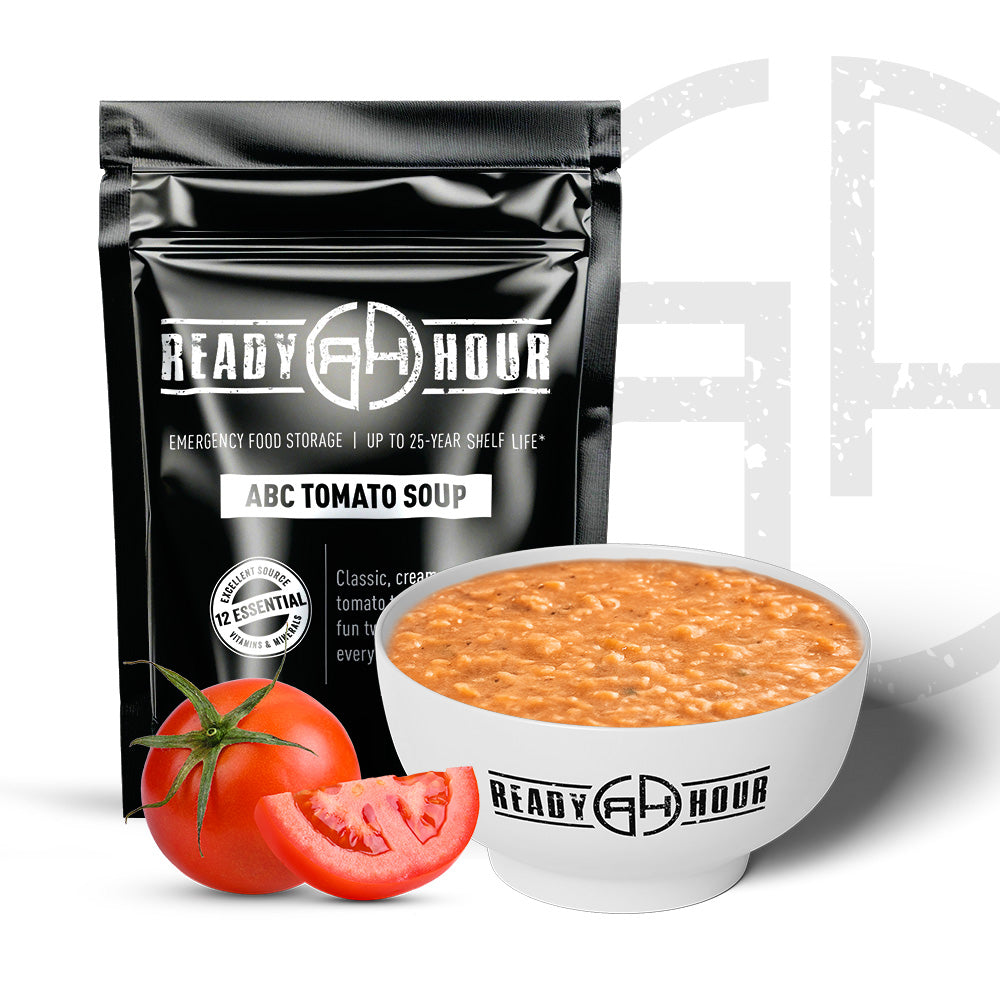
ABC Tomato Soup (6 pouches, 24 servings)
- ✓Freeze-dried tomato base rehydrates with hot water; requires minimal fuel and preparation skill
- ✓24 servings per case (6 pouches) = 2,400 calories if 100 cal/serving; one case feeds one adult 1.2 days
- ✓Foundation soup for mixing with pasta, rice, or crackers to increase total meal calories and carbohydrates
- ✓25-year shelf life under proper storage conditions (50–70°F, <15% humidity, sealed container)
- ✓Lightweight and compact: stores in a standard 5-gallon bucket with room for complementary shelf-stable foods
The Storage Math: Temperature, Humidity, and Actual Shelf Life
Freeze-dried foods advertise "up to 25 years" shelf life. That number is the maximum under optimal conditions. Optimal means:
- Temperature: 50–70°F (constant)
- Humidity: Below 15%
- Sealed, unopened packages
- Away from light
Most home storage fails one or more of these conditions. A basement that swings from 60°F in winter to 75°F in summer shortens shelf life. An unfinished basement at 40% humidity accelerates degradation. Opened packages degrade in weeks, not years.
Use a more conservative estimate for your planning: 15–20 years in typical basement storage (with temperature control), or 10 years if your storage area is unheated or experiences seasonal humidity swings.
If you need your emergency food to last exactly 25 years, invest in these storage conditions now:
- A standalone shelving unit in an interior closet (temperature-stable)
- Airtight buckets or Mylar bags with oxygen absorbers for opened pouches
- A basic humidity monitor ($15–30); replace packets if humidity climbs above 15%
Protein and Fat Gaps in Soup-Only Kits
Freeze-dried soups—tomato, broccoli, cheese—are carbohydrate and sodium heavy and protein-light. A typical 100-calorie serving provides 1–3 grams of protein. An adult needs 50–60 grams of protein daily. Soup alone will not meet this requirement.
Add these shelf-stable proteins to your kit:
- Peanut butter: 8 grams protein per 2 tablespoon serving
- Canned tuna or chicken: 20–25 grams protein per 3-ounce can
- Powdered milk: 8 grams protein per 1/4 cup
- Protein bars: 10–20 grams protein per bar
- Nuts and seeds in sealed packaging: 5–8 grams per 1-ounce serving
A practical 30-day emergency kit for a family of four combines soups, pasta/rice, canned proteins, and shelf-stable fats (oil, nut butter, nuts). This approach spreads your calorie load across multiple food categories and reduces the risk that a single food type fails or becomes unpalatable after eating it for days.
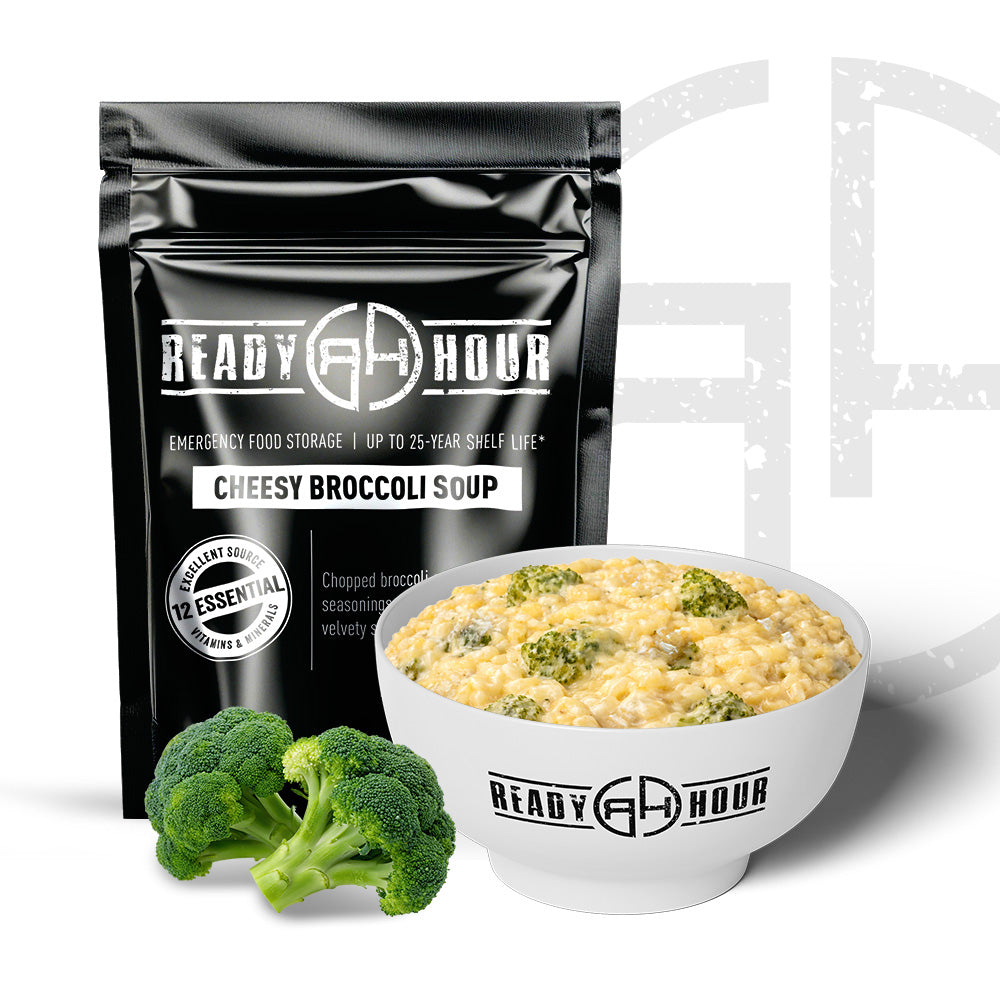
Cheesy Broccoli and Rice Soup (6 pouches, 24 servings)
- ✓Combines vegetables and rice base in a single pouch; rice adds carbohydrates that tomato soup lacks alone
- ✓24 servings per case = 2,400 calories; pairs with canned protein to complete a balanced emergency meal
- ✓Mixed vegetable content provides micronutrients soups don't; reduces palate fatigue on multi-day rotations
- ✓Rehydrates quickly in boiling water; suitable for camp stove, propane burner, or rocket stove cooking
- ✓Rice component absorbs water efficiently; produces thicker, more filling meal than broth-based tomato soup
Honest Limitations: What Freeze-Dried Soups Cannot Do
Freeze-dried soups will NOT provide complete nutrition on their own. They lack sufficient protein, fat, and micronutrient diversity. A person eating only soup, even high-calorie soup, will face nutritional deficiency within 14 days and fatigue within 21 days.
Soups require water—approximately 3–4 cups per pouch, depending on the brand. If your emergency scenario includes water scarcity, contaminated municipal supply, or a boil-water advisory, you must store and purify water separately. Water storage requires space and containers; 1 gallon per person per day for 30 days is 120 gallons for a family of four—roughly six 5-gallon buckets.
Soups require heat. Without power, you must have a backup cooking method: camp stove, propane burner, rocket stove, or outdoor fire. Families relying on electric stoves or microwaves and lacking fuel or alternative heat will not be able to prepare these meals.
Unopened pouches are shelf-stable; opened pouches degrade within hours if exposed to air and moisture. Once you open a pouch, you must consume it immediately or store the remainder in an airtight container in the refrigerator (if power is available) or freeze (if you have a freezer).
These limitations do not disqualify freeze-dried soups—they simply define their role. Use them as a foundation, not a complete diet.
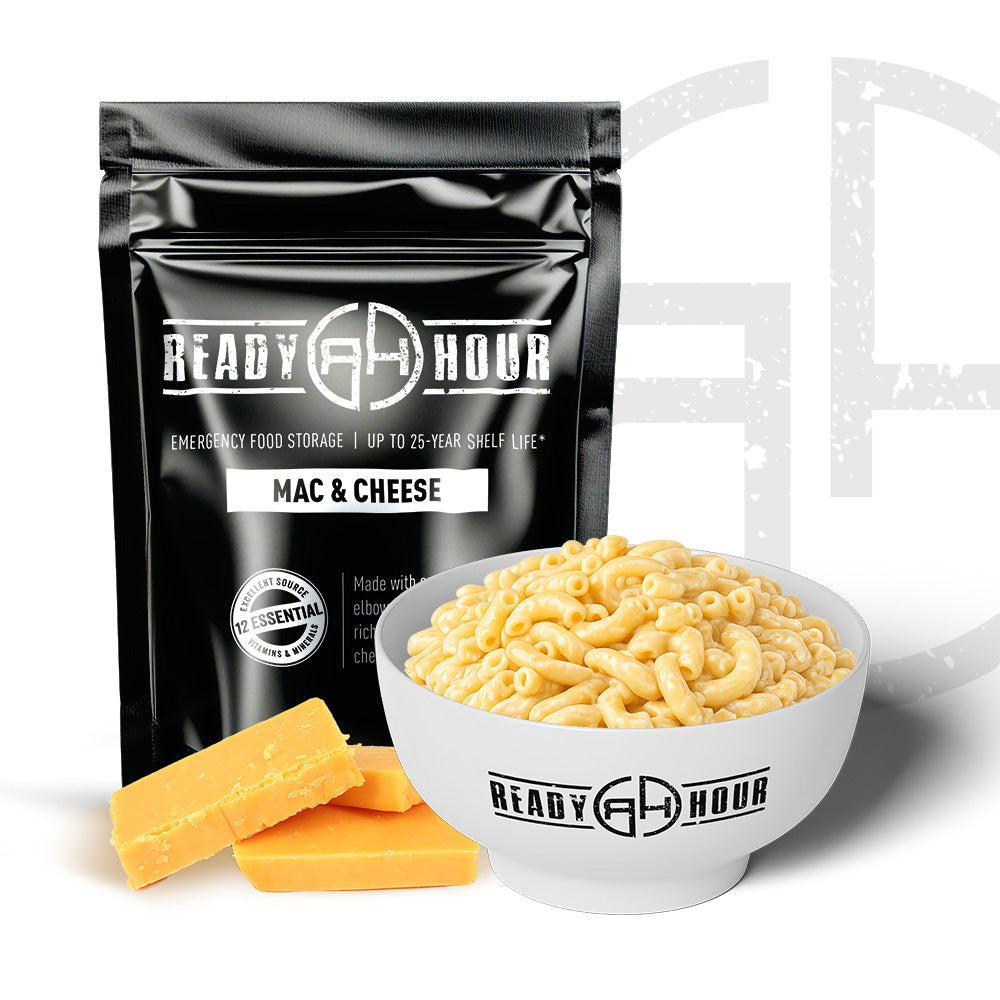
Mac & Cheese (6 pouches, 24 servings)
- ✓Pasta and cheese powder combine protein (dairy-based) with carbohydrates in one package; higher calorie density than soup alone
- ✓24 servings per case = approximately 2,400–2,800 calories depending on preparation (with or without added butter/milk)
- ✓Comfort food with high palatability for children; critical for morale during multi-week emergency scenarios
- ✓Rehydrates in boiling water without requiring additional ingredients; shelf-stable powdered milk can substitute for fresh dairy
- ✓Pairs easily with canned vegetables or freeze-dried vegetables to add micronutrients and visual variety to meals
Building a Balanced 30-Day Kit: The Practical Combination
Here is a real-world 30-day kit for a family of four that meets the 240,000-calorie requirement and addresses nutrition gaps:
| Category | Quantity | Calories | Purpose |
|---|---|---|---|
| Freeze-dried soup cases | 8 cases (48 servings) | 4,800 | Foundation meals; vegetable base |
| Pasta/rice shelf-stable | 20 lbs | 36,000 | Carbohydrate bulk; calorie density |
| Canned proteins (tuna, chicken) | 24 cans | 14,400 | Protein; fat from oil packing |
| Peanut butter (jars) | 4 jars (32 oz each) | 14,400 | Protein and fat; dense calories |
| Protein bars | 60 bars | 18,000 | Quick snacks; no preparation |
| Powdered milk | 5 lbs | 9,000 | Protein; dairy substitute for soups |
| Nuts and seeds (sealed packages) | 10 lbs | 45,000 | Fat, protein, micronutrients |
| Shelf-stable vegetables (canned) | 16 cans | 2,400 | Micronutrients; meal texture |
| Cooking oil (sealed bottles) | 2 bottles (1 quart each) | 7,920 | Calorie density; cooking fuel |
| Crackers and oats (sealed packaging) | 8 lbs | 17,600 | Carbohydrates; breakfast staple |
| TOTAL | — | 169,520 calories | — |
This total is 169,520 calories—7,520 calories short of 30 days. The shortfall is intentional: it accounts for the fact that some products will be damaged, opened accidentally, or require water for preparation that reduces water storage capacity. Build to 105–110% of calculated need, not exactly to the target.
Adjust the ratio for your household. A family with teenagers increases pasta and protein quantities. A household with young children increases palatability items (peanut butter, crackers) and reduces quantity of fiber-heavy vegetables that might cause digestive upset during stress.
Frequently Asked Questions
Q: How many calories per day does an adult need in an emergency? A: An adult at rest requires approximately 2,000 calories per day. This is the baseline for someone maintaining position and performing light work. During physical exertion—hauling water, moving debris, clearing land—calorie needs rise to 2,500–3,500+ calories per day. Cold-weather survival can push requirements above 4,000 calories per day. Plan your kit for 2,000 per day as your baseline, then add a separate exertion buffer if your scenario includes heavy physical work.
Q: How should I store freeze-dried emergency food to reach 25 years? A: Keep sealed, unopened packages in a cool, dry location: ideally 50–70°F and below 15% humidity. Use food-grade buckets with airtight lids for bulk storage. Open packages degrade within hours once exposed to air; transfer opened product to airtight containers or Mylar bags with oxygen absorbers. Store in an interior closet rather than an unfinished basement to avoid temperature swings. Use a basic humidity monitor ($15–30) to confirm conditions; if humidity exceeds 20%, add silica gel packets and reseal. Most home storage achieves 15–20 years rather than the advertised 25 years because conditions vary seasonally.
Q: What do freeze-dried soups lack that I need to add to my kit? A: Freeze-dried soups lack sufficient protein (1–3 grams per serving), fat, and complete micronutrient diversity. Add canned tuna or chicken, peanut butter, nuts, and powdered milk to reach 50–60 grams of protein per day. Pair soups with pasta, rice, or crackers to increase carbohydrate density and total meal calories. Mix in canned vegetables or dried herbs to improve nutrient profile and reduce palate fatigue. Soups alone will sustain an adult for 10–14 days but create nutritional deficiency by day 21 if they are the only food source.
Conclusion
Calculate your household's actual 30-day calorie requirement before buying a single case of freeze-dried food. A family of four needs roughly 240,000 calories—a number that forces you to combine multiple food categories rather than relying on soup alone. Start your kit by establishing your target number, then layer in soups as a foundation food, not a complete diet. Add pasta, canned proteins, nuts, and fat-dense foods to close the nutrition and calorie gaps. Your next step is to audit your current storage space and storage conditions—confirm that your temperature stays between 50–70°F and humidity remains below 15% for the long shelf life you are counting on.
Sources & Official Guidance
Authoritative further reading
This guide is for general informational purposes only and is not professional, medical, or safety advice. Always follow official guidance and, in a life-threatening emergency, call your local emergency number (911 in the US).
Mark Sutton, Lead Editor
Mark runs the editorial side of DoomsDayPreps. He digs into the research on emergency prep and survival gear, and checks anything safety-related against FEMA, CDC, and Red Cross guidance before it goes live.