Emergency Food Supply: Calculate Calories Per Day for Your Household
Learn how to calculate emergency food needs by calories. A 2,000-calorie daily budget ensures adequate nutrition for adults during disruptions lasting 30 days t
When an extended disruption occurs — job loss, supply chain breakdown, severe weather isolation — commercial food production stops. Your household must survive on what you stored. A 2,000-calorie-per-day baseline ensures adequate energy, cognitive function, and immune response for adults during the critical first year of any extended emergency.
This article teaches you how to calculate your actual household calorie needs, understand why the 2,000-calorie standard exists, and build a supply that prevents both malnutrition and dangerous weight loss during months-long disruptions.
Why 2,000 Calories Per Day Is the Emergency Baseline
The 2,000-calorie figure is not arbitrary marketing. It comes from decades of nutritional science and represents the basal metabolic requirement for a sedentary adult in temperate conditions. Your body burns these calories at rest — just maintaining core temperature, organ function, and cellular repair.
In an emergency, this baseline might even increase. Stress hormones elevate metabolic rate. Manual labor — hauling water, chopping wood, managing shelter repairs — adds 500–1,500 extra calories depending on intensity and body weight. Without sufficient stored calories, weight loss accelerates rapidly, weakening your ability to respond to danger and maintain health.
The standard assumes a healthy adult at moderate activity. Children, pregnant persons, and individuals with medical conditions require adjustment — which we will calculate below.
Calculating Total Household Calorie Needs
Begin with this baseline framework:
Adults (sedentary, non-working): 2,000 calories/day
Teenagers (ages 13–18): 2,400–2,600 calories/day
Children (ages 9–12): 1,800–2,000 calories/day
Children (ages 4–8): 1,200–1,400 calories/day
Young children (ages 1–3): 1,000–1,200 calories/day
These are baseline figures for normal conditions. In a stress event with physical work, add 300–500 calories per person per day.
Example household calculation:
- 2 adults: 2,000 cal/day × 2 = 4,000 calories
- 1 teenager (age 16): 2,500 cal/day × 1 = 2,500 calories
- 1 child (age 7): 1,300 cal/day × 1 = 1,300 calories
- Total daily need: 7,800 calories
For a 90-day supply (winter isolation scenario):
- 7,800 cal/day × 90 days = 702,000 total calories needed
For a full year:
- 7,800 cal/day × 365 days = 2,847,000 total calories needed
Store the supply distributed across multiple containers. Do not keep all calories in a single location — fire, flood, or contamination can destroy the entire supply in one event.
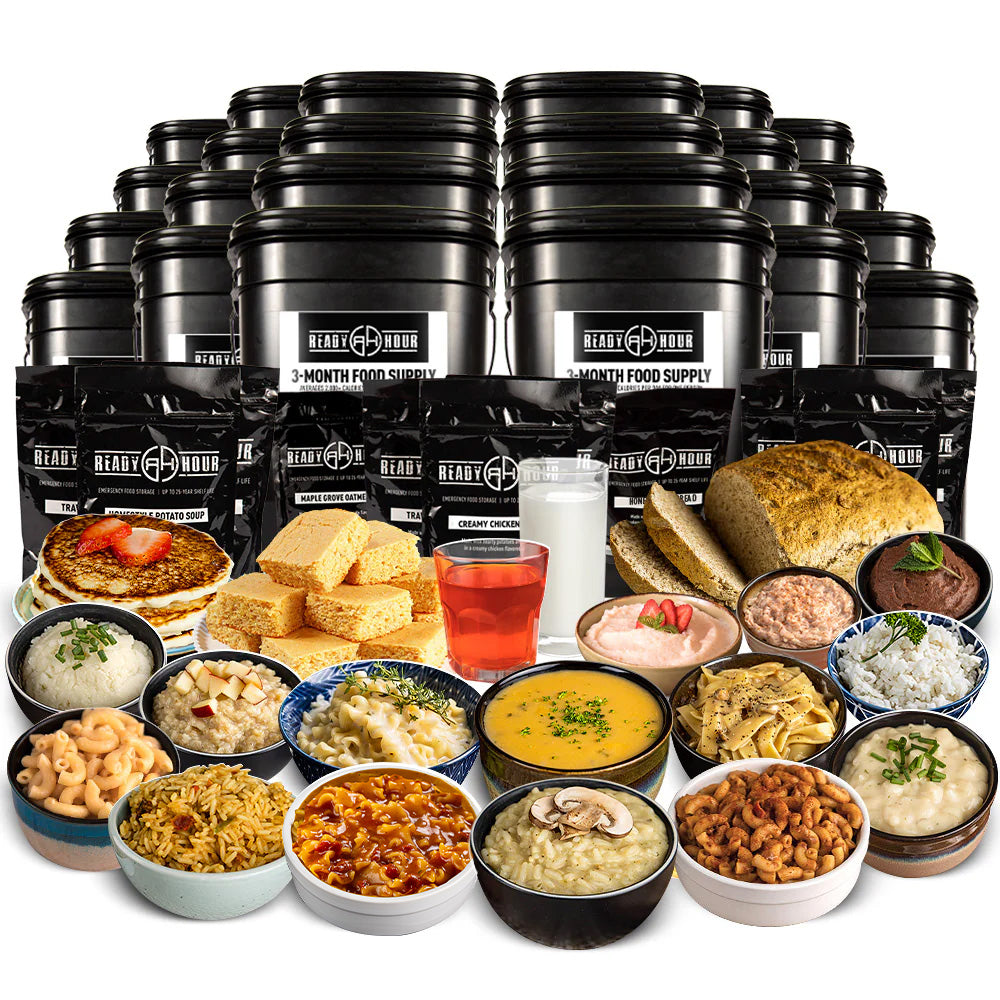
1-Year Emergency Food Supply (2,000+ calories/day)
- ✓Pre-portioned meals deliver 2,000+ calories per day, eliminating calculation steps during stress
- ✓360-day supply for one adult: 730,000+ total calories in 24 stackable buckets
- ✓Suitable for job loss, supply chain disruption, or extended home isolation scenarios
- ✓Includes variety of breakfasts, entrées, snacks, and drinks — prevents "emergency fatigue" from eating identical meals
- ✓Buckets are sealed with oxygen absorbers and store at 50–70°F; shelf life 25+ years if unopened
Calorie Density: Understanding What You're Actually Storing
Not all calories are equal in weight or volume. This matters for storage space and handling.
A pound of oil (9 calories per gram) provides 4,050 calories. A pound of protein powder provides roughly 1,800 calories. A pound of canned vegetables provides only 350–400 calories because of water content. If you store only water-dense foods, you need far more volume and weight to reach your calorie target.
Emergency food supplies compress calories into shelf-stable form. A typical serving packet contains 250–500 calories and weighs 2–6 ounces. A 25-year shelf-life supply achieves this through:
- Removal of water: Freeze-dried meals retain nutrition but lose 90% of original weight.
- Addition of shelf-life stabilizers: Oxygen absorbers (iron powder in packets) prevent oxidative rancidity in fats and oils for 25+ years.
- Sealed packaging: Mylar pouches and buckets block light and air, both of which degrade calories and nutrients.
A 1-year supply for one adult (730,000 calories at 350 cal/pound average) weighs approximately 2,000–2,400 pounds total. Stored in 24 buckets of roughly 85–100 pounds each, this is manageable in a basement, closet, or garage space.
Storage and Shelf-Life Reality
Shelf life depends on three factors: temperature, humidity, and seal integrity.
Temperature: Store at 50–70°F. Every 10°F increase above 70°F cuts shelf life in half due to accelerated fat oxidation and nutrient degradation. A basement at 55°F maintains integrity far longer than a garage attic cycling 40–120°F seasonally.
Humidity: Keep below 15% relative humidity. Moisture entry causes mold, nutrient loss, and clumping. Oxygen absorbers inside sealed buckets maintain an inert atmosphere that prevents this.
Seal integrity: Once opened, consume within 30 days and reseal tightly. An opened bucket exposed to air deteriorates within weeks.
Under ideal conditions (cool, dry, sealed), high-quality emergency food supplies remain safe and nutritious for 25–30 years. In poor conditions (warm garage, humidity fluctuation, opened buckets), expect 5–10 years maximum. Plan rotation: test one meal every two years, replace what you eat during testing, and never consume a meal purely to "rotate stock." Consume only what you've opened and tested.
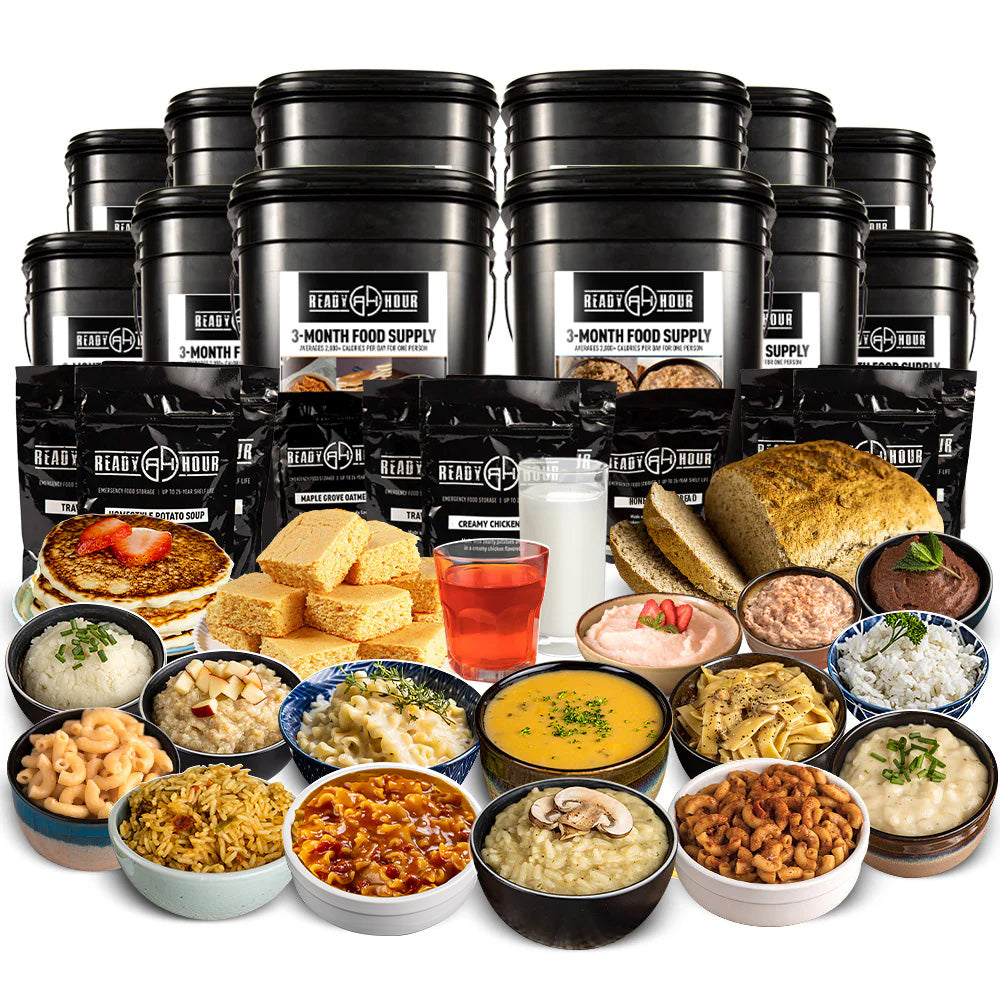
6-Month Emergency Food Supply (2,000+ calories/day)
- ✓180-day supply delivering 2,000+ calories daily for one adult
- ✓365,000+ total calories packed in 12 buckets — half the volume of a 1-year supply
- ✓Fits households building gradually or prioritizing immediate coverage before stock expansion
- ✓Breakfast, lunch, dinner, and beverages included — no supplemental shopping needed during the supply period
- ✓Buckets stack efficiently in standard closets or under-bed storage; each weighs approximately 85 lbs
Honest Limitations: When Emergency Food Supply Alone Is Not Enough
A calorie-based supply keeps you alive. It does not guarantee health, satisfaction, or sustained morale.
Texture and taste fatigue: Freeze-dried meals have uniform texture and limited variety despite different named dishes. After weeks of the same base ingredients in different sauces, eating becomes mechanical. Morale deteriorates. Include some fresh multivitamins, seasonings (salt, sugar, hot sauce), and comfort foods (chocolate, hard candy) in your budget. These are calorie-light but psychologically essential.
Missing micronutrients: Emergency supplies meet calorie and basic macronutrient targets but may fall short on folate, zinc, and vitamin D — especially if the supply lacks fruit and vegetable variety. Store a year's supply of a complete multivitamin alongside your food. Cost is minimal; insurance value is high.
Medical conditions requiring specific foods: Diabetes, celiac disease, severe allergies, and gastroparesis demand foods a standard supply cannot provide. A type 2 diabetic cannot sustain 2,000 calories of simple carbohydrates daily without medical consequence. Begin now to stock your condition-specific needs. You have time to build this; an emergency will not wait.
Digestive disruption: Freeze-dried food high in fiber can cause sudden bowel changes if your gut is not adapted. Add 30–50 feet of oral rehydration salts (for diarrhea management) and anti-diarrheal medication to your first-aid stores. Include modest amounts of bland comfort foods (crackers, canned soup) that your system already tolerates.
Physical inability to prepare meals: If arthritis, injury, or illness prevents standing and cooking, pre-made cold meals or meals requiring only hot water become critical. Test your supply: can you physically prepare and eat a meal using only one hand, or while lying down? A high-calorie supply is useless if you cannot access it.
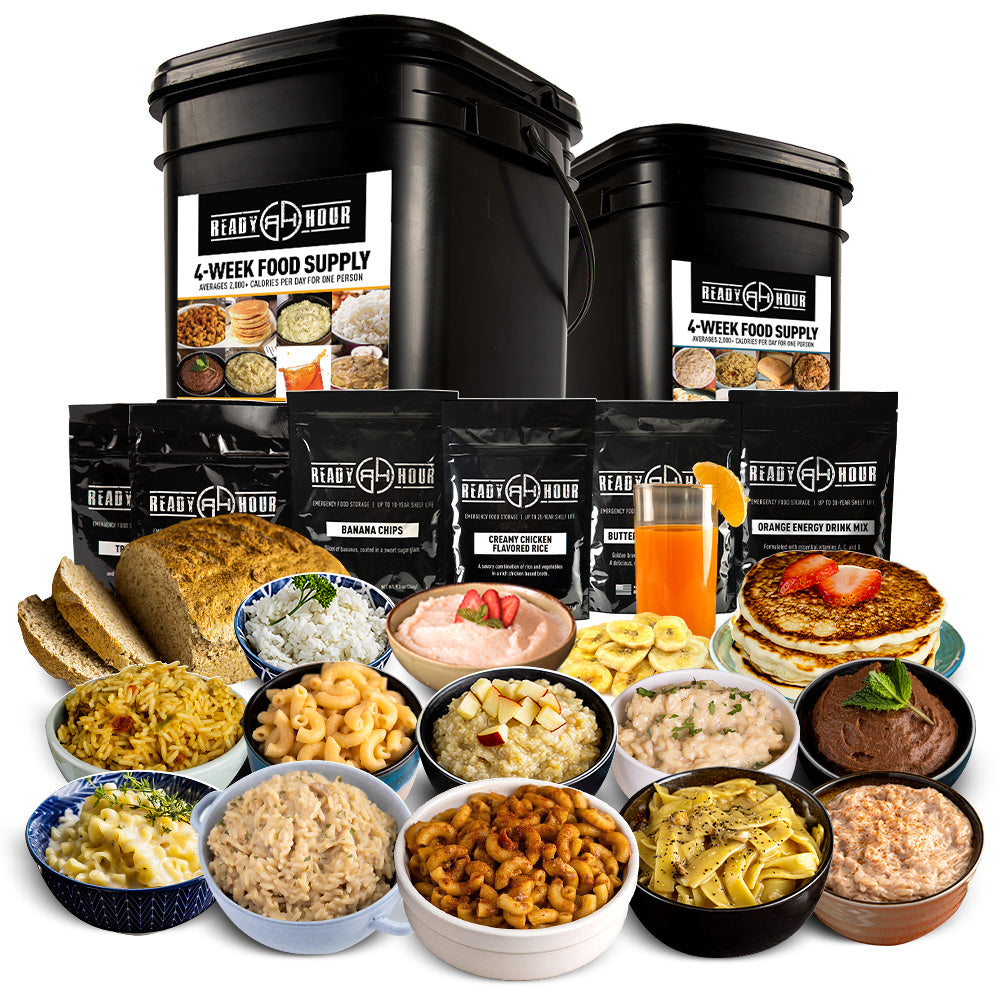
4-Week Emergency Food Supply (2,000+ calories/day)
- ✓56,000+ calories compressed into 3 buckets — smallest footprint option for testing or apartment storage
- ✓Serves one adult for 28 days or supplements a family's partial supply during a month-long disruption
- ✓Ideal entry point for households new to emergency food or skeptical of long-term supplies
- ✓Rotate by consuming one 4-week supply every two years, ensuring freshness and verifying your family's tolerance
- ✓Fits under a bed, in a closet, or behind a couch — requires minimal dedicated storage space
Frequently Asked Questions
Q: How many calories per day do I need in an emergency food supply?
A: A sedentary adult requires 2,000 calories per day minimum. Teenagers need 2,400–2,600 calories; children ages 4–8 need 1,200–1,400. If your emergency involves physical labor (hauling water, repairs, manual work), add 300–500 calories per person per day. Calculate your household total by multiplying each person's daily need by 365 days.
Q: How much emergency food does a family of four need for one year?
A: Assume 2 adults (2,000 cal each = 4,000), 1 teenager (2,500 cal), and 1 child age 8 (1,400 cal). Total: 7,900 calories per day. Multiply by 365 days: 2,883,500 total calories for one year. This requires approximately 8,000–9,000 pounds of food (after water removal), distributed across multiple buckets and storage locations.
Q: What happens if your emergency food has fewer than 2,000 calories per day?
A: Below 2,000 calories daily, adults lose approximately 1–2 pounds per week depending on activity level and starting weight. After 12 weeks, significant muscle and immune function decline occurs, reducing your ability to respond to danger or resist illness. Children and teenagers experience stunted growth and concentration loss within weeks. A calorie deficit is survivable short-term (30 days) but unsustainable beyond 60–90 days without serious health consequences. Always meet or exceed the 2,000-calorie baseline for each adult in your household.
Conclusion
Begin with your household roster and daily calorie total. Multiply by your chosen supply duration — 30 days, 90 days, or one year. Store the result across multiple containers in a cool, dry location (50–70°F, below 15% humidity). Test one meal every two years to verify storage conditions and confirm your family's tolerance. A year's supply provides security; a 4-week supply is where most households begin. Start now, while supply is available and budget is predictable.
Sources & Official Guidance
Authoritative further reading
This guide is for general informational purposes only and is not professional, medical, or safety advice. Always follow official guidance and, in a life-threatening emergency, call your local emergency number (911 in the US).
Mark Sutton, Lead Editor
Mark runs the editorial side of DoomsDayPreps. He digs into the research on emergency prep and survival gear, and checks anything safety-related against FEMA, CDC, and Red Cross guidance before it goes live.