Emergency Food Supply: Calculate Calories Per Person for Your Family
Learn how to calculate emergency food needs by person and household. Discover calorie math, storage conditions, and shelf-life reality for prepper food supplies
The math on emergency food is straightforward—but most people get it wrong. They buy random amounts, store them in warm kitchens, and then discover half the supplies are stale when they need them. The difference between a usable food supply and unusable storage is understanding caloric need by household member, real shelf-life under actual conditions, and how to verify that what you bought will actually sustain you when normalcy breaks.
How Much Food Your Household Actually Needs
A functional emergency food supply starts with a calorie calculation, not a guess. The United States Department of Agriculture baseline is 2,000 calories per day for adults in normal activity. But that number shifts based on age, size, and exertion during an actual emergency.
Adult baseline: 2,000 calories/day for sedentary adults. If you're managing evacuation, repair work, or walking for resources, add 500–1,000 calories. A 200-pound adult doing physical labor in an emergency may need 2,500–3,000 calories daily to maintain strength and cognition.
Teenage males (ages 14–18): approximately 2,500 calories/day—higher than adults due to growth and metabolism. This is not a rounding difference; it's a full extra meal per day per teenager.
Children (ages 4–8): approximately 1,400 calories/day. A 6-year-old does not eat like a small adult; they require less total food but comparable nutrient density.
Infants and toddlers (under 4): calorie needs are lower by total amount but more frequent—formula or breast milk, then transitional foods. A separate calculation applies.
Example household math:
- 2 adults × 2,000 cal/day = 4,000 cal/day
- 1 teenager × 2,500 cal/day = 2,500 cal/day
- 1 child (age 6) × 1,400 cal/day = 1,400 cal/day
- Household total: 7,900 calories/day
For a 7-day supply: 7,900 × 7 = 55,300 calories minimum for one week.
This is the non-negotiable floor. Once you know your household number, you can assess what a pre-made food supply actually covers and whether you need to layer in additional calories.
The Storage Environment Governs Actual Shelf Life
Emergency food shelf-life claims printed on packaging are theoretical maximums under laboratory conditions: 50–70°F, relative humidity below 15%, in darkness, unopened. Real homes don't meet those specs.
Temperature impact: Every 5°C (9°F) increase above 70°F cuts shelf life roughly in half. A food supply stored in a 90°F attic or garage has half the usable lifespan of one stored in a climate-controlled basement. A 25-year claim becomes 12–13 years in a warm garage; 6–7 years in a hot attic.
Humidity impact: Moisture degrades both nutrient density and texture. Opened containers, even if resealed, begin absorbing moisture immediately. Silica gel packets work only if the container stays sealed until use.
Light exposure: Even ambient indoor light oxidizes vitamins and degrades fats over time. Clear mylar pouches or buckets stored under kitchen lights lose nutritional potency faster than opaque containers in a dark cupboard.
Realistic expectation: A properly stored emergency food supply in a cool, dark, low-humidity location has a usable lifespan of 15–20 years. The same supply in a typical bedroom closet (which experiences temperature swings and humidity from showers) has a usable lifespan of 8–12 years. Plan rotation or testing at 70% of the advertised maximum, not 100%.
Portability vs. Volume: The Ammo Can Trade-Off
An emergency food supply serves two different purposes, and they require different storage strategies.
Home-based supply (shelter-in-place scenario): stored in cool, dark location; prioritizes cost and volume; rotation is predictable; can include bulk #10 cans or 5-gallon buckets.
Mobile supply (evacuation, bugging out, extended outdoor displacement): must be light, compact, water-resistant, and instantly transportable; calorie density per pound matters more than total cost; containers must protect food from moisture, temperature, and physical damage.
An ammo can is a rigid, sealed metal container originally designed to store rifle ammunition in field conditions. The seal keeps moisture and contaminants out. The steel construction resists puncture and crushing. For mobile emergency food, this is a material advantage: a mylar pouch survives once; an ammo can survives multiple transits and weather exposure.
The trade-off: an ammo can with 7 days of food for one adult (2,000 calories/day) weighs approximately 10–12 pounds. Manageable in a backpack. A 5-gallon bucket with the same calories weighs 8–10 pounds but cannot be thrown, dropped, or crushed without rupturing. For bug-out readiness, the weight penalty of the ammo can is worth the protection.

1-Week Food Supply Ammo Can (2,000+ calories/day)
- ✓Sealed steel ammo can design keeps contents dry and protected from physical damage during evacuation or extended travel, unlike mylar pouches that tear in motion
- ✓2,000+ calories per day for 7 days = 14,000+ calories total; meets adult baseline for one week without supplemental hunting or foraging
- ✓Designed for bug-out bags, vehicle emergency kits, or mobile shelter-in-place scenarios where sealed portability is essential
- ✓Steel construction survives repeated transit, extreme temperature swings, and outdoor exposure—mylar and plastic containers fail under these conditions
- ✓Compact enough to fit in a closet, vehicle, or backpack; label remains readable after years of storage without requiring temperature control
Scaling Beyond One Week
A single-person, one-week supply is a foundation, not a complete emergency plan. Real emergencies extend beyond 7 days. Grid failures, supply chain disruptions, and mobility restrictions can last weeks or months.
The 30-day threshold: Fourteen days feels like preparation; 30 days feels like readiness. At 2,000 calories/day, one adult needs 60,000 calories for 30 days. If you store five 7-day ammo cans, you reach 35,000 calories—58% of a 30-day supply. Adding a second set of five gets you to 70,000 calories, which covers 35 days for one adult, or 17.5 days for two adults.
Multi-person scaling: A household of 4 (as in the earlier example: 2 adults, 1 teenager, 1 child) with 55,300 calories daily needs 386,000 calories for a 7-day supply. Seven ammo cans of 2,000 calories each = 14,000 calories—less than 4% of one week for that household. You would need roughly 27 ammo cans for that household to reach 7-day coverage. At that volume, switching to bulk storage (larger food supply kits, #10 cans) becomes more cost-effective than multiple small containers.
Decision point: Use ammo cans for mobile readiness (bug-out, vehicle, travel). Use larger pre-made food kits (30-day, 90-day, or 1-year supplies) for home storage. Layer both for complete coverage.
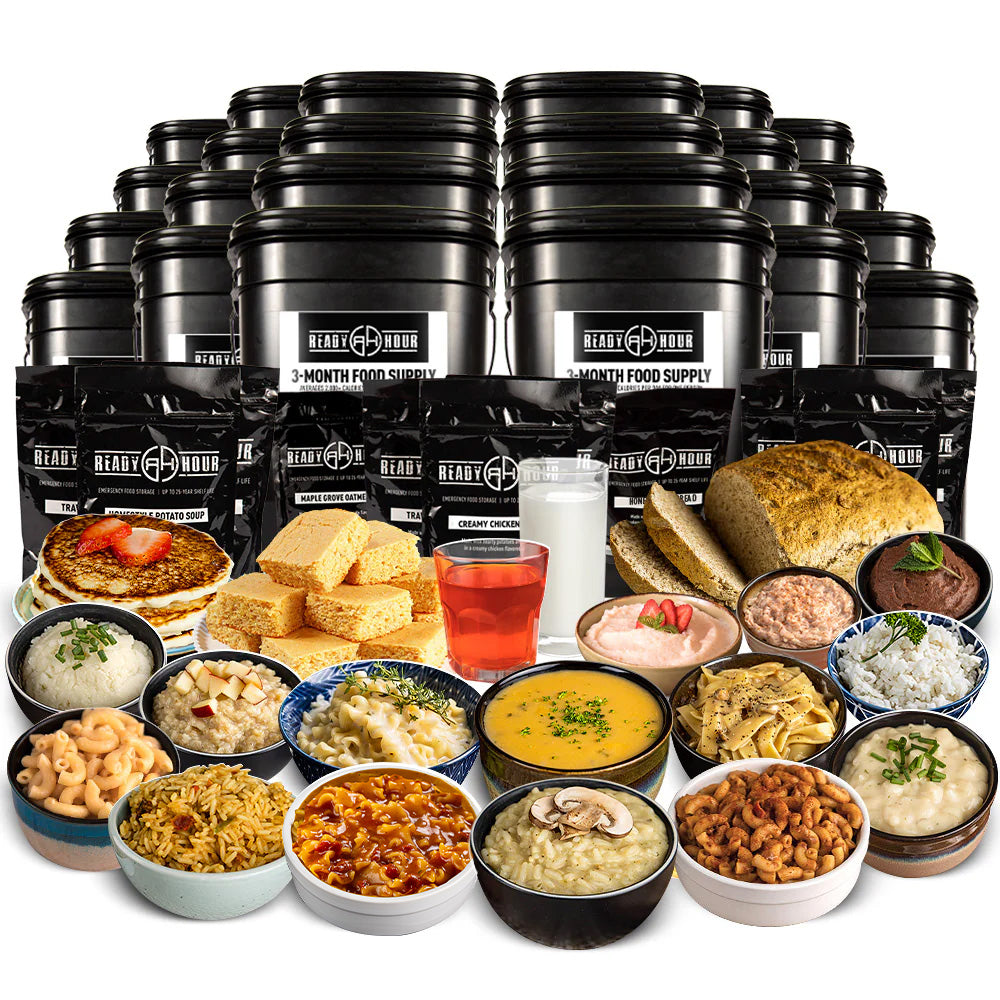
1-Year Emergency Food Supply (2,000+ calories/day)
- ✓Bulk freeze-dried and dehydrated meals provide 365 days of 2,000 calories/day for one adult = 730,000 total calories in shelf-stable form
- ✓Comes in meal packets (breakfast, lunch, dinner) with just-add-water preparation; no fuel intensive cooking required in extended outages
- ✓Stored in sealed buckets with oxygen absorbers; rated for 25+ years in controlled home storage conditions (50–70°F, <15% humidity)
- ✓Home-based supply designed for shelter-in-place scenarios; requires cool, dark storage location but provides comprehensive dietary coverage for longer events
- ✓Each meal packet serves one adult; rotate by meal type every 1–2 years to verify calorie density and palatability remain consistent
Honest Limitations: What Emergency Food Cannot Do
Emergency food supplies, even well-planned ones, have hard boundaries that matter.
They cannot replace water. A person consuming 2,000 calories from freeze-dried or dehydrated food requires proportionally more water for digestion and hydration than if eating fresh food with high water content. Plan 1 gallon of water per person per day minimum, separate from food supplies. Dehydrated meals require additional water for rehydration—this water is consumed as part of the meal but must be accounted for in your total water reserve.
Taste fatigue is real. After 3–5 days of the same meal rotation, even palatable emergency food becomes unappetizing. This is not a preference issue—it affects consumption. If someone is not eating out of aversion to repetitive meals, they are not receiving the intended calories. Including 2–3 food variety sources (different brands, meal types, or supplemental staples like peanut butter, oats, or canned fruit) extends acceptability beyond a single ammo can.
They do not prevent nutrient deficiency over months. A 7-day supply covers acute needs. Beyond 4–6 weeks of emergency food dependency, vitamin A, C, and mineral intake may drop below recommended levels if the food supply lacks vegetable content or is supplemented only with shelf-stable carbohydrates. Multi-vitamin supplements stored alongside emergency food address this gap.
They spoil if exposed to heat, water, or opened seals. An ammo can protects contents unless physically breached or stored in a location where condensation accumulates (like a basement near a water heater). If storage location experiences temperature swings above 80°F, rotate stock every 2 years instead of relying on the full advertised shelf life. Opened ammo cans must be resealed or contents transferred to airtight containers within hours of opening, or humidity will degrade remaining supplies within weeks.
They are not a substitute for medical supplies or special diets. Someone with celiac disease, type 1 diabetes, or severe allergies cannot rely on standard emergency food. Pre-packed supplies must align with household dietary restrictions or be supplemented with specialty foods purchased and rotated separately.
Frequently Asked Questions
Q: How many calories per day do I need in an emergency food supply?
A: Adults require approximately 2,000 calories/day for sedentary activity; teenagers require 2,500; children ages 4–8 require 1,400. If you are performing physical labor during an emergency (walking, clearing debris, repair work), add 500–1,000 calories. Calculate your specific household: (number of adults × 2,000) + (number of teenagers × 2,500) + (number of children × 1,400) = your daily requirement. Multiply by the number of days you want to supply.
Q: How long does emergency food actually stay fresh?
A: Advertised shelf life assumes storage at 50–70°F with less than 15% humidity in darkness. Real homes rarely meet this standard. In a cool basement, expect 15–20 years of usable nutrition. In a warm bedroom closet or garage, expect 8–12 years. Every 5°C increase above 70°F cuts shelf life roughly in half. Plan rotation or taste-testing at 70% of the advertised maximum; do not rely on 25-year claims in an uncontrolled home environment.
Q: What calories per day should I plan for kids vs. adults in a food supply?
A: A 6-year-old requires approximately 1,400 calories/day—not a scaled-down adult portion. A 16-year-old requires 2,500 calories/day—more than most adults. Do not use the 2,000-calorie baseline for children. Calculate each person individually and multiply by their specific daily requirement, not by a household average.
Your Next Action
Start with your household calorie calculation: write down each person's age and daily caloric requirement, then multiply by 7. That number is your one-week baseline. A single ammo can (14,000 calories) covers one adult for exactly one week. For a larger household, this is the foundation, not the complete solution. Pair a mobile supply (ammo cans for vehicles, bug-out bags, quick evacuation) with a larger home-based supply (30-day or 1-year kits stored in cool, dark conditions). Verify your storage location stays below 75°F year-round; if it does not, shorten your rotation cycle. Test one meal from your supply within 30 days of purchase to confirm palatability and actual calorie content before an emergency makes it the only option.
Sources & Official Guidance
Authoritative further reading
This guide is for general informational purposes only and is not professional, medical, or safety advice. Always follow official guidance and, in a life-threatening emergency, call your local emergency number (911 in the US).
Mark Sutton, Lead Editor
Mark runs the editorial side of DoomsDayPreps. He digs into the research on emergency prep and survival gear, and checks anything safety-related against FEMA, CDC, and Red Cross guidance before it goes live.

