Emergency Light Sources Without Power: 3 Methods That Work
Emergency light sources work without electricity. Learn how candles, flashlights, and solar lights keep you visible and safe during outages.
When the grid goes down, light becomes survival currency. A flashlight without batteries is a paperweight. A candle that gutters out leaves you in darkness. The difference between three emergency light methods—wax candles, battery-powered flashlights, and solar-rechargeable systems—lies not in sentiment but in burn time, reliability, and what happens when you can't resupply them.
This guide teaches you the combustion and photon principles behind each light source, shows you realistic duration math for your household size, and helps you choose which combination actually keeps your family visible and safe when conventional power fails.
How Candles Work as Emergency Light—and Why Duration Matters
A candle produces light through paraffin wax combustion. The wick draws melted wax up through capillary action—the same force that lets a paper towel absorb water. That liquid wax vaporizes at the flame's base and reacts with oxygen, releasing heat and light. The flame sits around 1,500°F, hot enough that the wax above the melt pool never fully solidifies; the candle never "recovers" until you stop burning it.
A traditional dinner candle burns roughly 5–7 hours total. The wax molecule is finite. Burn time scales proportionally with wax volume, not wick size—a thicker candle with more total wax lasts longer, period.
An emergency candle, by contrast, uses a denser wax formula and a wider vessel to maximize surface area and wax-to-wick ratio. This is the critical design difference. More wax, same combustion rate, longer burn. The container itself—usually steel or tin—becomes part of the survival function: it holds the wax, focuses heat for warmth, and lets you carry the light.
Paraffin candles are smokeless and odorless when burned properly because paraffin is a refined petroleum product, not a plant material. (Soy or beeswax candles, by contrast, produce a faint woody smell.) This matters in shelters or vehicles where air quality is fixed: a smokeless candle won't degrade your breathing space or coat surfaces.
The physics is simple. More wax = more burn time. No resupply needed. No batteries to die. The trade-off is fixed light output—you cannot brighten it—and no portability once lit.
Duration Math: How Many Candles Your Household Actually Needs
Let's calculate realistic emergency lighting inventory for a four-person household during a 72-hour outage.
Baseline assumption: You light one candle in your main living area for 6 hours each evening (dusk until bedtime), and one candle in a secondary space (bedroom, kitchen) for 2 hours nightly.
- Evening candle: 6 hours/night × 3 nights = 18 hours of burn
- Secondary candle: 2 hours/night × 3 nights = 6 hours of burn
- Total burn time needed: 24 hours
A 100-hour candle provides 100 hours of rated burn time, but rated time assumes continuous, uninterrupted burning. In reality, you'll use that candle in three-session chunks. It will last roughly three 72-hour cycles before exhaustion. A single 100-hour candle covers your baseline 24 hours of use per outage and leaves a 76-hour reserve.
More conservative prep (14-day outage, two candles burning daily):
- 14 days × 2 candles × 8 hours average = 224 hours needed
- 224 ÷ 100 = 2.24 candles minimum
- Recommendation: three 100-hour candles per person, stored in a cool, dry location
| Household Size | 72-Hour Outage | 14-Day Outage | 30-Day Outage |
|---|---|---|---|
| 1 adult | 1 candle (50+ hrs left) | 3 candles (76 hrs left) | 7 candles (100+ hrs left) |
| 2 adults | 2 candles | 5 candles | 14 candles |
| 4 adults + 2 children | 3 candles | 8 candles | 20 candles |
Children need light too—a dark bedroom amplifies fear and creates tripping hazards. A 4-person household should hold no fewer than 8 candles; a 6-person household, 12. The cost per candle is low enough that over-supply is impossible.
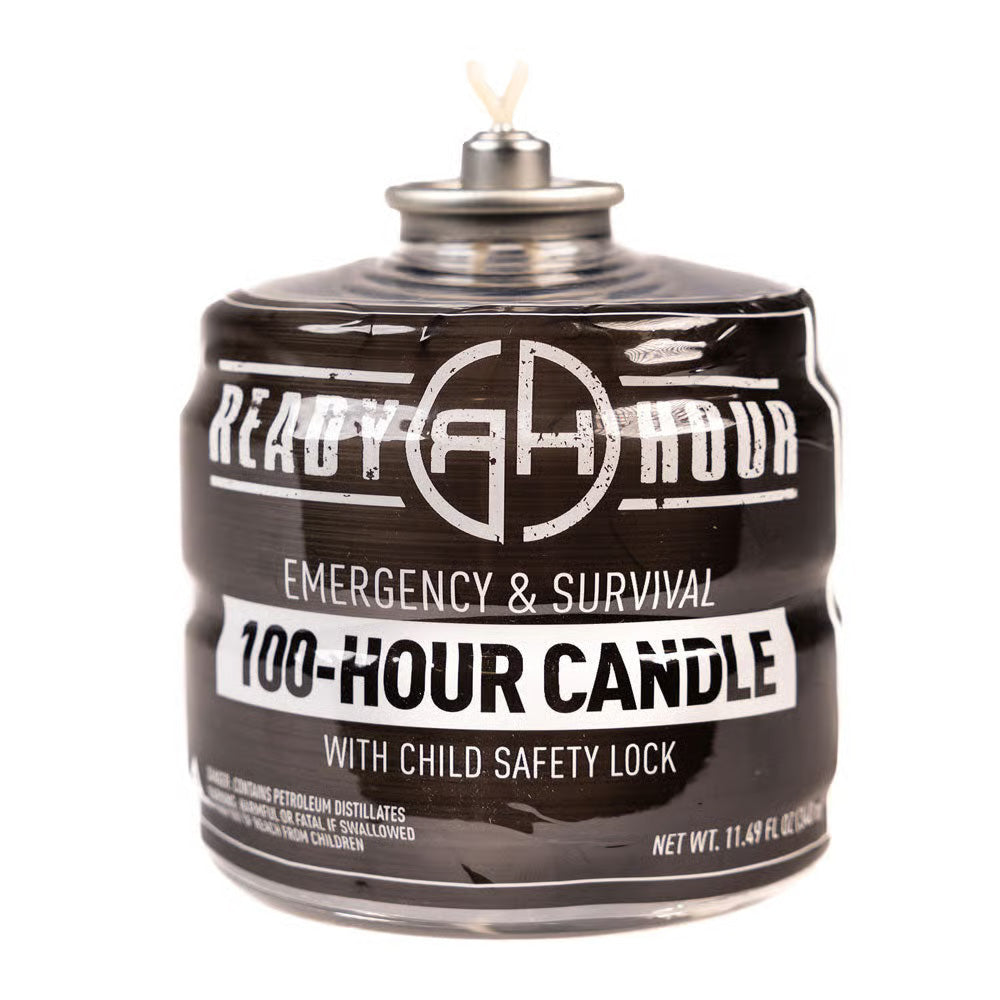
100-Hour Candle by Ready Hour
- ✓Paraffin wax combustion produces consistent 1,500°F flame without smoke or odor, safe to burn in enclosed shelters
- ✓Burns 100 hours continuously; three candles cover a 14-day outage with 76+ hours reserve
- ✓Steel container holds wax safely, focuses radiant heat into living space, eliminates fire hazard of loose wicks
- ✓No batteries, no charging, no solar dependency—light works at any temperature, indoors or outdoors
- ✓Stores indefinitely in cool, dry conditions; wax does not degrade or lose potency over decades
Rechargeable and Solar Alternatives—When Candles Aren't Enough
Candles are silent, indefinite, and require no external input. But they produce fixed light output and a heat signature. In some scenarios, a flashlight is the better tool.
A rechargeable LED flashlight—powered by hand crank, solar panel, or battery—gives you adjustable, portable light. Hand-crank flashlights generate electricity through mechanical rotation: you turn a handle, friction spins a magnet inside a copper coil, and the moving magnetic field induces an electric current. No battery required. The trade-off is immediate: you do the work. A two-minute crank gives you 5–10 minutes of LED light, depending on brightness mode.
Solar-rechargeable flashlights store energy in an internal battery, charged by a small photovoltaic panel. During daylight, the panel converts sunlight into electrical current, filling the battery. At night, you draw that stored charge into the LED. This works indoors only if you've already charged the battery outdoors in daylight. A solar flashlight left inside a dark room cannot charge itself.
LED light is efficient—modern LEDs convert roughly 40–60% of electrical input into visible light (incandescent bulbs: 5%). An LED headlamp drawing 500 milliamps at 3 volts (1.5 watts) produces useful light for 8–12 hours on a rechargeable AA battery. Compare that to a candle, which produces light continuously but cannot be aimed or dimmed.
The real advantage of solar or hand-crank systems is independence. You're not depleting a finite fuel or battery stock. A hand-crank flashlight works for 20 years. A solar flashlight works as long as daylight exists.
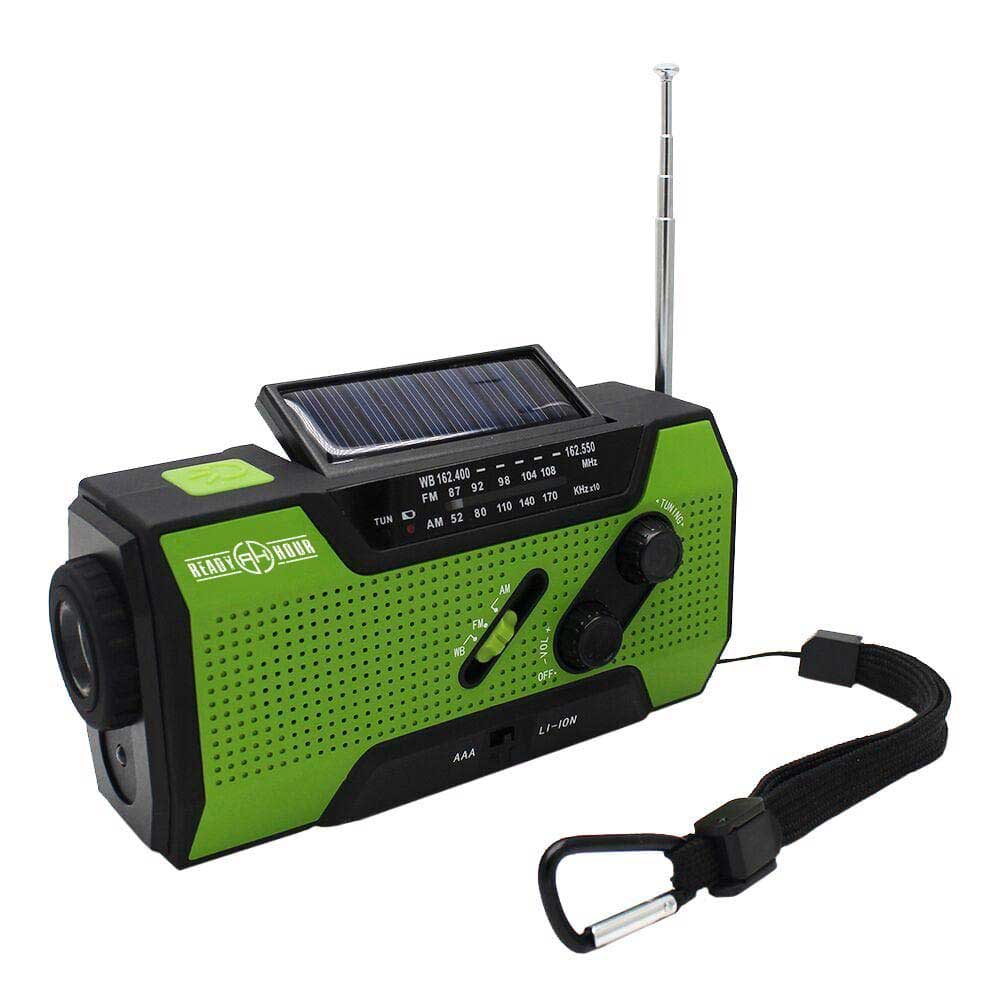
4-in-1 Emergency Solar Flashlight & AM/FM/NOAA Weather Radio w/ Hand Crank by Ready Hour
- ✓Hand-crank mechanical generator produces emergency light without batteries or solar charging—two-minute crank = 10+ minutes LED light
- ✓Integrated AM/FM/NOAA weather radio keeps you informed during extended outages, critical for evacuation warnings
- ✓Solar panel charges internal battery during daylight; one full sunny day = 12+ hours LED runtime
- ✓Portable beam focuses light precisely where needed—flashlight covers distance, candles cover area; choose based on task
- ✓Fits a backpack or vehicle emergency kit; 10-year shelf life as long as solar panel and hand crank remain intact
Honest Limitations—When Each Light Source Fails
A candle cannot be used:
- On moving vehicles. Road vibration and acceleration swing the flame, spilling hot wax and risking fire.
- In strong wind. Outdoor gusts blow the flame sideways and blow it out.
- For signaling. The fixed flame cannot pulse or sweep; a flashlight beam travels hundreds of feet.
- By anyone with tremors or grip weakness. The container is hot after extended burn; dropping it spills flaming wax.
A hand-crank flashlight cannot be used:
- For more than 10–15 minutes continuously. Your forearm exhausts. A two-minute crank produces diminishing returns on the second cycle.
- As ambient light. A flashlight beam is narrow. It illuminates what you point at, not the room.
- Without intact mechanical parts. A broken hand crank cannot be field-repaired.
A solar flashlight cannot be used:
- Indoors during a long outage without external charging. The battery depletes; the solar panel, inside a house, produces zero current. You must physically take it outside every daylight hour.
- Below 40°F. Cold reduces battery voltage and LED efficiency; below freezing, some rechargeable batteries shut down entirely.
- At night without prior daytime charge. Unlike a candle or hand crank, a solar system is always dependent on a prior energy cycle.
A comprehensive household needs all three. Candles for sustained ambient light. A hand-crank light for mobility and independence. A solar flashlight for daylight charging and backup.

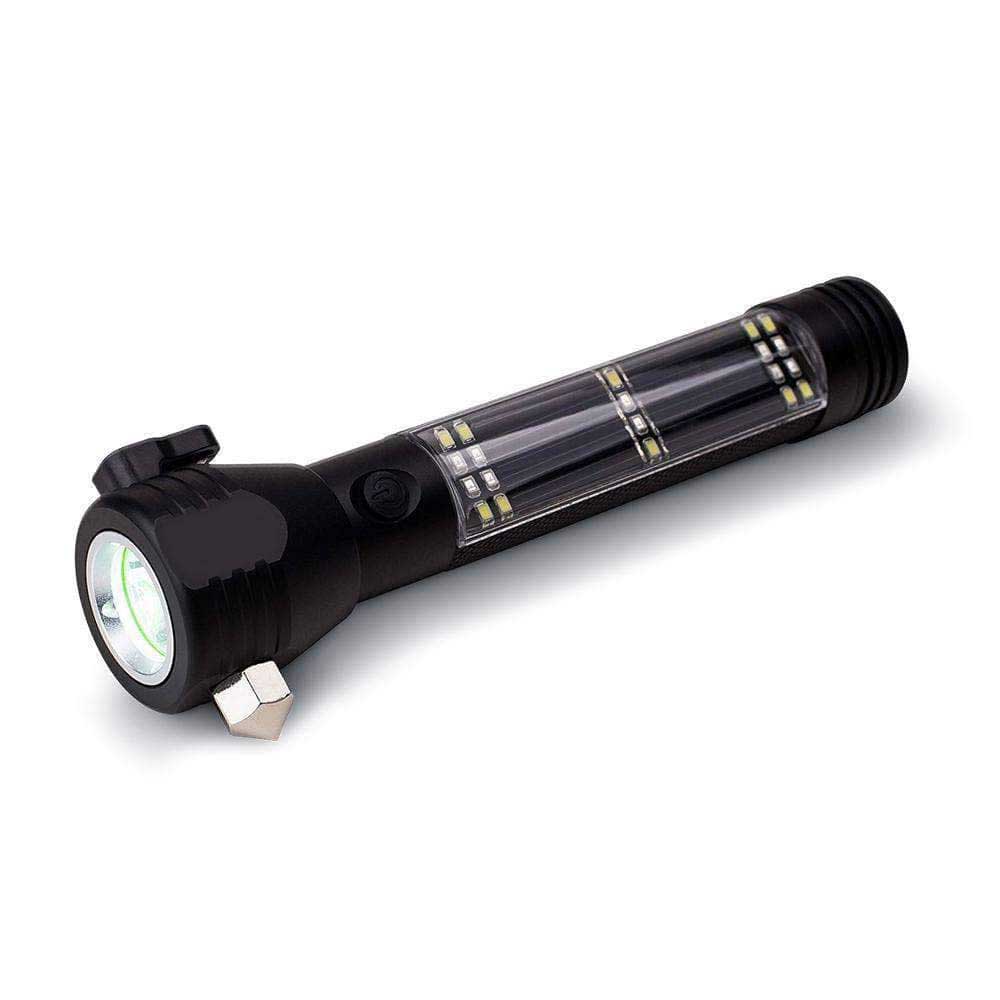
9-in-1 Multi-Function LED Solar Rechargeable Flashlight by Ready Hour
- ✓Solar panel charges internal battery during daylight; one full sunny day provides 6–8 hours of LED runtime at night
- ✓Multiple light modes (white LED, red night light, strobe) cover different tasks—area light, navigation, emergency signaling
- ✓Compact design fits into a glove box, backpack, or bedside table; 5-year solar panel lifespan with normal use
- ✓USB input allows charging from any power source when sun is unavailable—maintains readiness during extended cloud cover
- ✓No hand crank required—silent operation, both hands free for other tasks during emergency response
FAQ
Frequently Asked Questions
Q: How long does a 100-hour emergency candle actually burn?
A: A 100-hour candle burns for approximately 100 hours of continuous burning. If you use it in three-hour sessions (evening light), it lasts roughly 33 sessions, or one month of nightly use. During a short 72-hour outage with 6 hours of daily burn, a single 100-hour candle covers the entire event with 82 hours remaining. Rated burn time assumes no interruptions; real-world use with periodic relighting may vary by 5–10% depending on room temperature and draft.
Q: What's the difference between a candle and a rechargeable flashlight for emergencies?
A: A candle provides 360-degree ambient light without electricity—it lights an entire room continuously for 100+ hours on one purchase. A rechargeable flashlight produces a focused beam you control, requires charging (via solar, hand crank, or USB), and typically runs 6–12 hours per charge. Candles are better for sustained room lighting; flashlights are better for task lighting, signaling, and mobility. Most prepared households use both.
Q: Can you use solar lights indoors during a power outage?
A: No. A solar panel produces current only in daylight, and most windows transmit insufficient light for charging during overcast conditions. You must charge a solar flashlight outside or near a bright window during daylight, then use it indoors at night. If the outage lasts longer than a few days or cloud cover persists, a solar light alone will fail. Pair it with hand-crank backup or store candles for extended outages.
Conclusion
Emergency lighting is not about finding the "best" source—it's about eliminating single points of failure. A household that relies on one candle loses all light if that candle burns out. A family depending on a single solar flashlight loses readiness if clouds arrive for three days straight. The households that stay functional during outages hold at least three light sources: candles for sustained ambient light, a hand-crank flashlight for emergency independence, and a solar or USB-rechargeable light for extended scenarios.
Your next action: inventory your current light sources. Count your flashlights (and test the batteries). List your candles. If you have fewer than three working light sources per person in your household, order a 100-hour candle and a hand-crank flashlight this week. Store them in your primary living space, not in a basement or vehicle. A light source you cannot reach is worse than no light source at all.
Sources & Official Guidance
Authoritative further reading
This guide is for general informational purposes only and is not professional, medical, or safety advice. Always follow official guidance and, in a life-threatening emergency, call your local emergency number (911 in the US).
Mark Sutton, Lead Editor
Mark runs the editorial side of DoomsDayPreps. He digs into the research on emergency prep and survival gear, and checks anything safety-related against FEMA, CDC, and Red Cross guidance before it goes live.