Emergency Power Bank Capacity: Calculate What You Actually Need
Learn how to calculate power needs, choose the right capacity, and maintain emergency power systems. Essential prepper skills before buying.
An outage lasting 72 hours means three days without refrigeration, without charging devices, and without access to information. Most preppers buy a power bank without doing the math—they grab whatever has the biggest number on the label and hope it covers their devices. That approach leaves you scrambling when the bank dies halfway through day two.
This article teaches you the actual calculation. By the end, you'll know exactly what capacity your household needs, how to match it to real devices, and the specific trade-off between portable capacity and solar recharging. You'll be able to make a decision based on numbers, not marketing claims.
How Power Banks Work and Why Capacity Matters
A power bank stores electrical energy in an internal battery. The capacity is measured in two ways: milliamp-hours (mAh) and watt-hours (Wh). Understanding the difference is essential because they tell you different things about what the bank can actually deliver.
mAh measures the total charge available—think of it as the size of the tank. Wh (watt-hours) measures the usable energy the bank can deliver at different voltages. This matters because a power bank doesn't deliver all its stored energy to your device; there are losses in the conversion circuit.
Here's the relationship: Wh = (mAh × Voltage) ÷ 1,000. A bank rated 50,000 mAh at 3.7V nominal = approximately 185 Wh of stored energy. But when you charge a 5V phone, the bank's internal converter steps up the voltage, and efficiency drops to roughly 80–85%. Real-world deliverable energy is closer to 155–160 Wh—about 15% less than the rating suggests.
This is why spec sheets list Wh alongside mAh. The Wh number is what actually matters for your device.
The Device-by-Device Calculation: Build Your Real Number
Before buying any capacity, list the devices you must power during an outage and their battery sizes.
A typical phone battery holds 10–15 Wh (average smartphone). A tablet holds 20–35 Wh. A headlamp with rechargeable battery holds 2–5 Wh. A two-way radio holds 5–10 Wh. A medical device—CPAP, insulin pump, hearing aid charger—can range from 8 Wh to 50 Wh depending on the model.
Real calculation example:
- iPhone 15: 12.68 Wh
- Tablet: 28 Wh
- Two-way radio: 8 Wh
- Headlamp: 3 Wh
- Total single charge: 51.68 Wh
If you must charge these devices twice during a 72-hour outage (day 1 and day 3), you need approximately 103 Wh of usable energy from your bank. Adding a 15% safety margin for conversion losses and aging battery degradation, you're targeting 120 Wh minimum.
The same logic scales. A household with two phones, two tablets, one radio, and critical medical devices could need 200–250 Wh. A single person with a phone, headlamp, and radio needs 80–100 Wh.
The key insight: Most people overestimate. A 100 Wh bank is sufficient for one person's essential devices for 72 hours. A 150 Wh bank covers a two-person household. A 200+ Wh bank is needed only if you're powering high-drain devices (portable WiFi hotspot, medical equipment, or multiple family members' phones and tablets).
Charge Cycles and Recharging Strategy During Outages
A power bank loses 3–5% of its stored charge per month when sitting idle due to internal leakage. More important: every charge cycle (full drain and recharge) degrades the battery. After 300–500 full cycles, capacity drops to 80–90% of the original rating.
In an extended outage, you cannot rely on wall power to recharge the bank. This is where solar compatibility becomes the deciding factor between a bank that's useful for three days and one that sustains you for two weeks.
A 15W solar panel in direct sunlight delivers approximately 10–12 amps at 20V (roughly 200W peak output). On a clear day with 6 hours of usable sunlight, that panel provides about 60–70 Wh of energy, assuming no cloud cover and optimal panel angle. On overcast days, expect 25–40% of that.
The math: a 65 Wh bank fully depleted takes 6–8 hours of direct sunlight to recharge completely from a 15W solar panel. If you charge your phone at 5W draw and simultaneously recharge the bank from solar at 10W input, you're running a net loss—consumption exceeds generation. You must prioritize. Charge your phone in the morning (from the bank), then spend the afternoon recharging the bank from solar. At nightfall, the bank has power again for evening and emergency use.
This is not optional complexity—it is the operating reality of extended outages. Buying a large power bank without solar means you have a 2–3 day solution, not a long-term one.
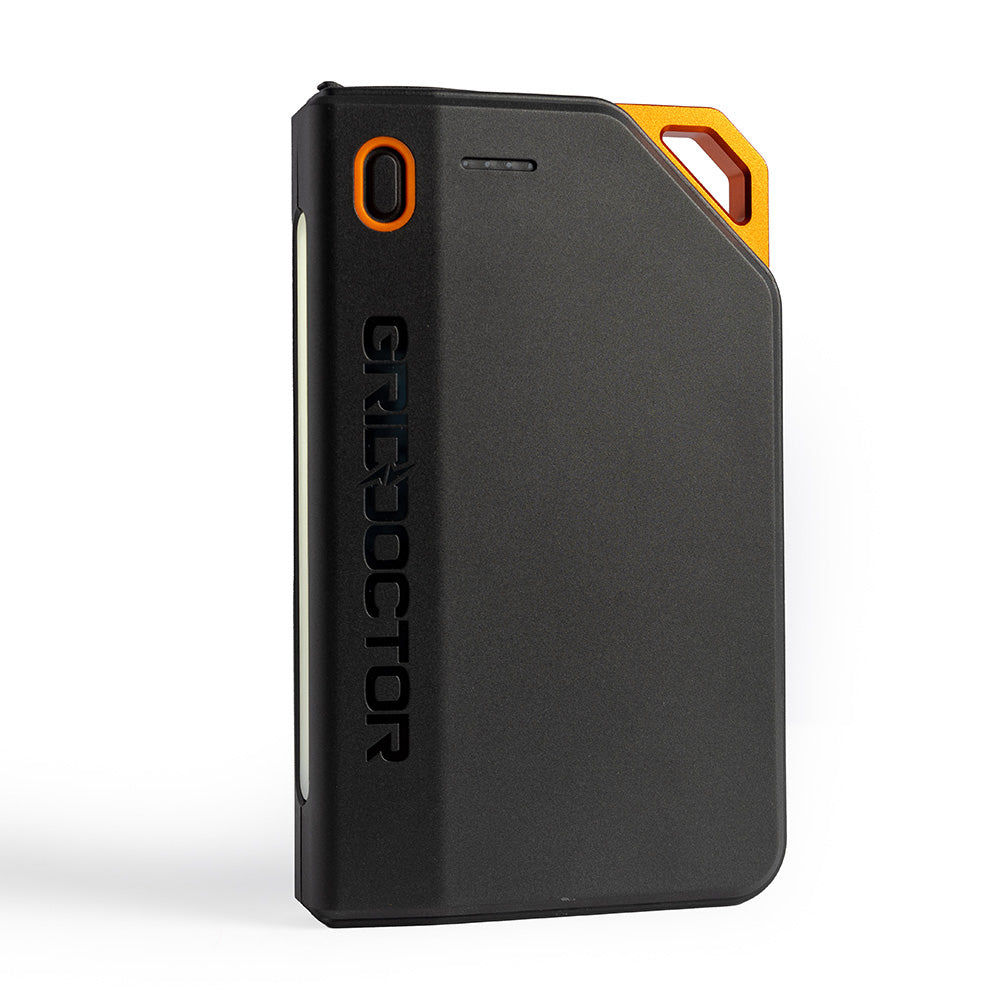
65W Power Bank by Grid Doctor
- ✓Delivers 65 Wh of usable energy via 25,000 mAh at 3.7V nominal, with integrated charge-boost circuitry to maintain voltage stability across repeated charge cycles
- ✓Charges a full smartphone twice (12–15 Wh per phone) plus headlamp and radio, or sustains two devices for 72 hours at shared usage
- ✓Rugged design for emergency bag storage; input ports support both USB-C and micro-USB for flexible recharging from wall, car, or solar sources
- ✓Unlike smaller 10,000–20,000 mAh banks, the 65 Wh capacity means you're not choosing between charging your phone OR your tablet—you can do both once
- ✓Compact enough to fit a backpack; heavy enough (roughly 12–14 oz) that you notice it's there, reinforcing daily carry discipline
Real-World Failure Modes and Honest Limitations
Power banks fail in specific, avoidable ways. Understanding them now prevents panic when you're actually in an outage.
Cold temperatures are the most common failure. Below 50°F, lithium-ion battery chemistry slows charge and discharge rates. Below 32°F, many banks refuse to charge entirely, though they may still discharge to a phone. A bank stored in an unheated garage or car in winter loses 10–20% of its capacity in cold conditions. Store your bank indoors at 50–70°F.
Overcharge damage happens if you leave the bank plugged into solar or wall power continuously after it reaches full capacity. Most modern banks include overcharge protection, but older or cheap models do not. Unplug or disconnect the solar panel once the bank is full.
Partial discharge cycles are misleading. If you top up the bank every evening rather than fully discharging it, it will last more charge cycles (500+ cycles possible), but in an actual outage with no wall power, you cannot top up. You will fully discharge the bank repeatedly. Expect 300 full cycles maximum in a real emergency scenario—that means after 10 months of weekly full-cycle testing, the bank drops to 80% capacity.
Solar panel angle and orientation matter enormously. A 15W panel in full sun overhead generates 3× the power of the same panel at 30 degrees off perpendicular. If your only option is a window with indirect light, a solar panel is nearly useless. If you cannot commit to repositioning a panel every 2 hours to track the sun, expect half the theoretical output.
High-amperage devices drain the bank rapidly and may not charge from it. A 100W heating pad, portable espresso maker, or air compressor cannot run from a 65 Wh bank—and you should not attempt it, because the sustained current draw can damage the bank's charge circuit. A power bank is designed for small portable electronics: phones, tablets, headlamps, radios, e-readers, small fans, LED lighting. It is not a portable generator and should not be marketed as one.
Who should NOT rely solely on a power bank: Anyone with critical medical devices (CPAP, ventilator, refrigerated medication) in an outage lasting more than 72 hours needs both a power bank AND a backup generator (gas, propane, or solar with battery bank rated in kWh, not Wh). A power bank is a tier-two backup, not the primary solution for life-critical loads.
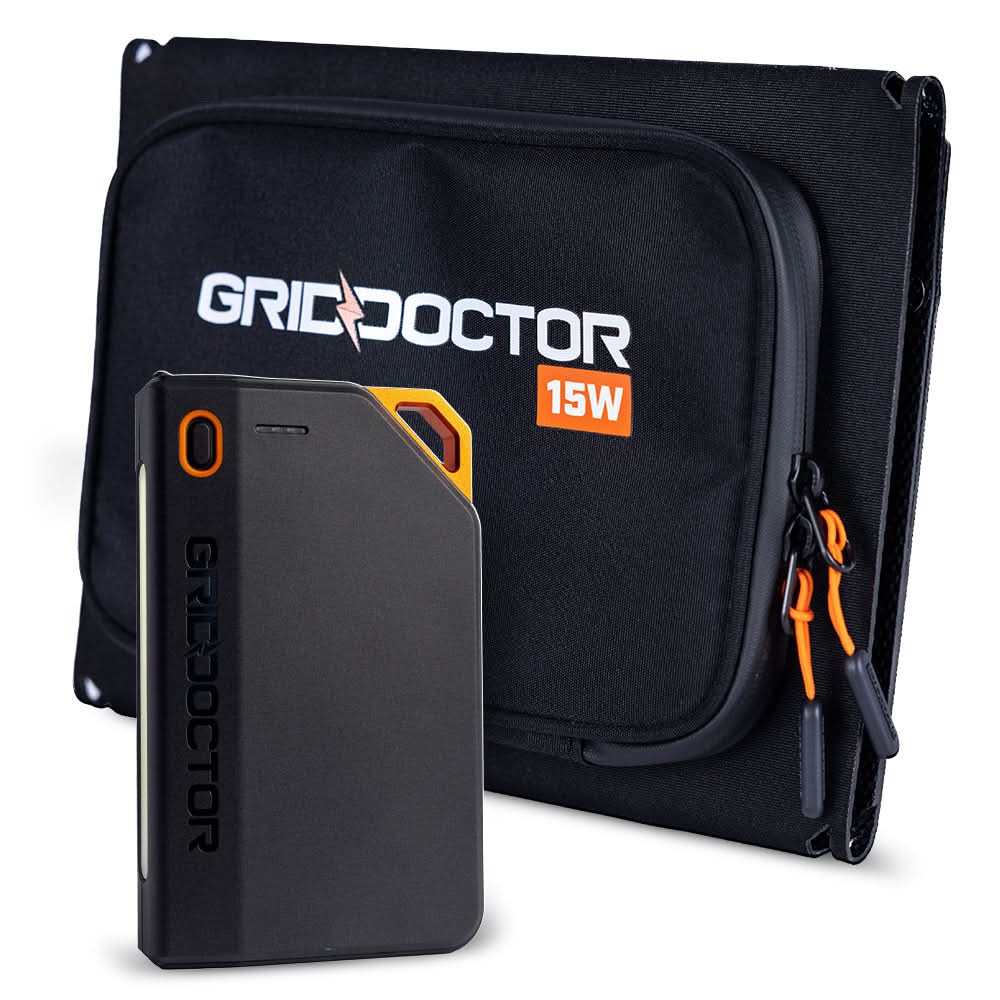
65W Power Bank w/ 15W Solar Panel by Grid Doctor
- ✓Combines 65 Wh power storage with a 15W monocrystalline solar panel; the panel generates 60–70 Wh per clear day, enabling sustained recharging without wall power
- ✓Single-package approach eliminates the mistake of buying a bank and forgetting to source compatible solar—both components are integrated and tested together
- ✓Solves the 72-hour-to-two-week transition: charges phones and devices day one, recharges itself from solar day two onward, supporting indefinite outage duration
- ✓Monocrystalline panels outperform polycrystalline at angles >30 degrees off perpendicular; this panel maintains 70–80% output even when not perfectly aligned
- ✓Dual kickstand design allows hands-free solar angle adjustment throughout the day without repositioning the entire unit; folds to 16" × 10" for vehicle or bag storage
Household Scaling: One Bank or Multiple Banks?
The decision between one large bank and several smaller ones depends on your household size and power strategy.
Single large bank (100+ Wh): Best for individuals and couples. Easier to manage, simpler charging protocol, less complexity during actual outage. One point of failure, but that failure is manageable—if it fails, your backup is a car charger or wall outlet (if available).
Multiple smaller banks (40–50 Wh each): Better for families with 3+ devices and longer expected outages. Distribute them across the household so each family member carries one. In an outage, children have their own device power, reducing dependency on a single bank. Downside: higher total cost and more batteries to age and maintain.
Mixed strategy (one large + one medium): Deploy the large bank to shared devices (family tablet, two-way radio). Each adult carries a medium bank (40–50 Wh) for personal phone and light devices. This provides redundancy—if the primary bank fails, household comms still function. Requires more discipline in discipline but maximizes resilience.
The math: a 65 Wh bank covers one adult or one adult + child for 72 hours at typical usage (one phone charge per day, radios and lights as needed). A household of four needs either one 200+ Wh bank or two 100 Wh banks or three to four 50–65 Wh banks.
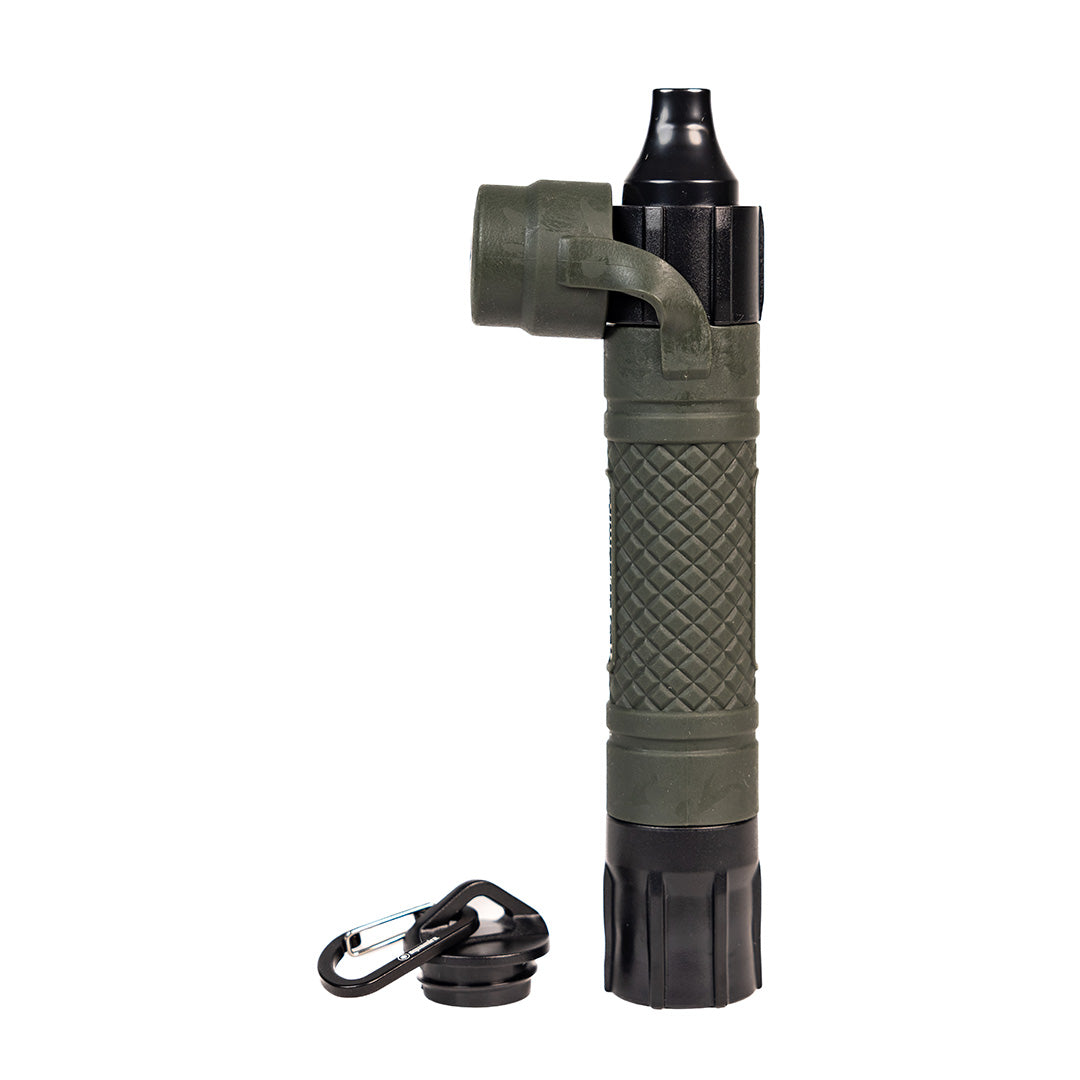
Survival Straw Personal Water Filter by Aquamira
- ✓Uses a hollow-fiber membrane rated to 0.1 microns; removes bacteria, protozoa, and sediment from untreated water sources without chemicals or electricity
- ✓One straw lasts 1,000 gallons of use—sufficient for one person, one liter per day, for nearly three years of emergency supply
- ✓Portable emergency-bag weight (less than 2 oz); powers from gravity alone—place straw in a bucket or stream and let water filter through to your container
- ✓Removes pathogens that power outages enable: cryptosporidium and giardia in untreated municipal water if treatment plants shut down; bacteria from boil-water advisories
- ✓Store in a cool, dry place; backflush with clean water after each use to extend membrane life; freezing damages the membrane, so store indoors
Maintenance and Seasonal Checks
Every 30 days, check the power bank's current charge level. If it's sitting at 30% or lower, top it up from wall power to 80–100% and leave it there. A power bank at 0% charge for more than three months is at risk of permanent internal damage from crystallized lithium deposits.
Every 90 days (quarterly), do a "function test": fully charge the bank, then fully discharge it by charging a phone. This cycles the battery and prevents charge pathway crystallization. Document the discharge time—if it drops more than 10% from the previous quarter, the bank is aging faster than expected.
Store the bank at 50–70°F, out of direct sunlight, away from metal objects. Do not store it in the basement during winter (too cold) or in a vehicle in summer (too hot). An interior closet shelf is ideal.
Check the USB port connectors annually for corrosion or loose contacts. A corroded USB-C connector can prevent charging entirely. If corrosion appears, clean it with isopropyl alcohol and a soft brush; do not attempt to scrape or force the connector.
Frequently Asked Questions
Q: How long will a 65 Wh power bank run my phone? A: A typical smartphone battery (12–15 Wh) charges completely one time, sometimes closer to 1.5 times depending on the phone model and the bank's conversion efficiency. If you charge your phone to 50% instead of 0–100%, the same bank delivers two partial charges, extending your power window. Budget one complete phone charge per 65 Wh of bank capacity when planning a 72-hour outage.
Q: Can I charge a power bank with solar panels during an outage? A: Yes, but only if the panel is in direct sunlight for 6+ hours daily. A 15W panel generates roughly 60–70 Wh on a clear day—enough to recharge a depleted 65 Wh bank by late afternoon, but only if you stop drawing power from the bank during recharging. On overcast days, expect 25–40% of that output, meaning a full recharge takes 18–24 hours. Plan your usage: charge phones in morning and early afternoon from stored bank power, then dedicate the afternoon to solar recharging the bank for evening and night use.
Q: What's the difference between watt-hours and milliamp-hours, and which one matters? A: Wh (watt-hours) is the amount of usable energy the bank can deliver to your device. mAh (milliamp-hours) is the total charge stored inside the bank, but conversion losses mean you never use all of it. Wh is the spec that matters for your devices. A 50,000 mAh bank at 3.7V stores about 185 Wh, but you'll actually receive roughly 155–160 Wh at your phone's charging port due to circuit losses. Always check the Wh rating on the spec sheet; if only mAh is listed, convert it using (mAh × 3.7) ÷ 1,000 = approximate Wh.
Conclusion
A 65 Wh power bank sustains essential devices for 72 hours without recharging. Beyond that window, a 15W solar panel becomes mandatory—not optional. Calculate your actual device needs before purchasing capacity; most preppers buy double what they need, wasting money and storage space. Store your bank indoors at room temperature, test it quarterly, and check the charge level monthly. For outages extending beyond a week, pair your power bank with a larger backup solution—a car charger, home battery system, or portable generator—because a power bank solves the emergency window, not indefinite outages.
Sources & Official Guidance
Authoritative further reading
This guide is for general informational purposes only and is not professional, medical, or safety advice. Always follow official guidance and, in a life-threatening emergency, call your local emergency number (911 in the US).
Mark Sutton, Lead Editor
Mark runs the editorial side of DoomsDayPreps. He digs into the research on emergency prep and survival gear, and checks anything safety-related against FEMA, CDC, and Red Cross guidance before it goes live.