Emergency Whistle Survival Signaling: Physics, Range & Rescue Technique
Learn how emergency whistles work for rescue signaling and why they outperform yelling. Covers sound physics, effective rescue techniques, and kit placement.
When you need rescue, your voice fails. A human shout carries roughly 100–150 feet in calm conditions—but exhaustion, panic, wind, and distance collapse that range to useless. An emergency whistle cuts through environmental noise where sound discipline fails, which is why every survival kit needs reliable audible signaling. This article explains the physics behind whistle effectiveness, the exact conditions that determine range, and how to position whistles in your emergency kit for fastest access when seconds matter.
How Emergency Whistles Work: The Physics of Sustained Sound
A whistle produces sound through Helmholtz resonance—air forced through a chamber creates a specific frequency that the chamber itself amplifies. This is fundamentally different from vocal cords, which produce sound through vibration and require muscular energy to sustain.
Here's the operational advantage: a human voice at maximum output produces 80–90 decibels of sound pressure. A standard emergency whistle produces 110–120 decibels from the same effort—a 10-decibel increase that represents a doubling of perceived loudness. The whistle achieves this without fatigue because you're not vibrating tissue; you're moving air through a fixed resonant chamber.
The "pea-less" design (a whistle without the traditional ball bearing inside) removes a failure point: the pea can freeze solid, fill with moisture, or rattle loose, all of which degrade whistle response. A solid-chamber design produces consistent tone even when wet, cold, or after sitting unused for months.
Frequency matters for penetration. Most emergency whistles operate between 3,000 and 4,000 Hz—the exact frequency range human ears detect as loudest and most attention-grabbing. Lower frequencies (foghorns, air horns) carry farther in open air but require more volume to produce. Higher frequencies (dog whistles, 20,000+ Hz) don't carry as far through obstacles. The 3–4 kHz range is the survival sweet spot: you get attention without needing to produce a deep roar.

Emergency Whistles, 2-PACK
- ✓Pea-less design eliminates moisture and freezing failure points in emergency conditions
- ✓120+ decibels of rescue-level sound from a single breath—no voice fatigue over extended signaling
- ✓Two whistles enable kit placement redundancy: one in your primary pack, one in your vehicle or secondary location
- ✓Orange SurvivorCord® attachment prevents loss and adds day-bright visual signaling without additional gear
- ✓Lightweight ABS plastic construction floats in water and survives impacts that would crack metal whistles
Effective Range: Numbers That Change With Terrain and Weather
Range is not absolute—it depends on three variables: background noise, line of sight, and atmospheric conditions.
Open terrain with low background noise. A 120dB whistle carries 600–800 feet in calm air with no obstacles. A trained rescue responder specifically listening for distress signals can detect it at 1,200 feet if the wind is favorable. Yelling at the same intensity travels 100–150 feet maximum.
Wooded terrain or urban canyon. Dense vegetation or buildings absorb high-frequency sound. The same 120dB whistle drops to 300–400 feet effective range. This is the realistic scenario for most rescues—people are lost in forests or trapped in damaged structures, not in open fields.
High background noise (traffic, machinery, helicopter blades). The whistle's frequency advantage collapses. At a construction site or near a highway, range drops to 150–200 feet because the whistle no longer stands out acoustically. However, a sharp, sudden whistle blast still grabs attention better than a tired voice.
Wind. A 15 mph crosswind reduces effective range by 30–40% because the sound disperses laterally. Downwind propagation can extend range to 1,000+ feet, but you cannot predict which direction a rescuer will approach from.
Practical calculation: Assume a conservative 400-foot range in mixed terrain (the most common emergency scenario—forests, suburban areas, light obstacles). If you are stranded and rescuers are conducting a ground search, your whistle becomes effective once they enter that 400-foot radius. A search team covering a 10-acre plot (about 660 × 660 feet) will move through your 400-foot whistle radius; they will hear three short blasts. A voice at equal effort would not.
The decisive difference is consistency. You can sustain whistle signaling for 30–45 minutes before your breath-control muscles fatigue. Yelling at rescue volume for 30 minutes causes hoarseness and vocal damage. A whistle produces the same 120dB output on blast 1 and blast 200.
Honest Limitations: When Whistles Fail and What Actually Helps
Whistles do not work in every scenario. Understanding when they fail prevents false confidence.
Unconscious or unresponsive. If you are injured or incapacitated, the whistle is useless—you cannot blow it. This is why whistles must be paired with location-indicating systems: a bright-colored shelter, reflective clothing, or a personal locator beacon (for true wilderness). A whistle finds rescuers who are already searching; it does not broadcast your position to strangers.
Underwater or with a blocked airway. A whistle requires you to move air from your lungs through the chamber. If you are drowning, choking, or have facial injuries, the whistle becomes inaccessible. This is why many hikers attach whistles to external pack straps, not inside pockets.
Extreme cold. Plastic becomes brittle below –20°F; ABS plastic can crack on hard impact. Metal whistles conduct heat away from your lips (causing adhesion). In polar survival, a whistle is still useful but less reliable than in temperate conditions. Keep it in an outer pocket where you can access it before your hands lose dexterity.
Continuous high background noise. In a major disaster (earthquake, building collapse, machinery accident), constant ambient noise reduces the whistle's advantage. Search-and-rescue teams in these scenarios rely more on heat signatures, visual searches, and structural listening devices than on acoustic signals.
The decisive prep step most people skip: storing your whistle where you can access it within 5 seconds of needing it. A whistle in the bottom of a pack is a useless whistle. It must be on your person, on a carabiner, or clipped to the outside of your pack.
Whistle Signaling Protocol: The Universal Distress Pattern
Effective signaling is not random blasts—it is a pattern rescuers are trained to recognize.
International distress sequence: Three 2-second blasts, 1-second pause, repeat. This pattern is taught to all search-and-rescue personnel, military units, and wilderness guides. A single blast or continuous noise is not recognized as intentional signaling; the three-blast pause is the universal code.
Duration math. A single 2-second blast at 120dB uses roughly 2–3 liters of lung capacity (roughly 10–15% of a full adult breath). Three blasts at 6-second intervals (3 blasts + 3 pauses + breathing room) = about 30 seconds per cycle. You can sustain this cycle for 30–40 minutes before fatigue becomes severe. That is 60–80 complete distress sequences—more than enough to be found by any nearby search team.
Timing your signaling. In the first hour of being stranded, signal every 10 minutes. In hour 2–4, signal every 20 minutes. After 4 hours, reduce to every 30 minutes to conserve energy and voice if you need to shout to a rescuer you can see. Do not signal continuously—the monotony does not improve detection and exhausts you faster.

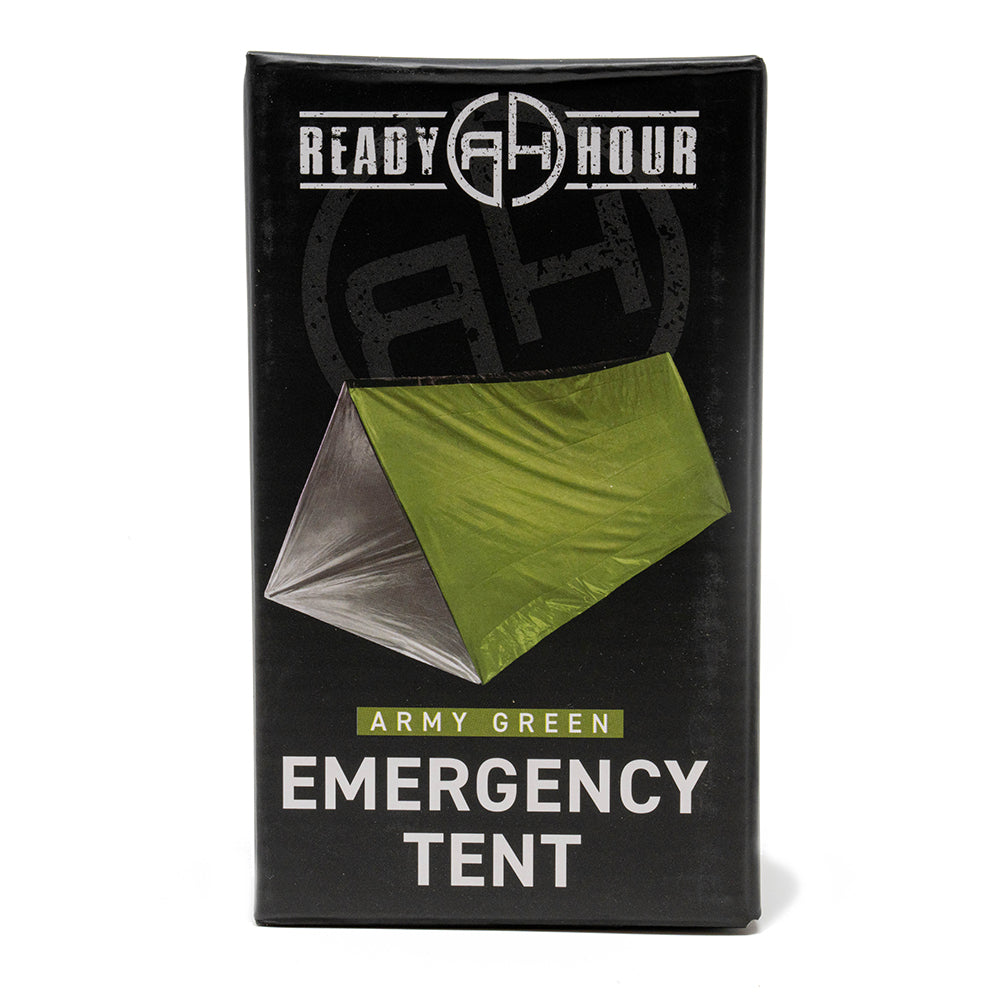
Army Green Nylon Emergency Tent with Survival Whistle by Ready Hour
- ✓Integrated whistle attachment point keeps rescue signaling gear within arm's reach while sheltering
- ✓Combined visual refuge plus audible signaling eliminates the prep gap where people carry one but not both
- ✓Lightweight nylon construction stays dry while wind-tested assembly maintains structural integrity in storm-force conditions
- ✓Green color matches woodland deployment; reflective whistle cord adds night detection capability without flashlight dependency
- ✓Compact packed size (roughly 2–3 lbs) fits vehicle emergency kits where tent plus whistle stays deployable year-round
Building Whistle Placement Strategy: Distributed Redundancy
A single whistle creates a single point of failure. If it is lost, dropped, or damaged, you have no rescue signaling capability. Two whistles—strategically positioned—solve this.
Primary whistle: On your person, attached to your belt loop, pack shoulder strap, or jacket zipper. This is the whistle you reach for in the first 10 seconds of realizing you are stranded. It must be accessible without setting down your pack or searching through pockets.
Secondary whistle: In your vehicle emergency kit, your home emergency kit, or a fixed location (cabin, vehicle, bug-out cache). This whistle covers the scenario where you are not wearing your primary kit—you arrive at a trailhead, get lost immediately, and do not have your full pack. The vehicle whistle covers the scenario where you break down on a road and need audible signaling in the first minutes before you can establish your location.
Tertiary option (if you carry a go-bag or EDC kit): A small whistle in a jacket pocket or a carabiner on your keys. This covers urban separation scenarios—you are stranded in a city, separated from your vehicle, and need to draw attention from potential rescuers in surrounding buildings or on adjacent streets.
Calculation: Two whistles cost roughly $10–15 total and weigh less than 1 ounce combined. The probability that you will lose or damage one during an actual emergency is real. A backup whistle is the most cost-efficient redundancy you can add to any survival kit.
Frequently Asked Questions
Q: How far can an emergency whistle be heard in different conditions? A: In open terrain with calm conditions, a 120dB emergency whistle carries 600–800 feet and can be detected by active rescuers up to 1,200 feet away. In wooded or urban terrain, effective range drops to 300–400 feet due to sound absorption by vegetation and structures. High background noise (traffic, machinery) reduces range further to 150–200 feet, but the whistle still cuts through ambient noise better than a human voice.
Q: Why is a whistle more effective than yelling for rescue? A: A whistle produces 120+ decibels using Helmholtz resonance through a fixed chamber, requiring minimal muscular effort and zero fatigue over extended use. Your voice at maximum output produces 80–90 decibels and causes vocal exhaustion after 15–20 minutes of sustained shouting. A whistle's 3–4 kHz frequency is the human ear's most sensitive acoustic range—it grabs attention as "intentional signaling" rather than ambient noise. You can sustain the three-blast distress pattern for 30–40 minutes; you cannot shout for 30 minutes without losing your voice.
Q: Where should you keep emergency whistles in your survival kit? A: The primary whistle must be on your person—clipped to a belt loop, pack shoulder strap, or jacket zipper—so you can access it within 5 seconds of realizing you are stranded. A whistle buried in your pack is useless. A secondary whistle belongs in your vehicle emergency kit or home kit, covering the scenario where you do not have your primary pack. Two whistles provide redundancy against loss or damage and cost under $15 total.
Conclusion
An emergency whistle is not a psychological comfort item—it is acoustic infrastructure that works through predictable physics and rescuer training. Store your primary whistle where you can reach it in seconds, learn the three-blast distress pattern, and add a backup whistle to your vehicle or home kit. The difference between being found and remaining stranded often comes down to whether you can sustain audible signaling long enough for rescuers to reach your location. Start by positioning your first whistle today.
Sources & Official Guidance
Authoritative further reading
This guide is for general informational purposes only and is not professional, medical, or safety advice. Always follow official guidance and, in a life-threatening emergency, call your local emergency number (911 in the US).
Mark Sutton, Lead Editor
Mark runs the editorial side of DoomsDayPreps. He digs into the research on emergency prep and survival gear, and checks anything safety-related against FEMA, CDC, and Red Cross guidance before it goes live.