How Solar Showers Work in Emergencies: Heating Water Without Power
Learn how solar showers work in emergencies, calculate water heating time, and why hygiene matters during disasters. Practical water heating without power.
When the grid fails, running water disappears within hours. Most preppers focus on drinking water and skip sanitation entirely—until disease becomes the real threat. A solar shower turns free sunlight into hot water without fuel, electricity, or complex equipment. This guide teaches you the physics of solar water heating, how to calculate realistic temperatures for your climate, and why thermal mass matters more than bag size.
The Physics of Solar Water Heating
Solar showers work on a single principle: solar radiation passes through a transparent material, heats the water inside, and the water cannot easily escape that heat back out. This is the greenhouse effect in miniature.
Here's the mechanism: the sun's infrared and visible light wavelengths pass through clear plastic. When that light hits the dark backing (usually black) inside the bag, it converts to heat energy. The dark material absorbs this energy and transfers it to the water surrounding it. The clear front prevents the heated air and water vapor from escaping as thermal radiation back out of the system—the plastic traps it.
The critical variable is thermal mass: the amount of water sitting in the bag. More water means a larger heat reservoir. A gallon of water requires roughly 3,500 BTUs (British Thermal Units) to raise its temperature 70°F. A solar shower in direct sun can deliver 200–400 BTUs per hour under real conditions—not peak conditions, which manufacturers sometimes claim. This means a 5-gallon solar shower in full sun can raise from 50°F to 80–90°F in 4–6 hours, depending on air temperature, humidity, and sun angle.
The angle of the sun matters. A vertical bag on the ground receives diffuse light. A bag hung at a 45-degree angle during midday captures more direct radiation. In summer, when the sun is high, the angle is steeper; in winter, it's shallower. Latitude shifts this window—a solar shower in the Midwest performs differently in January than in July.
The dark backing is not optional. Clear-only designs fail because they allow heat to radiate back out. The black (or dark blue or copper) backing absorbs wavelengths the clear front cannot block, converting them into heat that warms the water trapped against it. No dark backing means water temperature may only reach ambient air temperature plus a few degrees—useless for hygiene.
Why Hygiene Matters in Emergencies
This is not comfort. Hygiene is infection prevention.
Unwashed skin accumulates bacteria, fungi, and cellular debris. In a post-disaster scenario with no running water, limited medical access, and higher injury rates, skin infections escalate from minor to life-threatening. A wound contaminated with dirt or biofilm is exponentially harder to treat without antibiotics. Even intact skin that remains wet and unwashed breeds fungal infections within 48 hours.
Hot water (above 100°F) removes oils that trap bacteria; it also opens pores and allows soap to work effectively. Cold water can rinse, but hot water is measurably more effective at pathogen removal. In a disaster, this difference can prevent infection that antibiotics are not available to treat.
A solar shower means you can clean wounds, wash hands before food prep, and prevent the skin-to-soil transmission chain that leads to gastroenteritis and soft-tissue infections. It is cheap infrastructure against epidemic-scale problems.
Realistic Temperature Calculations for Your Climate
Stop using marketing claims. Use physics.
The baseline calculation:
Water temperature rise = (Solar irradiance × Bag surface area × Absorption coefficient × Time) ÷ (Water mass × Specific heat of water)
In plain terms: a 5-gallon solar shower (roughly 130 square inches of exposed surface) in direct sunlight receives approximately 1,000 watts per square meter on a clear day. That translates to 0.15 watts per square inch. Over 4 hours, with a dark-backed transparent bag capturing 60–70% of that energy, you're adding roughly 360–420 BTUs to 40 pounds of water. Result: a 9–11°F temperature rise above ambient. If ambient is 60°F, expect 69–71°F water.
In full sun at solar noon, with a dark-backed bag:
| Air Temperature | 4 Hours | 6 Hours | 8 Hours |
|---|---|---|---|
| 50°F | 60–62°F | 65–68°F | 70–73°F |
| 65°F | 75–77°F | 80–83°F | 85–88°F |
| 80°F | 90–92°F | 95–98°F | 100°F+ |
These are realistic, not peak. Clouds, humidity, bag angle, and water circulation affect actual results. A bag sitting flat gains less than a bag propped at 45 degrees. A translucent (milky) bag loses more heat than a crystal-clear one.
Winter performance drops dramatically. In December at 40°N latitude (Northern US), the sun angle is 26 degrees above the horizon at noon—half the summer angle. Direct irradiance is cut roughly in half, and the angle of incidence is poor. Plan for 5–10°F temperature rise in winter, not 10–15°F.
For emergency use: a solar shower is realistic for body washing, wound cleaning, and hand sanitization at temperatures above 80°F. For comfort showering—the kind that feels hot on your skin—you need 100°F+. This requires 65°F+ ambient, full direct sun, and 6+ hours. Below those conditions, it works as a passive pre-warmer (raising water from 40°F to 65°F) before mixing with a small amount of heating-fuel-warmed water.
Practical Use in Survival Scenarios
Size matters. A 5-gallon bag (40 lbs when full) is the standard. That volume is enough for two full body washes with 1-gallon per person (soap and rinse), or four face/hand washes (0.5-1 gallon each). Smaller 2.5-gallon bags heat faster but cover fewer people.
Placement: Hang the bag in open sun 6–8 hours before use, not 1–2 hours. Peak solar heating occurs 10 AM–4 PM depending on season and latitude. Fill the bag with water from your supply tank and allow it to sit undisturbed; agitation and constant circulation slow heating.
The thermometer strip matters. Printed thermometers on the bag surface show whether water has reached usable temperature (above 80°F for comfort, 100°F+ for optimal hygiene). Do not rely on feel—water that feels warm to the touch may be 75°F, insufficient for soap to work effectively.
Hygiene protocol without running water:
- Heat water in the solar shower 6+ hours in advance.
- Pour warm water into a washbasin or larger bucket.
- Submerge a cloth, apply soap, wash hands thoroughly (20+ seconds).
- Rinse with warm water.
- Repeat for face, wounds, and body as needed.
- Save rinse water for plants or secondary washing if water is scarce.
The integrated pocket for hose and toiletries reduces clutter and keeps soap accessible. Dedicated storage prevents you from hunting for supplies while standing wet in an emergency.

Arb Sol Solar Shower W/front - Pocket To Hold Hose/toiletries
- ✓Transparent front with black backing captures solar radiation through the greenhouse effect, delivering measurable temperature rise without fuel
- ✓Thermometer strip shows exact water temperature; typical 5-gallon capacity reaches 75–85°F in 4 hours at 65°F+ ambient air temperature
- ✓Integrated front pocket stores hose, soap, and washcloth—essential supplies stay accessible during camp setup or post-disaster water rationing
- ✓Dark backing prevents thermal radiation loss that clear-only bags cannot block, making temperature rise consistent across weather conditions
- ✓Compact when empty; filled 5-gallon bag weighs 40 lbs and hangs from standard rope or cord for hands-free heating during daylight hours
Honest Limitations: When a Solar Shower Fails You
A solar shower is not a shower. It is a water heater that produces small quantities of warm water.
It does not work at night. No sunlight, no heating. You need a reserve of pre-warmed water if you plan to wash after dark, or you wait until morning.
Winter rendering is real. In latitudes above 40°N (most of the northern US) from November through February, solar showers produce marginal heat. A 5-gallon bag may only reach 50–60°F after a full day, inadequate for washing. In these months, a secondary heating method (small wood fire, camp stove) becomes necessary to get water above 80°F.
Cloudy days fail. Heavy cloud cover reduces irradiance by 70–80%. A cloudy day yields 1–3°F temperature rise, not 10°F. You cannot predict clear days in advance, so solar showers are backup, not primary.
The bag is fragile. Thin plastic gets punctured, seams split under weight stress, and UV exposure degrades plastic over years. A stored solar shower will not last 20 years—expect 3–5 years of functional life before seams fail. Inspect before use every season.
It does not provide enough water for laundry. Washing clothes in a survival scenario is necessary for wound and illness prevention, but a 5-gallon solar shower cannot heat enough water for more than one small load. You need a larger heat source or accept washing clothes in cold water and drying them fully before wearing.
Who should not rely on this alone: anyone in a winter climate without backup heating, anyone with burn risk (solar showers filled with hot water can scald), anyone needing immediate water (no 6-hour lead time for heating).

ARB Trauma Pak III with Dressing and SWAT Tourniquet - Emergency First Aid Solution
- ✓Pre-assembled trauma dressing and SWAT tourniquet for control of arterial bleeding; keeps wound-cleaning supplies organized in one compact pouch
- ✓Designed for rapid deployment when hot water from a solar shower alone cannot treat an injury—addresses wounds that require direct pressure and hemostasis first
- ✓Compact 6-by-4-inch envelope fits inside a vehicle, pack, or shelter medical station alongside soap and wound rinse water
- ✓Integrated quick-release closure and color-coded components allow non-medical personnel to apply under stress
- ✓Pairs with a solar shower routine by providing immediate first aid while hot water is heating for wound irrigation and hygiene
Water Conservation in a No-Grid Scenario
One hidden benefit: a solar shower forces water consciousness. You cannot waste 50 gallons for a shower when you are heating one gallon at a time. This scarcity mindset builds realistic survival habits.
Calculation for a 3-person household over 30 days:
- Minimum: face and hand washing only = 1 gallon per person per day = 3 gallons/day = 90 gallons over 30 days
- Moderate: face, hands, and weekly full-body wash = 1.5 gallons per person per day = 4.5 gallons/day = 135 gallons over 30 days
- With wound cleaning and illness isolation hygiene = 2 gallons per person per day = 6 gallons/day = 180 gallons over 30 days
A 55-gallon emergency water supply covers the moderate scenario for one month. Two 55-gallon drums cover a household. Scale this for your household size and use.
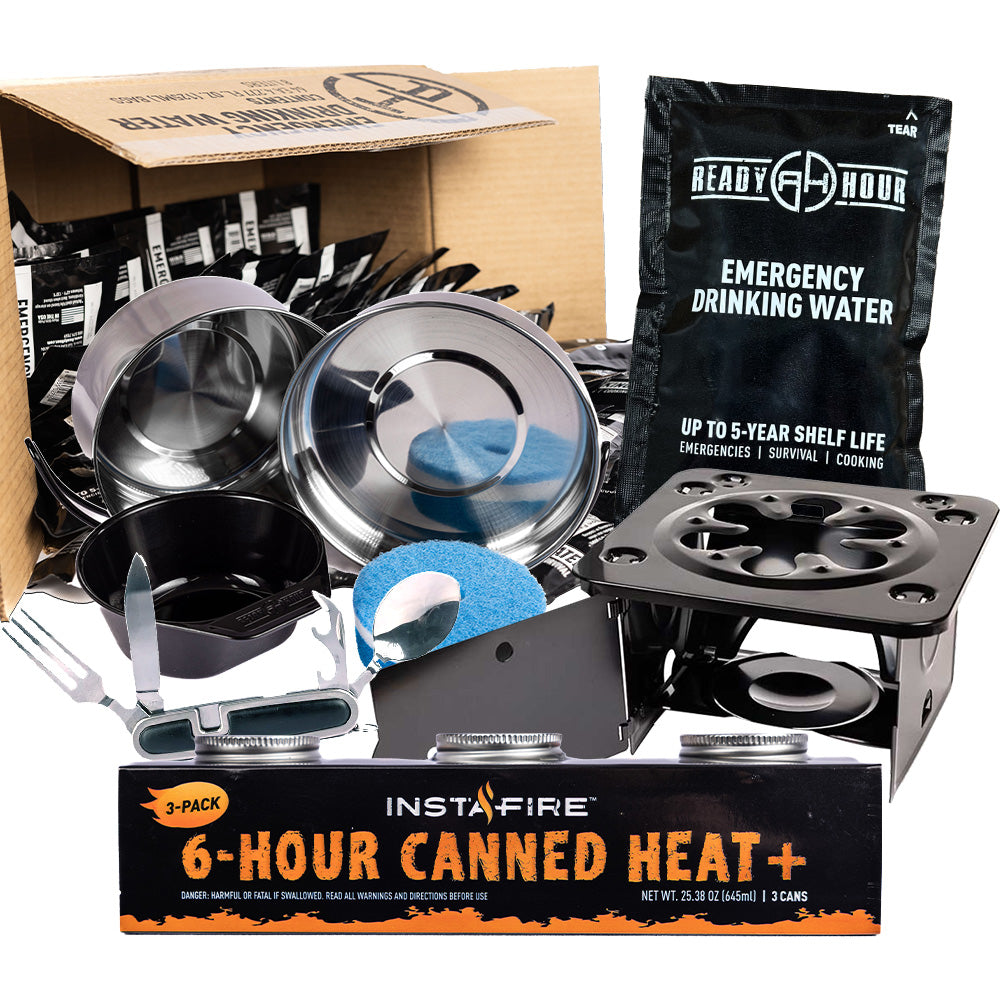
Meal Ops Kit - Everything Needed to Make Your Meals
- ✓Complete set of cooking utensils, mess kit, and food-prep tools for use with heating water from a solar shower or camp stove
- ✓Includes components for preparing meals while maintaining hand hygiene—essential when grid failure prevents conventional kitchen cleanup
- ✓Compact and portable; fits into emergency supply containers for rapid deployment to shelters or alternate living locations
- ✓Designed for off-grid cooking scenarios where hot water is limited and cleanup requires water rationing
- ✓Coordinated with emergency food plans that require boiling water or rehydration (freeze-dried meals, grains, legumes)
Setting Up a Multi-Day Solar Shower Rotation
Do not plan to use one bag continuously. Rotation prevents algae growth and thermal degradation.
Three-bag rotation system:
- Bag 1: Heating in full sun (6–8 hours)
- Bag 2: In use or cooling (ready for the next day)
- Bag 3: Stored in shade, refilled for the next rotation cycle
This system provides daily access to warm water without relying on unpredictable single-bag performance. If one bag fails, two remain functional.
Fill bags early in the day (7–8 AM) so they reach peak temperature by 2–4 PM, the window when people most need washing water. Store heated bags indoors or in an insulated container overnight to retain warmth if you plan to use them after sunset.
Frequently Asked Questions
Q: How long does it take a solar shower to heat water? A: Under full sun, a dark-backed 5-gallon solar shower reaches usable warm water (75–80°F) in 4–6 hours, depending on air temperature and starting water temperature. In direct sunlight at 65°F+ ambient, expect 10–15°F temperature rise over 6 hours. Winter or cloudy conditions extend the time to 8+ hours or render heating inadequate. Agitation slows heating; leave the bag undisturbed.
Q: Can you use a solar shower in winter or cloudy weather? A: Yes, but performance drops significantly. Cloudy days produce only 1–3°F temperature rise because cloud cover blocks 70–80% of solar irradiance. Winter (November–February above 40°N latitude) produces marginal heat due to low sun angle; a full day may yield only 50–60°F water, insufficient for effective washing without additional heating. A solar shower functions as a passive pre-warmer in winter—raising water from 40°F to 60°F—but requires a secondary heat source (fire or camp stove) to reach 80°F+ for hygiene.
Q: How much water does a typical solar shower hold? A: Standard consumer solar showers hold 5 gallons (approximately 40 lbs when filled). That volume covers two full-body washes (1 gallon per person) with soap and rinse, or four face-and-hand washes (0.5–1 gallon each). Smaller 2.5-gallon bags heat faster but serve fewer people. Larger bags (10+ gallons) exist but are harder to handle and require more time to heat.
Conclusion
A solar shower is not a luxury—it is infection prevention infrastructure. Hot water removes oils and bacteria; soap becomes effective; wounds stay clean. In a grid-failure scenario, the difference between washing regularly and not washing is the difference between health and disease outbreaks that spread through a group faster than injuries.
Your first step: buy one 5-gallon solar shower with a thermometer and integrated pocket. Test it on a sunny day before an emergency arrives. Fill it, hang it, check the temperature at 2 PM, 4 PM, and 6 PM. Write down the actual numbers for your location and season. Use this real data, not marketing specs, to plan how much reserve water you need and when you will use it. Then buy a second bag for rotation.
Sources & Official Guidance
Authoritative further reading
This guide is for general informational purposes only and is not professional, medical, or safety advice. Always follow official guidance and, in a life-threatening emergency, call your local emergency number (911 in the US).
Mark Sutton, Lead Editor
Mark runs the editorial side of DoomsDayPreps. He digs into the research on emergency prep and survival gear, and checks anything safety-related against FEMA, CDC, and Red Cross guidance before it goes live.

