How to Calculate Emergency Food Calories Per Day for Your Household
Learn how to calculate emergency food needs by calorie intake. Calculate servings for your household, understand shelf life, and build a kit that actually lasts
Most people buying emergency food kits guess at quantity and end up with either too little to sustain anyone or surplus that expires unused. The math is simple once you know the baseline: an adult needs roughly 2,000 calories per day at rest, but that number changes based on age, activity level, and your specific emergency scenario. This guide teaches you how to calculate your household's actual calorie need, determine the right kit size, and understand what "52 servings" or "100 servings" actually means in terms of days of food for your family.
The Calorie Baseline for Emergency Food Planning
Caloric need depends on age and activity level. The USDA establishes these daily requirements:
- Adult males (19–50): 2,400–2,600 calories per day
- Adult females (19–50): 1,800–2,000 calories per day
- Children ages 4–8: 1,200–1,400 calories per day
- Teenagers ages 9–18: 2,000–2,800 calories per day depending on sex and activity
In a survival situation, activity may be higher (hauling water, managing power, repairs) or lower (sheltering in place during lockdown). A reasonable assumption for emergency planning is 2,000 calories per person per day as the baseline, then adjust upward if your household includes multiple teenagers or if your scenario involves physical labor.
The mechanism is straightforward: calories are the unit of energy your body needs to maintain core temperature, immune function, and physical movement. Underfeed a person by 500 calories daily and by day 7 they are fatigued and cognitively impaired. At 1,000 calories per day, decline accelerates. Emergency food kits solve this by delivering shelf-stable, calorie-dense meals that require minimal water and fuel preparation.
How to Calculate Total Days of Food for Your Household
Here's the math you'll repeat for every kit:
Step 1: List your household. Example: 2 adults, 1 child (age 6)
Step 2: Assign daily calorie needs.
- Adult 1: 2,000 cal/day
- Adult 2: 2,000 cal/day
- Child: 1,300 cal/day
- Total: 5,300 calories per day for your household
Step 3: Choose your supply duration. Most emergency planners target 30 days as a minimum, though 90 days is more realistic for extended power loss, supply chain disruption, or job loss. Let's calculate both:
- 30-day supply: 5,300 cal/day × 30 days = 159,000 calories total
- 90-day supply: 5,300 cal/day × 90 days = 477,000 calories total
Step 4: Check kit calorie density. Emergency food kits label servings, not total calories. Each serving typically ranges from 180–250 calories depending on the meal type. If a kit states "52 servings" and averages 200 calories per serving:
- 52 servings × 200 cal/serving = 10,400 calories per kit
- To reach 159,000 calories (30-day household supply): 159,000 ÷ 10,400 = 15.3 kits (round to 16)
- To reach 477,000 calories (90-day supply): 477,000 ÷ 10,400 = 45.9 kits (round to 46)
This is why a single kit marketed as "emergency food for a family" is misleading—it supplies roughly 2–3 days at 2,000 cal/day per person, not a month.

52 Serving Prepper Bucket - ReadyWise Emergency Meal Kit for Survival and Preparedness
- ✓Freeze-dried meals retain 97% of nutrients and require only hot water—no fuel-intensive cooking in power outages
- ✓52 servings × ~200 calories = approximately 10,400 calories per bucket; a household of four needs 16 buckets for 30 days at 2,000 cal/day
- ✓Designed for scenarios where you cannot access stores—hurricanes, blizzards, supply disruptions, or job loss lasting weeks
- ✓Meals are pre-portioned and shelf-stable for 25+ years at room temperature, eliminating the need to rotate or calculate yield loss
- ✓Stackable 5-gallon bucket format stores in basements, closets, or vehicles; each bucket weighs approximately 20–22 lbs (9–10 kg)
Storage Conditions: Why They Matter to Your Math
Shelf life claims—"lasts 25 years"—are only valid under specific conditions. Most emergency food kits assume storage at 50–70°F with humidity below 15%. Every 10°F increase above 70°F cuts shelf life roughly in half due to oxidation and moisture migration. If you store in an attic reaching 100°F during summer, or a damp basement, your effective shelf life is 10–15 years, not 25.
This matters to your calculation because it determines your rotation schedule. A 90-day kit stored in ideal conditions might last a generation. The same kit in a garage subject to seasonal temperature swings requires replacement every 10–12 years. Plan to mark purchase dates on your buckets and rotate stock every decade at minimum, sooner if stored in warm or humid conditions.
Freeze-dried meals (used in most commercial emergency kits) retain nutritional quality better than dehydrated during long storage because the moisture removal happens at low temperature, preserving vitamins. However, once opened, freeze-dried food absorbs moisture from the air rapidly—a opened bucket loses quality within 30 days. Store opened servings in airtight containers with oxygen absorbers.
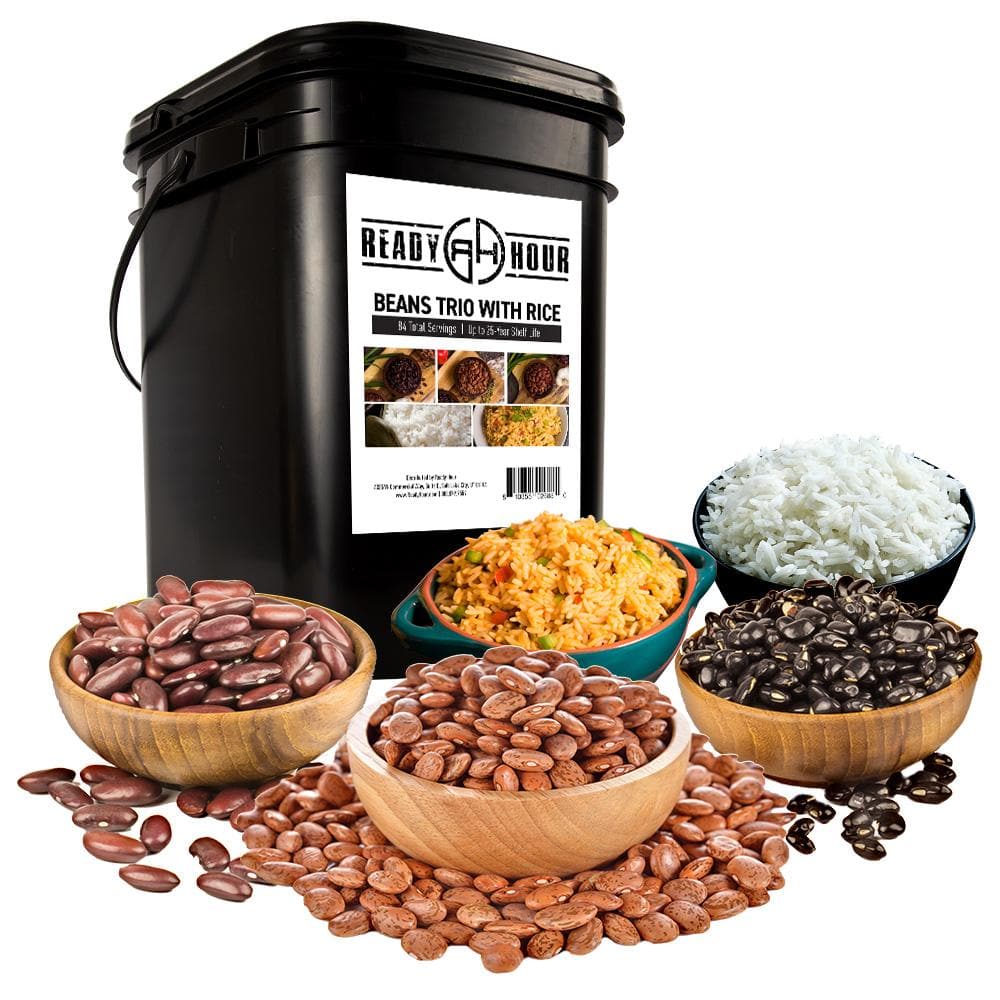
Beans Trio & Rice Kit (14 pouches, 100 servings)
- ✓Dried beans and rice are calorie-dense staples: 1 cup cooked beans ≈ 225 calories; 1 cup cooked rice ≈ 200 calories—a high-carbohydrate, low-fat alternative to freeze-dried meals
- ✓100 servings × ~170 calories per serving = approximately 17,000 calories; paired with a freeze-dried kit, this extends your supply without doubling purchase cost
- ✓Ideal for extended-duration scenarios (90+ days) where repetition of the same freeze-dried meals becomes monotonous and morale matters
- ✓Requires cooking (20–30 minutes for beans, 15–20 for rice) but uses less water than instant meals—useful if fuel is scarce but cooking capability exists
- ✓14 individual pouches allow selective rotation and storage in multiple locations; unopened pouches last 25+ years in cool, dry conditions
The Hidden Cost: Calories Burned During Emergencies
The 2,000-calorie baseline assumes sedentary conditions. If your emergency involves physical labor—clearing debris, hauling water, managing heating systems, or traveling—calorie needs rise to 2,500–3,500 per person per day. A person clearing snow burns roughly 400 calories per hour. A person hauling water or wood for heat burns 250–350 per hour.
Revise your calculation upward if your scenario includes:
- Winter weather (heating, shoveling)
- Flood or damage cleanup
- Water hauling or rationing (requires repeated trips)
- Childcare with no assistance (constant movement and stress)
If your household will face moderate physical activity, increase the baseline from 2,000 to 2,500 calories per person. This pushes the 30-day supply from 159,000 calories (example household) to 198,750 calories, requiring 19 kits instead of 15. The difference is the margin between adequate energy and depletion.
Honest Limitations: What Emergency Food Kits Cannot Do
Freeze-dried meal kits are calorie-dense but lack certain macronutrient diversity. Most are high in carbohydrates and sodium, lower in fiber and fat-soluble vitamins (A, D, E, K). A person subsisting on freeze-dried meals alone for 90 days will meet calorie and basic nutrient needs but may experience:
- Constipation (low fiber unless supplemented with canned vegetables)
- Dry mouth and thirst (high sodium meals increase water need)
- Fatigue despite adequate calories (if vitamin stores deplete)
These are not deal-breakers, but they mean a 90-day kit should include supplementary dried vegetables, canned fruits with syrup, and multivitamins. A pure freeze-dried diet works for 2–3 weeks without supplement; beyond that, add variety.
Additionally, freeze-dried meals are not suitable for infants under 12 months (texture and salt content) or people with severe gastroparesis or swallowing disorders (require softer, more processed food). Beans-and-rice kits are lower sodium but require fuel and 20–40 minutes of cooking time—not practical if you have no working stove or fuel source.

ReadyWise Adventure Meals Favorites Kit - For Emergency Food Supply and Outdoor Adventures
- ✓Meal variety (breakfast, lunch, dinner options) maintains morale during extended confinement and prevents taste fatigue that reduces eating and calorie intake
- ✓Multiple entree styles (soups, pastas, rice bowls) provide variety while maintaining freeze-dried preservation and 25+ year shelf life
- ✓Useful for both emergency sheltering and outdoor activities—allows you to test meals and storage before relying on them during crisis
- ✓Smaller kit format lets you store diverse flavors in multiple locations without committing to 16+ identical buckets for long-term supply
- ✓Each meal rehydrates in 5–10 minutes with boiling water, fitting scenarios where fuel is limited or time is critical
Frequently Asked Questions
Q: How many calories per day do you need in an emergency food kit? A: An adult at rest needs 2,000 calories per day; increase to 2,500–3,500 if the emergency involves physical labor (hauling water, repairs, cleanup). Children ages 4–8 need 1,200–1,400 calories per day. Use your household's actual composition—don't use an average. Multiply daily calories by your target duration (30, 90, or 365 days) to calculate total kits needed.
Q: How long should an emergency food supply last for a family of four? A: The minimum is 30 days; realistic is 90 days for scenarios like extended power loss, job loss, or supply disruption. A family of four (two adults, two children ages 4–8) burning 5,300 calories per day needs 159,000 calories for 30 days or 477,000 for 90 days. At 10,400 calories per bucket, that's 16 buckets for one month or 46 for three months. Start with 30 days and expand as budget allows.
Q: What's the difference between freeze-dried and dehydrated emergency food? A: Freeze-dried removes moisture via sublimation at low temperature, preserving nutrients and flavor; rehydrates in 5–10 minutes and lasts 25+ years. Dehydrated removes moisture via heat, is heavier, requires longer cooking, but costs less. Beans and rice are dehydrated; most commercial emergency kits are freeze-dried. For short-term (2–4 weeks) use, either works; for 90+ days, freeze-dried reduces monotony and prep time when morale and fuel matter most.
Next Step: Inventory Your Current Supplies
Calculate your household's baseline calorie need today—don't wait until a crisis. Write down ages, typical activity levels, and any dietary restrictions. Multiply daily calories by 30, then divide by the calorie content of kits you're considering. This single calculation determines how many units to buy and whether a 30-day, 90-day, or year-long supply is realistic for your budget.
Start with one complete 30-day kit for your household. Test one meal to confirm palatability and rehydration time. Then order additional kits to extend to 90 days. This staged approach prevents buying 46 buckets of food your family won't eat and lets you adjust quantities based on what works.
Sources & Official Guidance
Authoritative further reading
This guide is for general informational purposes only and is not professional, medical, or safety advice. Always follow official guidance and, in a life-threatening emergency, call your local emergency number (911 in the US).
Mark Sutton, Lead Editor
Mark runs the editorial side of DoomsDayPreps. He digs into the research on emergency prep and survival gear, and checks anything safety-related against FEMA, CDC, and Red Cross guidance before it goes live.

