Solar Battery Expansion for Emergencies: Stack Systems to 16,384Wh
Learn how to expand solar battery capacity for grid-down scenarios. Calculate runtime, stack systems, and build true energy independence without overbuying.
When the grid fails, a single battery has limits. Most households discover too late that their backup system can't sustain even one appliance long enough to matter. Solar battery expansion changes this calculation entirely—you stop worrying about whether your system is big enough and start building capacity that actually matches your household's real demand.
This article teaches you the math of stacking solar batteries, how to size an expanded system for your specific appliances, and the mechanics that make modular expansion work. By the end, you'll know exactly how many days of power your home can sustain and what the cost-per-kilowatt-hour difference is between stacking and starting over.
How Modular Battery Stacking Works—The Mechanics
A modular battery system gains its flexibility from parallel connection architecture. When you stack two battery units in parallel, you do not increase voltage; you double the ampere-hour (Ah) capacity. This matters because it changes total energy available, not peak output.
Here's the principle: A single 3,300Wh battery can deliver power at its rated capacity until depleted. Connect a second 3,300Wh unit in parallel—using dedicated expansion ports and matching cable gauges—and your system now holds 6,600Wh. The voltage stays constant (usually 48V in modular solar systems), but the duration you can draw at any given wattage doubles.
This is different from series connection, which increases voltage but is rarely used in residential emergency backup because it complicates charge controller matching and creates safety hazards if batteries are mismatched in age or state of charge.
Parallel stacking works because each battery module includes its own internal management: balancing circuits that equalize charge across all units, temperature monitoring, and over-current protection. The system "knows" it is expanded and distributes load intelligently across all stacks.
The decisive advantage is this: you can expand after installation. A fixed system forces you to buy peak capacity upfront, even if you do not need it for three years. A stackable system lets you add capacity when you acquire the budget or when experience shows you need more runtime.
Calculating Your Expansion Needs—The Math You Can Repeat
Start with your essential loads during an outage. Not your whole house—the appliances you actually need to survive and function.
Step 1: List your critical devices and their wattages.
- Refrigerator: 150W running (not peak startup)
- Sump pump: 800W (runs 15 minutes every 6 hours)
- LED lighting (5 bulbs): 50W total
- Laptop or small work device: 65W
- Phone/device charging: 20W
- Medical device (CPAP, oxygen concentrator, etc.): 30–100W (if applicable)
Step 2: Calculate daily watt-hours for a 24-hour cycle. If your fridge runs 8 hours per day: 150W × 8h = 1,200Wh. If your sump pump runs 60 minutes total: 800W × 1h = 800Wh. Lighting 6 hours: 50W × 6h = 300Wh. Laptop 4 hours: 65W × 4h = 260Wh. Charging: 20W × 8h = 160Wh. CPAP (if needed) 8 hours: 50W × 8h = 400Wh.
Total daily essential load = 3,120Wh per day.
Step 3: Determine how many days you need to sustain without sun. In a winter grid-down scenario in the northern US, you might have only 4–5 useful sun hours daily. If your solar panels generate 800Wh on a good day but your load is 3,120Wh, you have a deficit of 2,320Wh that battery must cover.
For a 3-day scenario with no sun (winter storm, grid repair delay): 3 days × 3,120Wh = 9,360Wh minimum.
Step 4: Apply the 80% rule. Lithium batteries should not be regularly discharged below 20% state of charge (to preserve lifespan). So you need 9,360Wh ÷ 0.80 = 11,700Wh of total battery capacity.
One 3,300Wh battery covers only 28% of that need. Three units stacked provide 9,900Wh (still short). Four stacked units = 13,200Wh, which exceeds your 11,700Wh requirement and gives you a real 4-day buffer.
| Configuration | Total Capacity | 3-Day Sustain | Days Usable |
|---|---|---|---|
| 1 unit (3,300Wh) | 3,300Wh | No | 1 day max |
| 2 units (6,600Wh) | 6,600Wh | No | 2 days |
| 3 units (9,900Wh) | 9,900Wh | Marginal | 3 days tight |
| 4 units (13,200Wh) | 13,200Wh | Yes | 4+ days safe |
The calculation is repeatable: your load in Wh/day, times the number of sunless days you prepare for, divided by 0.80, gives you the battery capacity to buy.
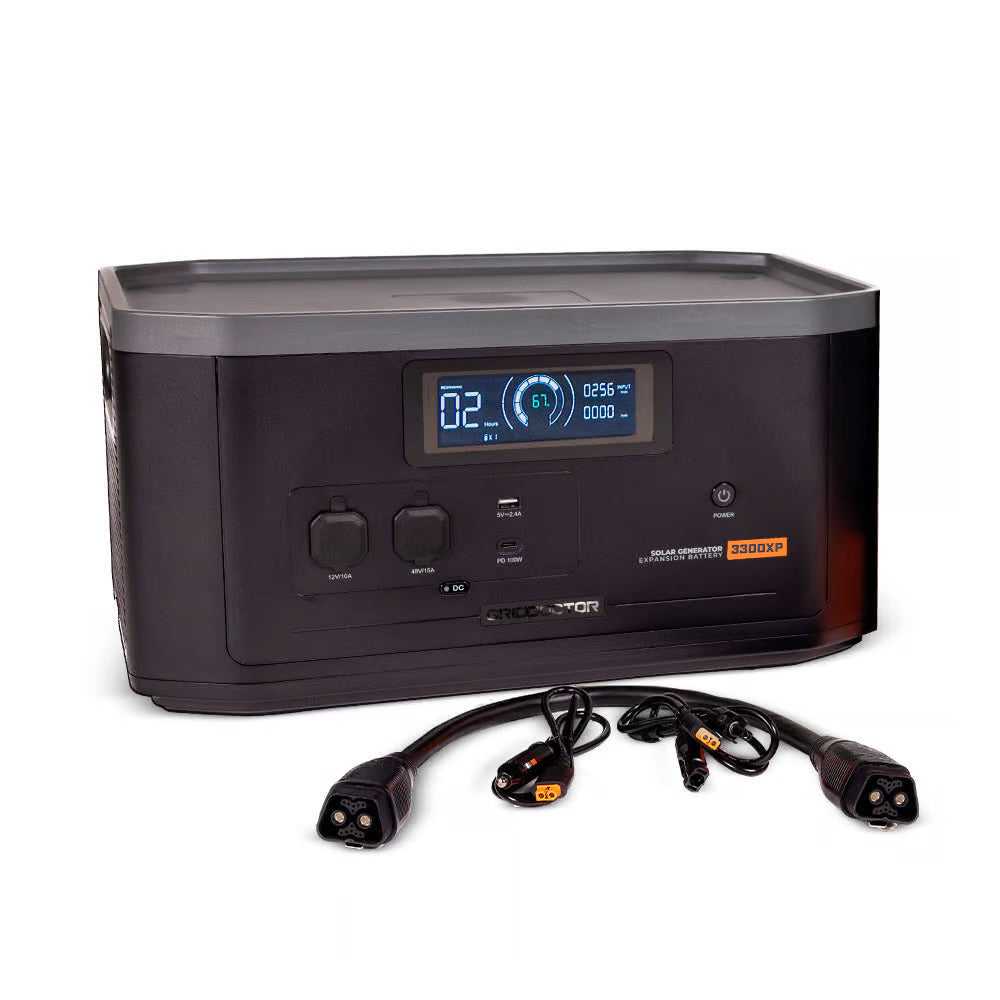
3300XP Expansion Battery Kits for the 3300 & 2200 Solar Generation Systems by Grid Doctor
- ✓Parallel architecture doubles capacity per stack without increasing voltage—critical for maintaining charge controller and inverter compatibility
- ✓Each 3,300Wh unit stacks up to 7 deep for 23,100Wh maximum; realistic 4-stack configurations deliver 13,200Wh, covering 4+ days of essential home loads at 3,120Wh/day consumption
- ✓Common prepper scenario: winter grid outage with 4-5 sun hours daily; 4 stacked units bridge 3-day deficit periods until solar recharges during day
- ✓Expansion ports on each unit prevent daisy-chain cable runs and voltage drops that plague DIY parallel systems
- ✓Compact dimensions (24" × 13" × 10" per unit) allow closet, garage, or basement storage without major renovation; stacked footprint stays under 4 sq ft for full 4-unit system
What Expansion Cannot Do—The Honest Limits
Stacking batteries does not increase your solar charge rate. If you have a 200W solar panel charging a single 3,300Wh battery, that same 200W panel still charges at the same amps-per-hour whether you have 1 or 4 batteries stacked behind it. The panel's output is determined by sunlight and panel wattage, not battery size.
This means expanding your battery from 3,300Wh to 13,200Wh without adding solar capacity creates a new bottleneck: recharge time. A single 200W panel might fully charge one battery in one sun-rich day. That same panel takes 4 days to fully recharge 4 stacked batteries if your household is consuming power during the day. You are not gaining days of autonomy—you are gaining duration only if you have enough solar input.
Stacking also will not help if your peak loads spike beyond the system's inverter rating. If you try to run a 240V hardwired air conditioner or well pump that draws 3,000W, the system's inverter (typically 3,000–4,000W continuous) will shut down—more batteries cannot fix an undersized inverter. Expansion solves energy capacity, not power output.
Cold weather reduces battery usable capacity by 10–20%, depending on temperature. A 13,200Wh system rated at 80% usable becomes 10,560Wh in freezing conditions. If your home is in a cold climate, factor this into your expansion calculation; do not assume summer-rated capacity for winter scenarios.
Pairing Expansion with Adequate Solar Input
The second bottleneck—recharge speed—is real. To match your 13,200Wh expanded capacity with realistic recharge, you need more solar input than a single 200W panel provides.
Basic calculation:
- 13,200Wh battery needs recharge in one day under cloudy conditions
- Available sun hours in winter: 4–5 hours
- Required solar wattage: 13,200Wh ÷ 4.5 hours = 2,933W output needed
- Account for 75% real-world efficiency (angle losses, temperature derating): 2,933W ÷ 0.75 = 3,911W panel capacity minimum
A single 200W panel outputs only 150W in real conditions. You would need approximately 26 × 200W panels to fully recharge 4 stacked batteries in one winter day. That is not practical for most homes.
More realistic: use 600–800W of installed solar (three to four 200W panels) to charge your 4-stack system in 1.5–2 days during average weather. This trades full autonomy for practical rebuild. During clear weather, 2–3 days of battery covers the recharge gap. During extended cloud cover, your runtime shrinks to 2–3 days instead of 4, but you accept that trade for reasonable panel count.
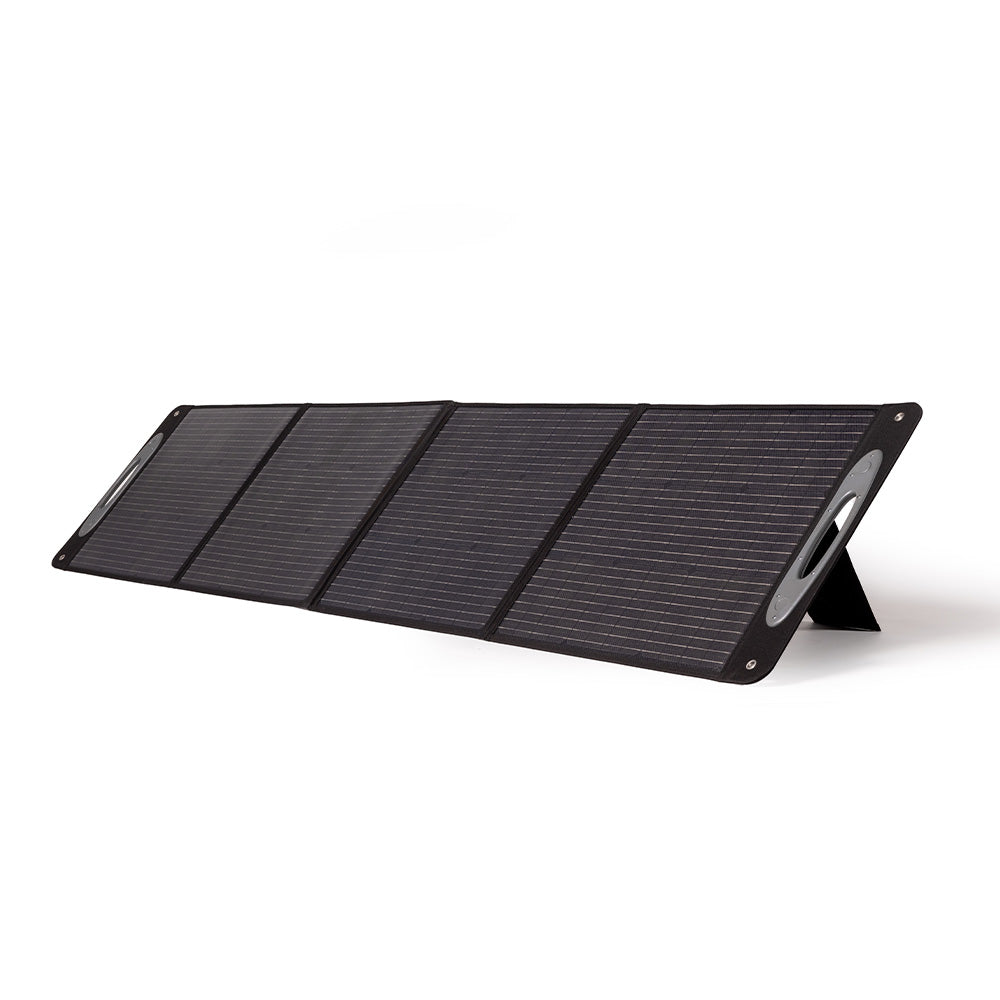
200W Waterproof Solar Panels by Grid Doctor for the 3300 & 2200 Solar Generator Systems
- ✓200W output per panel integrates with existing charge controllers on Grid Doctor systems; 3–4 panels (600–800W) realistically recharge 4-stack battery expansion in 1.5–2 days under average cloud cover
- ✓Waterproof IP67 rated design survives roof, ground, or mobile mounting through harsh seasons without corrosion
- ✓Matches voltage output of 3300/2200 series—no controller reprogramming or compatibility issues when adding panels to an expanded system
- ✓Fixed tilt mounts (included) allow 30–45° angle adjustments for seasonal sun height; proper angle increases winter output by 15–20% versus flat mounting
- ✓Each additional 200W panel adds roughly 1,000–1,200Wh daily recharge (winter baseline), directly reducing battery depletion during extended outages
Expansion Strategy—What Most People Get Wrong
The common mistake is buying expansion capacity all at once, then discovering your actual load is half what you assumed. You end up with 13,200Wh of idle battery, paying interest on money you did not need to borrow.
A better sequence: start with your core system and one 3,300Wh battery. Run it through a month of power-conscious operation (refrigerator off at night, lighting only when needed, no phantom loads). Measure actual consumption. If you hit 50% depth of discharge during your worst day, add a second stack. If you stay above 60% charge, you have enough.
After three months of real data, you know whether you need 2, 3, or 4 stacks for your household. This costs the same money but prevents overspending on capacity you never use.
The second mistake is forgetting that expansion requires matching cable gauges and breakers. A 3,300Wh battery outputs current through the charge controller. Adding a second battery in parallel does not automatically change the cable size—too-small cables create heat and voltage drop. The expansion kit includes correctly sized cabling, but DIY parallel connections often do not. This is a silent failure: the system works but loses 10–15% efficiency in the cables before power reaches your home.
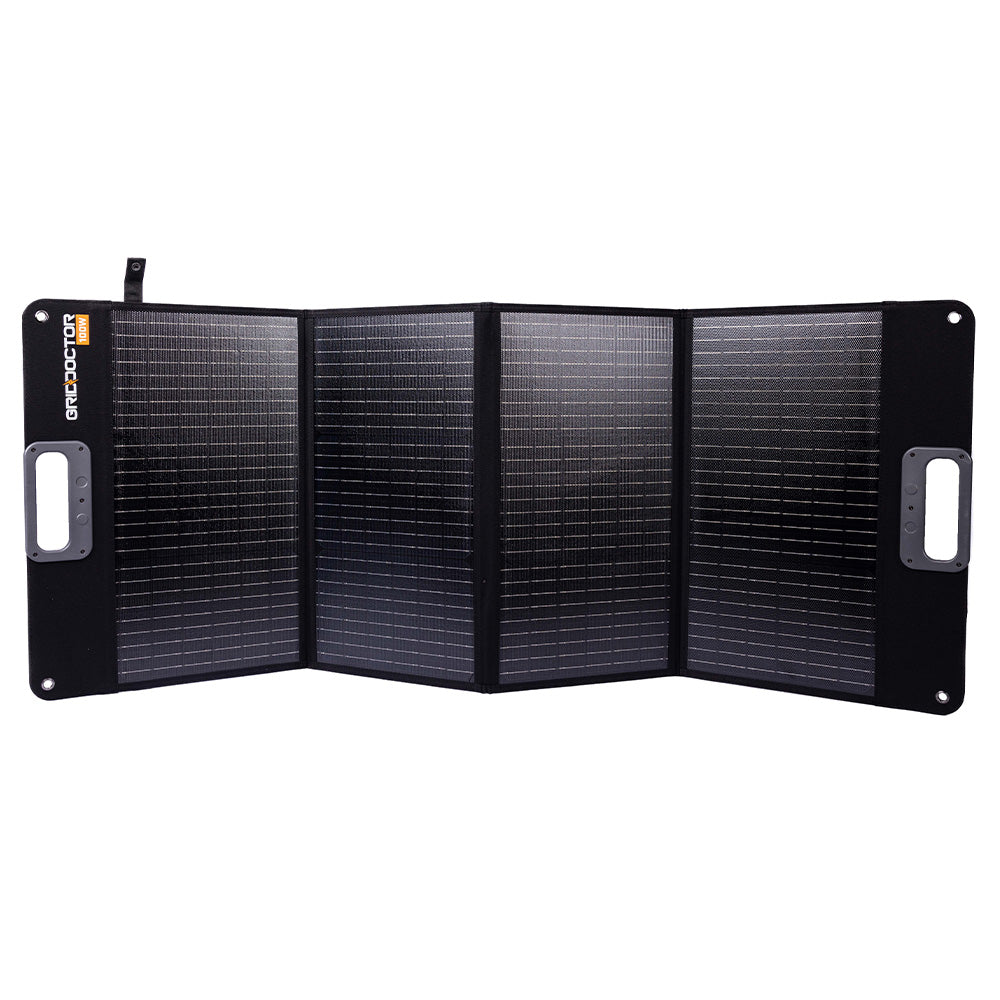
100W Solar Panel for the 300 Solar Generator System by Grid Doctor
- ✓100W output ideal for smaller systems or secondary location backup; outputs 500–600Wh daily in winter, 900–1,100Wh in summer—useful for charging devices or topping off batteries during low-draw days
- ✓Compact 48" × 26" footprint suitable for RV, camper, or small shed mounting without roof reinforcement
- ✓Paired with expansion batteries, a single 100W panel extends battery lifespan by reducing depth of discharge during clear days when loads are light
- ✓Same voltage and controller compatibility as 200W panels—stack as needed for modular solar growth
Frequently Asked Questions
Q: How many days can a stacked solar battery system run essential loads? A: With 4 stacked 3,300Wh units (13,200Wh total) and a 3,120Wh/day essential load, you sustain approximately 4 days at 80% usable capacity before needing solar recharge. Add 600W of solar panels and you can sustain indefinitely during average weather—recharge takes 1.5–2 days, meaning a 4-day buffer covers most outages. Cold weather reduces this to 3–3.5 days usable; factor this into your scenario planning.
Q: What's the real difference between stacking batteries and buying one large unit? A: Stacking costs less upfront (buy one, add later), allows incremental testing of your real load, and provides modularity if one unit fails (3 units still work at reduced capacity). A single large battery is more efficient (one set of cables, one inverter circuit) but forces you to guess capacity correctly and tie up capital immediately. For most preppers, stacking is the smarter financial choice.
Q: Can you connect solar panels to an expanded battery system, or do you need a new charge controller? A: Most charge controllers have a maximum input rating (e.g., 100A @ 48V). Adding batteries in parallel does not change this limit—the charge controller still controls the panels. However, adding more solar panels (a second 200W panel) requires checking that your total panel wattage stays within the controller's input specification. The Grid Doctor systems are designed to support 3–4 panels (600–800W) with the standard controller. Beyond that, you may need a second controller, which most expansion systems do not anticipate. Check your controller's manual before adding more than 400W of new solar.
The Action You Should Take Now
Measure your actual household consumption today, while the grid is up. Plug a kill-a-watt meter into your refrigerator overnight, track your lighting runtime, note your medical devices. Write the numbers down. Do not guess.
Once you have real data, use the 3,120Wh example in this article as a template—modify it for your actual loads and your local winter sun hours. Calculate how many days of grid-down you need to sustain, then work backward to the battery stack size you actually need. Start with one or two units. Add a third and fourth only after you have lived with the system through a season and confirmed your calculations.
This disciplined approach keeps you from overspending and ensures your expanded system matches what you actually do in an emergency, not what you imagine you will do.
Sources & Official Guidance
Authoritative further reading
This guide is for general informational purposes only and is not professional, medical, or safety advice. Always follow official guidance and, in a life-threatening emergency, call your local emergency number (911 in the US).
Mark Sutton, Lead Editor
Mark runs the editorial side of DoomsDayPreps. He digs into the research on emergency prep and survival gear, and checks anything safety-related against FEMA, CDC, and Red Cross guidance before it goes live.