Solar Generator for Emergency Power: Calculate Your Real Needs
Learn how solar generators work, calculate your actual power needs, and avoid costly mistakes. Includes battery math and wattage planning.
A power outage lasting just three days can render most homes uninhabitable without a backup plan. Unlike gasoline generators, solar generators operate silently, require no fuel storage, and work indoors without carbon monoxide risk—but only if you understand what wattage you actually need and how to match it to your devices. The difference between a generator that runs your critical loads and one that sits idle because you undersized it comes down to one calculation most people skip.
How Solar Generators Work—and Why Wattage Matters More Than Capacity
A solar generator has two critical ratings: wattage capacity (how much power it can deliver at one moment) and watt-hour capacity (how much energy it stores total). Most preppers focus only on the second number. That's a mistake.
Your refrigerator might need 600 watts to start (the compressor motor surge) but only 150 watts to run continuously. A solar generator with 2,000Wh capacity but only 1,500-watt output cannot start that fridge, no matter how much energy sits in the battery. The wattage limit is the hard ceiling—capacity is how long you can run before it drains.
The internal lithium battery stores energy as amp-hours (Ah) at a rated voltage. A 100Ah battery at 48 volts = 4,800Wh. When you draw power, the inverter converts that DC stored energy into 120V or 240V AC current. The inverter's wattage rating determines the maximum continuous load it can support. Surge capacity (peak wattage for 1–2 seconds) is separate and higher, which is why a generator can briefly power a device that requires a motor startup surge.
This matters in a blackout because you'll want to run multiple devices—lights, phone charger, a small heater, a radio. If your generator maxes out at 2,000 watts and your space heater draws 1,500 watts, you cannot simultaneously charge a laptop (100 watts) or run LED lights (50 watts). You must choose: heat or charge.
The second critical principle: depth of discharge. Lithium batteries last longest when you cycle them between 20% and 80% charge, not 0% to 100%. A 3,300Wh generator you fully drain and fully recharge daily will degrade faster than one you keep in the 20–80% window. In real emergencies, you're drawing power continuously, which naturally pulls it down. Understanding that your usable capacity is often closer to 70% of the advertised figure (if you want the battery to survive multiple years of use) changes your sizing decision.
Calculate Your Actual Power Needs—The Math You Cannot Skip
Start by listing every device you need during a grid-down scenario.
| Device | Wattage | Daily Hours | Daily Wh |
|---|---|---|---|
| LED lights (4 bulbs × 10W) | 40 | 8 | 320 |
| Phone + tablet charging | 25 | 2 | 50 |
| Refrigerator (running, not startup) | 150 | 24 | 3,600 |
| Laptop | 65 | 4 | 260 |
| Small space heater | 750 | 6 | 4,500 |
| Radio/communications | 5 | 12 | 60 |
| Total | — | — | 8,790Wh |
This household burns through 8,790Wh in one day. A single 3,300Wh generator covers only 37% of that demand. If you're not running the heater simultaneously with the refrigerator (you control the load), you can sequence loads throughout the day: refrigerator runs all the time, heater runs for 6 hours, other devices fill gaps. That works for one day, but a three-day outage requires either (a) solar panels to recharge the battery during daylight, or (b) multiple batteries.
The refrigerator is the anchor load—it must run 24/7 to prevent food spoilage. That alone is 3,600Wh daily. Everything else is negotiable.
Peak wattage is separate from daily consumption. A space heater drawing 750 watts requires a generator with at least 750-watt continuous output (plus headroom for surge). A refrigerator with a 600-watt startup surge requires 600-watt surge capacity. Most modern solar generators handle this with rated continuous watts and peak/surge watts listed separately.
Solar Panel Recharge Rate—Why Size Matters
A 200W solar panel in ideal conditions (direct sun, 45-degree angle, clear sky) produces approximately 200 watts of DC power flowing into the battery. But "ideal conditions" occur for maybe 4–6 hours on a clear day. Cloud cover reduces output by 50–80%. Winter sunlight is weaker and lower in the sky.
Real-world math: 200W panel × 5 peak sun-hours (PSH) = 1,000Wh recharged per day under good conditions.
Applying this to your scenario—if you drew 3,300Wh from a generator and then got one full sunny day, a single 200W panel recharges only 1,000Wh back. You need 3.3 panels to return to full charge in one day. With one panel, you recover about 30% daily if weather holds. Two panels get you to 60%. Three panels let you operate in a repeating cycle on sunny days.
This is why the bundle includes a free 200W panel but many preppers add more—not for vanity, but because 200W is the minimum to sustain small loads indefinitely. Bigger loads or longer cloudy periods require more panels.
Charge time calculation:
- 3,300Wh battery discharged to 20% = 2,640Wh usable capacity remaining
- 200W panel at 5 peak sun-hours = 1,000Wh input per day
- To charge from 20% to 80% (2,640Wh needed), you'd need 2.6 full-sun days with one panel in good conditions
In reality, winter conditions and clouds mean 3–5 days of slow trickle charging. That's still infinitely better than a gasoline generator that needs fuel you may not have.

3300 Solar Generator System w/ EMP Intercept Technology + FREE Waterproof 200W Solar Panel by Grid Doctor
- ✓Uses a 48V lithium battery core with 3,300Wh nominal capacity; internal charge controller optimizes input from solar panels and wall power
- ✓Rated 3,000W continuous output with 6,000W surge capacity; reaches usable 2,640Wh at 20–80% depth of discharge for long battery lifespan
- ✓Dual 120V/240V outlets power refrigerators, space heaters, and multiple devices simultaneously; compatible with most residential circuits during grid-down scenarios
- ✓Built-in EMP intercept shielding protects the internal electronics from electromagnetic pulse events; many generators lack this layer of protection
- ✓Includes one waterproof 200W solar panel; expandable to 600W+ by connecting additional panels through the proprietary connector; sealed casing withstands weather storage
What a Solar Generator Cannot Do—Honest Limitations
A solar generator cannot power a central air conditioning system. AC units draw 3,500–5,000 watts continuously and require 240V three-phase power or full-home backup. Neither is practical from a portable unit. If cooling is critical (heat-sensitive medications, infant care), you must plan differently—shade, evaporative cooling, or relocating to a cooler location.
A well pump requires instantaneous high wattage to start the motor. If you have a deeper well with a larger pump, the surge can exceed 2,500 watts. Shallow wells with smaller pumps (under 1 HP) are manageable. Before betting on a generator for water, test your actual well's startup draw.
A solar generator will not output at rated capacity in cold weather. Lithium batteries lose voltage when cold and charge far more slowly. In winter or if your generator sits outside, expect 30–50% capacity loss at temperatures below 40°F. You must keep the unit in a climate-controlled space or accept seasonal performance degradation.
EMP protection is real but not perfect. Shielding reduces risk, but no single device guarantees immunity. A hardened EMP bunker with multiple faraday cages provides stronger protection than a generator case alone. However, a shielded generator is demonstrably better than one with no protection if an EMP event occurs.
A solar generator cannot sustain indefinite power consumption. Once the battery is depleted and the sun is down, you have no output. This is why realistic load planning and panel quantity matter—you must match your daily consumption to what the panel can recharge in the season where you live.
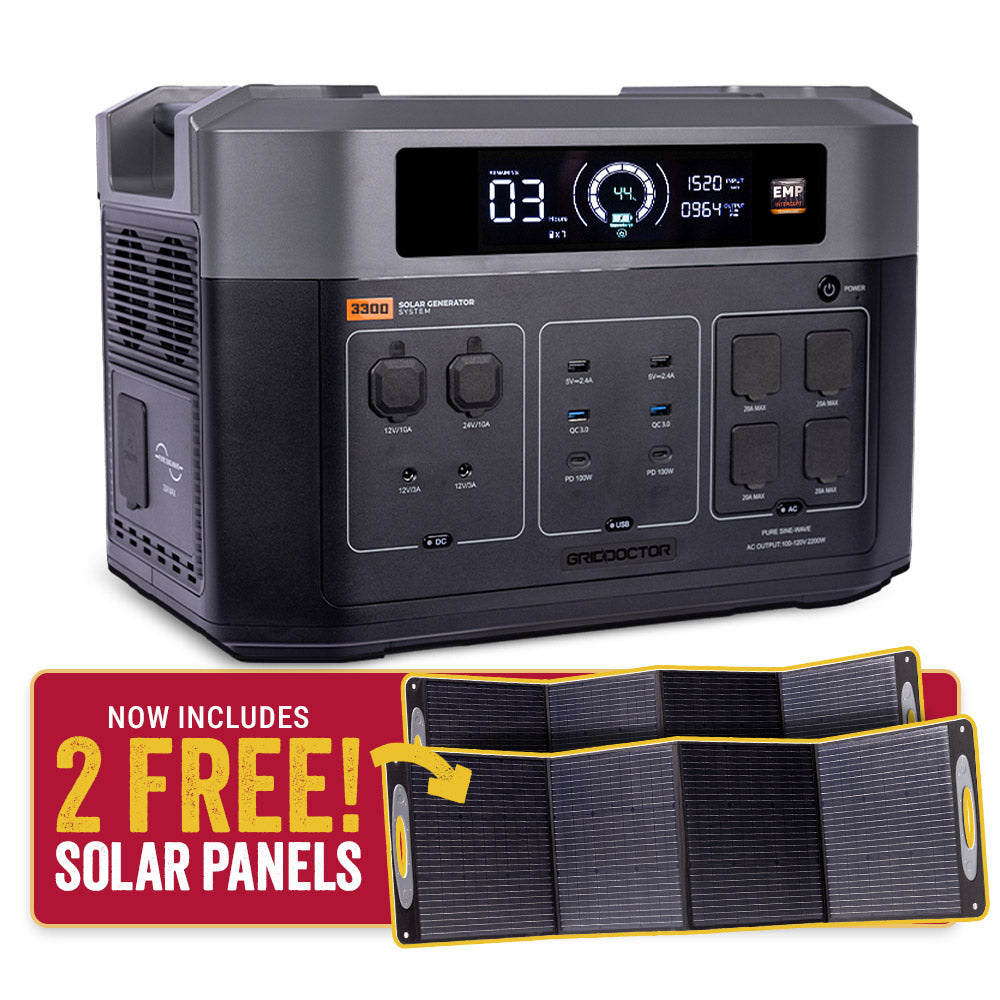
3300 Solar Generator System w/ EMP Intercept Technology + 2 FREE Waterproof 200W Solar Panels by Grid Doctor
- ✓Two 200W panels (400W combined) recharge the 3,300Wh battery in roughly 2 days under good conditions instead of 3–5 days with a single panel; halves recovery time between discharge cycles
- ✓400W solar input allows sustained operation loop: refrigerator (150W) + LED lighting (40W) + communications (5W) = 195W average draw, easily covered by 400W peak production on sunny days
- ✓Dual-panel setup creates redundancy; if one panel degrades or gets shaded, the second continues charging; critical for reliability over months-long scenarios
- ✓Weatherproof connectors and cable bundling reduce setup friction and allow field reconfiguration; panels orient independently for maximum sun tracking
- ✓Exceeds the wattage needed to sustain core-load indefinitely in most seasons; supports occasional high-draw loads (heater, pump startup) without draining reserves
Realistic Storage and Maintenance
A solar generator stored indoors at 50–70°F will hold 85–95% charge over a month if left unplugged. Over three months, expect 60–75% retention due to internal parasitic drain. This means a charged unit stored in winter will lose meaningful capacity by spring. The solution: check charge level every 60 days and top up from wall power or solar panels quarterly.
The included 200W panel should be stored inside when not in use. Continuous outdoor exposure degrades the frame, seals, and output over 2–3 years. A garage or basement keeps panels functional for 20+ years. When deploying for emergency use, unfold the panel, place it in direct sun at a 45-degree angle if possible, and connect the proprietary cable. Alignment matters—angled directly at the sun produces 20–30% more power than flat or poorly angled orientation.

NEW Grid Doctor 3300 Solar Generator System Now with built-in EMP Protection! (Waterproof 200W Panel Included FREE)
- ✓Newest model integrates EMP shielding directly into the battery enclosure design rather than as an add-on, improving structural integrity and reducing internal heat
- ✓3,300Wh lithium battery with built-in charge controller; ships preconfigured for wall outlet or solar input, no additional setup beyond unboxing
- ✓Works as both emergency backup and everyday home energy storage; connect to wall power during normal times and discharge during outages or peak-rate hours
- ✓Includes one 200W waterproof panel and all necessary cables; expandable architecture supports connecting additional panels via industry-standard connectors
- ✓Updated inverter firmware (2024+) optimizes voltage regulation under variable solar input, preventing shutdown on cloudy days when older models would cut out
Frequently Asked Questions
Q: How many watts do I actually need in a solar generator for home backup?
A: Calculate your must-run loads: refrigerator (150W), lights (40W), communications (5W) = 195W continuous minimum. Add occasional loads: phone charging (25W), laptop (65W), space heater (750W). Your generator must handle the simultaneous peak—if you run fridge + heater + lights, that's 940W. Buy a generator rated at least 20% above your anticipated peak load. A 2,000–3,500W unit covers most households running essential loads only.
Q: Can a solar generator power a refrigerator or furnace during an outage?
A: A refrigerator yes—it draws 150–200W running and handles startup surges under 600W. Most solar generators exceed this. A furnace no—oil or gas furnaces need 240V three-phase power and draw 2,000+ watts during startup. Electric furnaces are even worse, requiring 5,000–10,000W. If heating is critical, plan redundancy: propane heater, passive solar gain, or heavy insulation instead of relying on a generator.
Q: How long does it take a 200W solar panel to charge a 3300Wh battery?
A: Under ideal conditions (direct sun, 45-degree angle, clear sky), a 200W panel produces roughly 1,000Wh per day over 5 peak sun-hours. Charging from fully depleted (0%) to full (100%) would take 3.3 days. In reality, you operate at 20–80% depth of discharge, requiring 2,640Wh. This takes 2.6 full-sun days. Winter, clouds, or poor panel angle extend this to 5–7 days. Two panels halve recharge time; three panels let you sustain indefinite operation on sunny days.
Conclusion
Size your solar generator by calculating your simultaneous peak wattage, not just total daily consumption. A 3,300Wh battery with 200W solar input sustains core loads (fridge, lights, communications) indefinitely on sunny days but cannot power high-draw devices like heaters or AC without planned sequencing. Start by listing every device you need during a three-day outage, add up their wattage, and choose a generator rated 20% above that peak. Add a second or third solar panel if you live in a cloudy region or want to sustain loads beyond the essential minimum. Test your setup with a one-week simulation before relying on it—run your planned loads from the generator without plugging in, note how fast the battery drains, and confirm your panel recharges it on schedule. This real-world data is worth more than any spec sheet.
Sources & Official Guidance
Authoritative further reading
This guide is for general informational purposes only and is not professional, medical, or safety advice. Always follow official guidance and, in a life-threatening emergency, call your local emergency number (911 in the US).
Mark Sutton, Lead Editor
Mark runs the editorial side of DoomsDayPreps. He digs into the research on emergency prep and survival gear, and checks anything safety-related against FEMA, CDC, and Red Cross guidance before it goes live.

