Solar Panel Emergency Power: Calculate Your Wattage & Build a System
Learn how to pair solar panels with portable power stations for complete grid-independent electricity. Calculate your household needs and build a resilient syst
An unexpected blackout reveals the gap between assumption and reality. Most households assume they need far less backup power than they actually do. Without calculation, you'll either over-invest in panels you don't need or undersize a system that fails when it matters. This article teaches you to calculate your actual power draw, size a solar panel array correctly, and assemble a system that works during the outage scenarios preppers actually face.
How Solar Panels Convert Sunlight to Usable Electricity
A solar panel converts photons into direct current (DC) electricity through the photovoltaic effect—silicon cells absorb light energy and release electrons, creating electrical flow. That DC current cannot power household devices directly; it must move through a charge controller (regulates voltage) and then into a battery bank or inverter (converts DC to AC wall current, 120V/240V). The panel's rated wattage (e.g., 200W) is its output under standardized test conditions: full sun, 25°C, no shading. Real-world output drops 15–40% depending on temperature, angle, cloud cover, and time of year. A 200W panel in winter at 40°F with morning/afternoon angle loss delivers roughly 120–140W of usable power, not the full 200W.
This matters because many preppers size systems for summer peak performance, then face undersized capacity in winter or cloudy weather—exactly when grid-down scenarios tend to occur (ice storms, prolonged cold snaps). Understanding this discrepancy is the difference between a system that works occasionally and one that sustains you through a real emergency.
Calculate Your Actual Household Power Draw
Before buying a single panel, list every device you need to power during an outage. Not everything—only essentials: refrigerator, well pump (if applicable), space heater or furnace blower, LED lighting, phone/laptop charging, medical devices. Do not include air conditioning, electric water heater, or pool equipment. Write down the wattage of each device—check the nameplate on the back of the appliance or search the model number online.
Example calculation for a 4-person household:
| Device | Watts | Runtime (hours/day) | Daily Watt-Hours |
|---|---|---|---|
| Refrigerator | 600 | 8 (compressor cycles) | 4,800 |
| Well pump | 1,200 | 1 | 1,200 |
| Furnace blower | 800 | 4 | 3,200 |
| LED lighting (5 bulbs × 10W) | 50 | 5 | 250 |
| Phone/laptop charging | 100 | 2 | 200 |
| Total daily consumption | — | — | 9,650 Wh |
This household needs approximately 9,650 watt-hours (9.65 kWh) per day during an outage. A 200W solar panel producing 120–140W in real-world winter conditions generates roughly 1,200–1,400 Wh on a full-sun day. To meet 9,650 Wh daily demand, you'd need 7–8 such panels—about 1,400–1,600W of rated capacity. A single 200W panel alone supports critical loads (lighting, charging, small appliances) but cannot sustain a refrigerator and furnace blower simultaneously.
The math reveals why panel sizing matters: undersizing means daily shortfalls that deplete your battery bank faster than it recharges. Oversizing costs more upfront but ensures reliable power through cloudy stretches and seasonal variation.
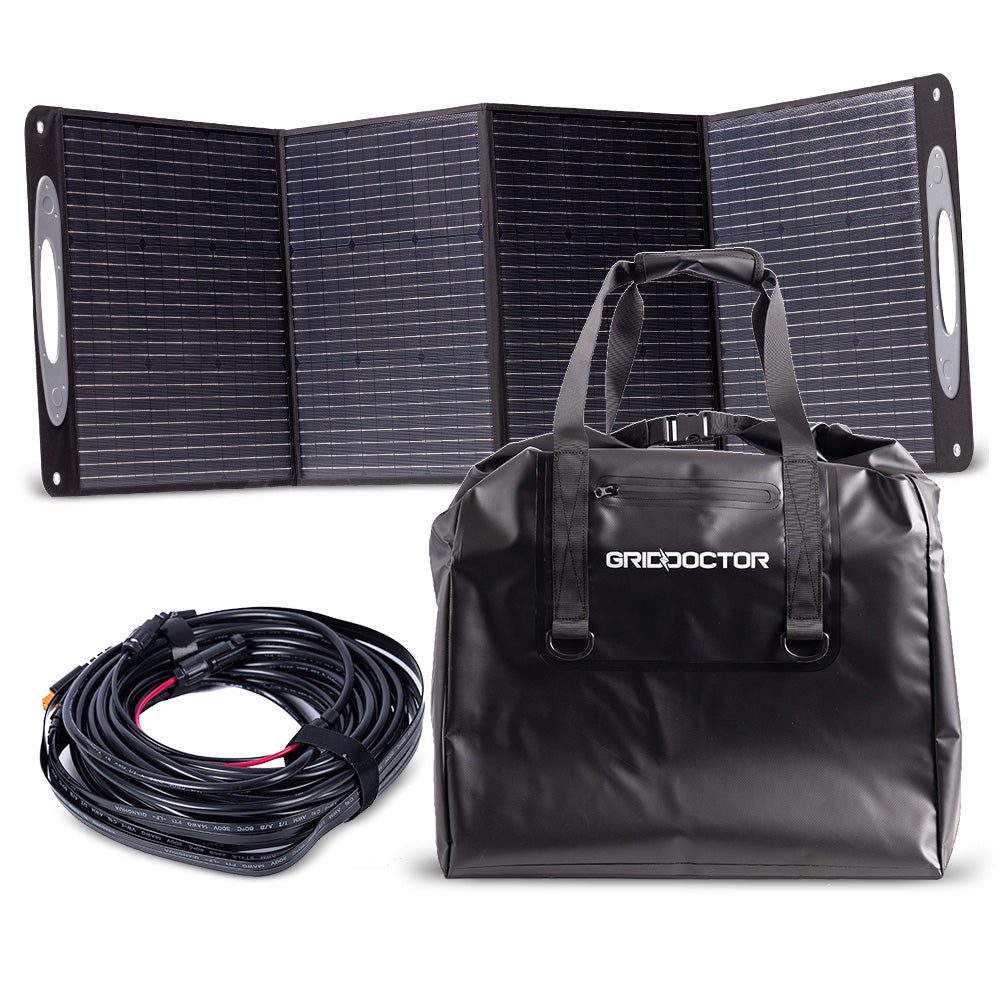
200 W Panel + Under‑Door Cord + Faraday Bag
- ✓Converts sunlight into DC power at rated 200W; real-world output ranges 120–140W in winter conditions depending on angle and cloud cover
- ✓Generates 1,200–1,400 watt-hours on a full-sun day; 4–5 panels supply typical household loads (refrigerator, lights, charging) with margin for cloudy days
- ✓Under-door cord bridges weatherproof power routing when mains are offline—keeps cables from damaging door seals and protects connection points from water intrusion
- ✓Includes integrated Faraday storage bag; protects the panel assembly and cables from electromagnetic pulse (EMP) damage if stored unused, isolating them from potential grid-wide electrical surge
- ✓Transportable system: 200W panel + cords fit in bag for relocation between properties or rotation to sunniest seasonal position without disassembly
System Architecture: Panel → Charge Controller → Battery → Inverter
A complete solar backup system has four layers, each essential:
1. Solar Array (200W or larger). Provides the charging current. More panels = faster recharge on cloudy days and ability to meet simultaneous loads without battery drain.
2. Charge Controller (MPPT or PWM). Sits between the panel and battery. Its job is to regulate voltage and current so the battery charges without overcharging or sustaining damage. A charge controller designed for your panel wattage is critical—undersizing here creates bottlenecks where the panel can't transfer full current.
3. Battery Bank (Portable Solar Generator or LiFePO₄ battery + enclosure). Stores DC energy for use when sun is absent. Capacity is measured in amp-hours (Ah) or watt-hours (Wh). A 3,000Wh battery paired with a 200W panel takes roughly 15 hours to fully charge in full sun—fast enough for daily top-ups in most scenarios but slow during extended cloud cover. Larger generators (3,300Wh+) charge slower but hold more stored energy for multi-day outages.
4. Inverter (built into most portable generators, or standalone). Converts stored DC power to AC (wall current, 120V), the standard for household appliances. Pure sine-wave inverters (preferred for sensitive devices like furnace controls and medical equipment) cost more than modified sine-wave types but prevent malfunction in precision electronics.
Skipping any of these layers breaks the chain. A panel without a battery bank cannot power anything at night. A battery without an inverter can only run DC-specific devices (lights, USB chargers). Most preppers solve this by purchasing a portable solar generator (battery + inverter + charge controller built in)—it's the fastest entry point and avoids compatibility mistakes.
How Many Panels Do You Actually Need? Seasonal and Weather Reality
A household needing 10 kWh daily must account for two dynamics:
Seasonal variation: A 200W panel produces 1,200–1,400 Wh on a winter day with full sun but 1,800–2,000 Wh on a summer day with the same sun duration. In December at 40°N latitude (northern United States), available daylight drops to 9 hours; the same panel in June gets 15 hours. This is not a small difference—a 200W panel in June generates 36% more total energy per day than in December, even if real-world efficiency drops remain constant.
Cloud cover and multi-day outages: If your outage spans 3–5 consecutive cloudy days (not uncommon during winter storms), a single 200W panel generating 200–300 Wh daily is grossly insufficient. A 1,000–1,200W array (5–6 panels) can supply 40–50% of normal output even under thick cloud, keeping critical loads alive while battery reserves last.
The practical solution: Size the array to meet 70–80% of daily demand under real-world winter conditions (not peak summer). This means:
- 10 kWh/day household → 1,400–1,600W array (7–8 × 200W panels)
- 5 kWh/day household → 700–900W array (3–4 × 200W panels)
- 2 kWh/day household (lights, charging, small appliances) → 400–600W array (2–3 × 200W panels)
Most households underestimate load and thus undersize panels. The result: batteries deplete faster than they recharge, and by day 2 or 3 of an outage, critical devices go dark.
Faraday Shielding: Why It Matters and What It Does
An electromagnetic pulse (EMP)—whether from a high-altitude nuclear detonation, a solar coronal mass ejection, or a localized grid transformer failure—can induce destructive currents in unshielded electronics. Solar panel electronics (charge controllers, inverters, wiring) are vulnerable during an extended outage when the grid has already failed and replacement is not an option.
A Faraday bag (or Faraday cage) is a conductive enclosure—typically copper mesh or aluminum-lined fabric—that reflects electromagnetic waves away from contents rather than allowing them to induce current. It does NOT prevent an EMP from reaching you or harming someone directly exposed to the burst. It does protect stored electronics if they are inside an unpowered, unconnected state when the pulse occurs.
A practical Faraday strategy for preppers: Store a second solar panel and spare charge controller in a Faraday bag—kept disconnected and indoors. If your main array is damaged by an EMP or physical catastrophe, the shielded backup remains viable. Without this redundancy, your entire solar backup system is a single point of failure in a true SHTF scenario. The under-door cord itself stays unshielded (it must) because it bridges outdoor connection points; shield the spare equipment, not the active system.
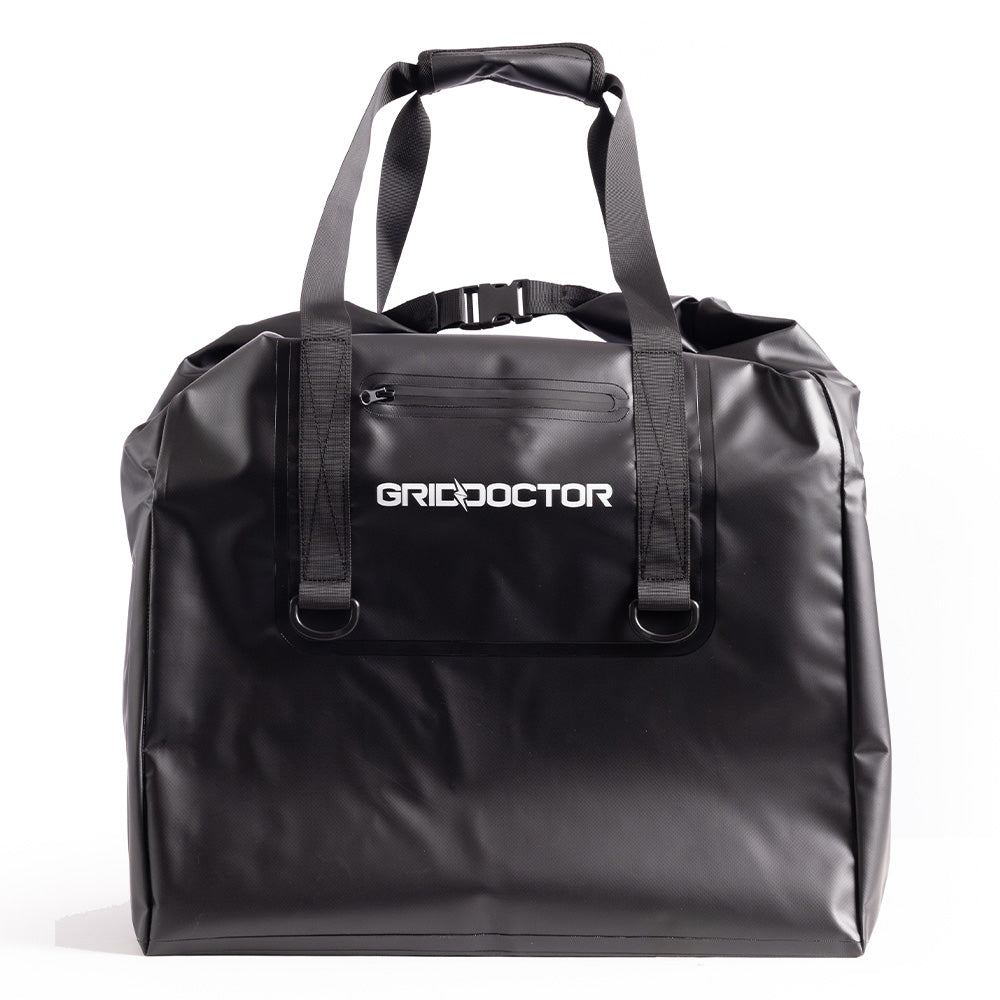
Large Faraday EMP Bag for the 3300 & 2200 Solar Generators by Grid Doctor (110 Liter)
- ✓Conductive mesh lining reflects electromagnetic fields; protects unconnected, unpowered electronics from EMP-induced current during storage
- ✓110-liter capacity holds a portable solar generator (3,300Wh+) plus spare panels and charge controllers—enables full system redundancy for multi-property or rotation scenarios
- ✓Faraday protection only functions when electronics are stored disconnected and inside the bag; active systems must remain outside for operational use
- ✓Keeps backup equipment viable if grid-wide EMP or solar coronal mass ejection renders primary panels/controls inoperable
- ✓Designed for Grid Doctor generators; compatible with standard solar panel and controller dimensions for non-brand-specific backup storage
Realistic Limitations and Failure Modes
A solar emergency power system cannot sustain indefinitely. Clouds lasting 4–7 days (not rare in winter) exceed the recharge rate of even a well-sized array. Your battery bank depletes, and you're rationing power to essential loads only. A 5-day cloudy winter outage with a 10 kWh/day household demand and a 5 kWh daily solar input means a 25 kWh deficit. You must have either (a) a massive battery bank (20–30 kWh, expensive and physically space-intensive), or (b) a fuel backup—natural gas generator, propane heater, wood stove—to bridge the gap. Relying on solar alone during a prolonged winter storm is a plan that fails.
Winter performance drops sharply. If your household's winter daily demand is 8 kWh and you size the array to produce 8 kWh on a winter day, you have zero margin. A single cloudy day depletes the battery. A two-day cloud cover empties it entirely. Your array must produce 50–100% more than your minimum winter load—this means upgrading from 4 panels to 6 or 7 for true resilience.
Temperature degrades inverter efficiency. Most portable solar generators have maximum operating temperatures around 45°C (113°F). In a hot summer without grid cooling, the inverter may throttle output or shut down to protect itself. If you're depending on the system during a heat wave, you may get 60–70% of nameplate capacity.
Portable generators are not installed backup. A 3,300Wh generator can power a refrigerator for 5–8 hours, not the whole day. You cannot run a well pump, furnace, and refrigerator simultaneously from a single portable unit. Many preppers buy the system expecting whole-home backup and face disappointment on day one when they must choose which load to power first.
Who should not rely on solar alone: Households with large heating or cooling needs (electric furnace, AC), homes in cloudy climates (Pacific Northwest, Northeast), and anyone in a medical fragility scenario (oxygen concentrator, dialysis, critical monitoring). For these situations, add a fuel backup or a grid-tied battery system with utility fallback—solar cannot be your only layer.
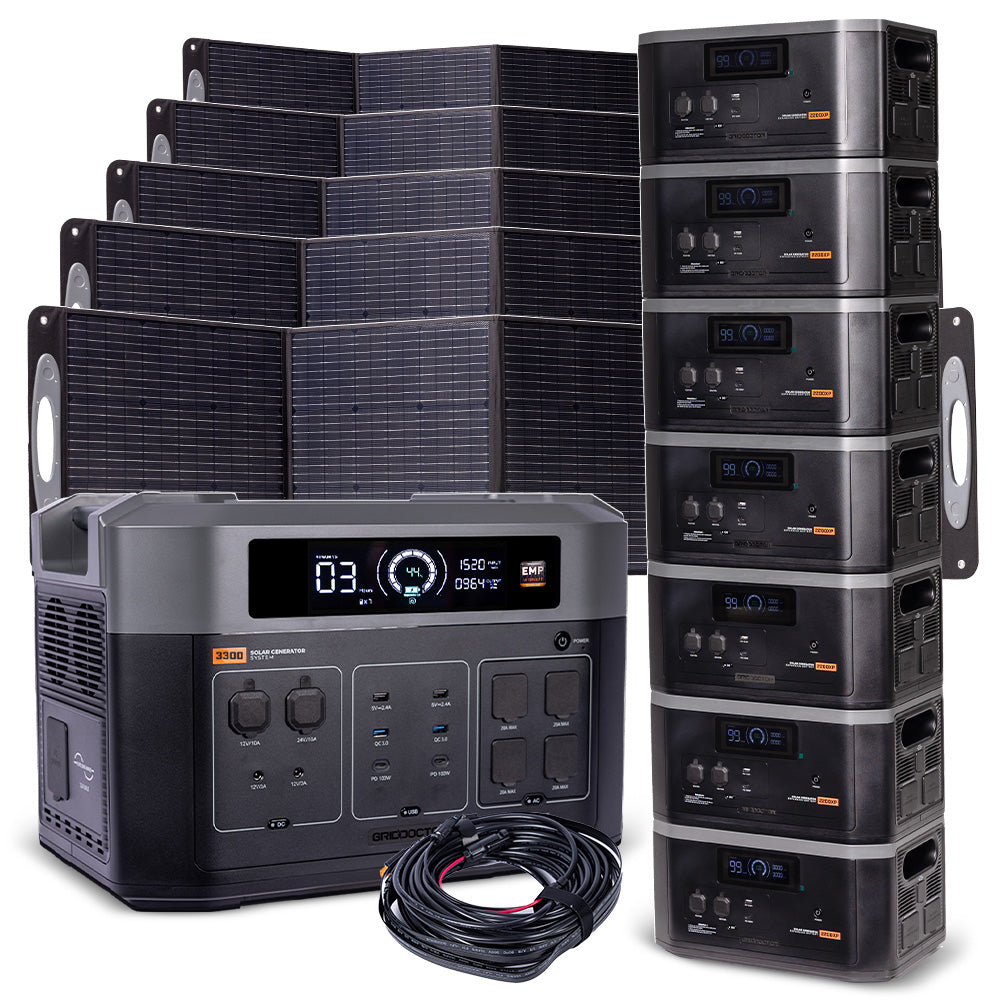
Grid Doctor 3300 Power Tower
- ✓3,300Wh LiFePO₄ battery with integrated pure sine-wave inverter; supports simultaneous AC loads up to 3,500W peak and 2,400W continuous
- ✓Charges from a single 200W panel in 15–17 hours of full sun; four panels charge in 4–5 hours, enabling daily recharge on most sunny days without battery depletion
- ✓Runs refrigerator + lights + phone charging for 12–16 hours on a single charge (household dependent); overnight + morning before solar tops it up
- ✓Includes Grid Doctor charge controller; compatible with standard solar panels and the under-door cord routing system for weatherproof, damage-resistant connection
- ✓LiFePO₄ chemistry retains 80%+ capacity after 3,000+ cycles; 10+ year usable lifespan if maintained in 50–70°F storage and kept above 20% state of charge
Frequently Asked Questions
Q: How many watts of solar do I actually need to power my home in an outage?
A: Start with your daily watt-hour demand (total watts × hours of use per device), then multiply by 1.5 to 2.0 to account for real-world losses and cloudy days. A 10 kWh/day household needs 15–20 kWh of solar generation capacity to sustain itself. Since a 200W panel produces roughly 1.2–1.4 kWh daily in winter, that's 10–17 panels—1,000–1,600W of installed capacity. Most households undersize because they calculate peak summer output, not winter reality. The correct size feels oversized until you live through a three-day winter storm.
Q: What's the real difference between a 200W panel and a larger solar array?
A: More panels mean faster recharge and system resilience during cloudy weather. A single 200W panel charges a 3,300Wh battery in 15+ hours; four 200W panels do it in 4–5 hours. On a partly cloudy day when one panel produces 40% output, a single-panel system generates only 500Wh, while a four-panel system still produces 1,600Wh—enough to run essential loads without draining the battery reserve. Larger arrays also provide margin during winter when daily output is lowest and seasonal variation is harshest.
Q: Can a solar panel charge a portable generator in bad weather or winter?
A: Yes, but slowly. Thick cloud cover reduces output to 10–25% of rated capacity—a 200W panel might generate 20–50W. A 3,300Wh generator would take 70+ hours to fully charge under those conditions. In practical terms, cloudy weather tops up the battery but does not fully recharge it. If your household is drawing power simultaneously, the solar input doesn't keep pace, and the battery depletes. This is why multi-day cloud cover requires either a fuel
Sources & Official Guidance
Authoritative further reading
This guide is for general informational purposes only and is not professional, medical, or safety advice. Always follow official guidance and, in a life-threatening emergency, call your local emergency number (911 in the US).
Mark Sutton, Lead Editor
Mark runs the editorial side of DoomsDayPreps. He digs into the research on emergency prep and survival gear, and checks anything safety-related against FEMA, CDC, and Red Cross guidance before it goes live.