Solar Panel for Emergency Power: How to Calculate Your Household Need
Learn how solar panels generate emergency power and calculate your household needs. Portable 15W systems work in blackouts without fuel or noise.
When the grid fails, solar panels keep working. Unlike generators that require fuel, propane, or diesel—resources that deplete and run out—solar panels convert sunlight into usable electricity indefinitely. But a 15W panel is not a universal solution. It delivers a specific amount of power under real-world conditions, and matching that output to your household's actual load is the difference between a useful tool and an expensive paperweight.
This article teaches you how to calculate your solar power need, understand what a 15W system realistically provides, and make an informed decision about whether portable solar is right for your emergency plan.
How Solar Panels Generate Emergency Power
A solar panel works by the photovoltaic effect: when photons from sunlight strike the silicon cells inside the panel, they knock electrons loose from their atoms, creating a flow of electric current. The panel's wattage rating describes its peak output under ideal laboratory conditions—full sun, 77°F, a perpendicular angle to the sun.
Real-world output is always lower. A 15W panel rated at peak produces roughly 12 watts under typical outdoor conditions (partial cloud cover, non-ideal angles, dust or pollen on the surface). On an overcast day, output drops to 3–5 watts. At sunrise or sunset, output is negligible. The key is this: the wattage a panel produces is not constant—it varies hour by hour and day by day.
This variability is why household voltage matters. Most small portable solar panels output at 18–22 volts, but your batteries and devices require 12 volts or lower. A charge controller sits between the panel and the battery, converting the panel's variable voltage into a steady charging current. At 18 volts input and 12 volts output, with 85% efficiency typical of small controllers, a 15W panel delivers approximately 10 watts of usable power to your battery in real-world sunlight.
The math: 15W ÷ 18V = 0.83 amps at panel output. Converted to 12V and accounting for 85% efficiency: 0.83 × 18 × 0.85 ÷ 12 = approximately 1.05 amps charging current at 12V. Over 8 hours of useful sunlight, that is roughly 8.4 amp-hours of energy stored in your battery.
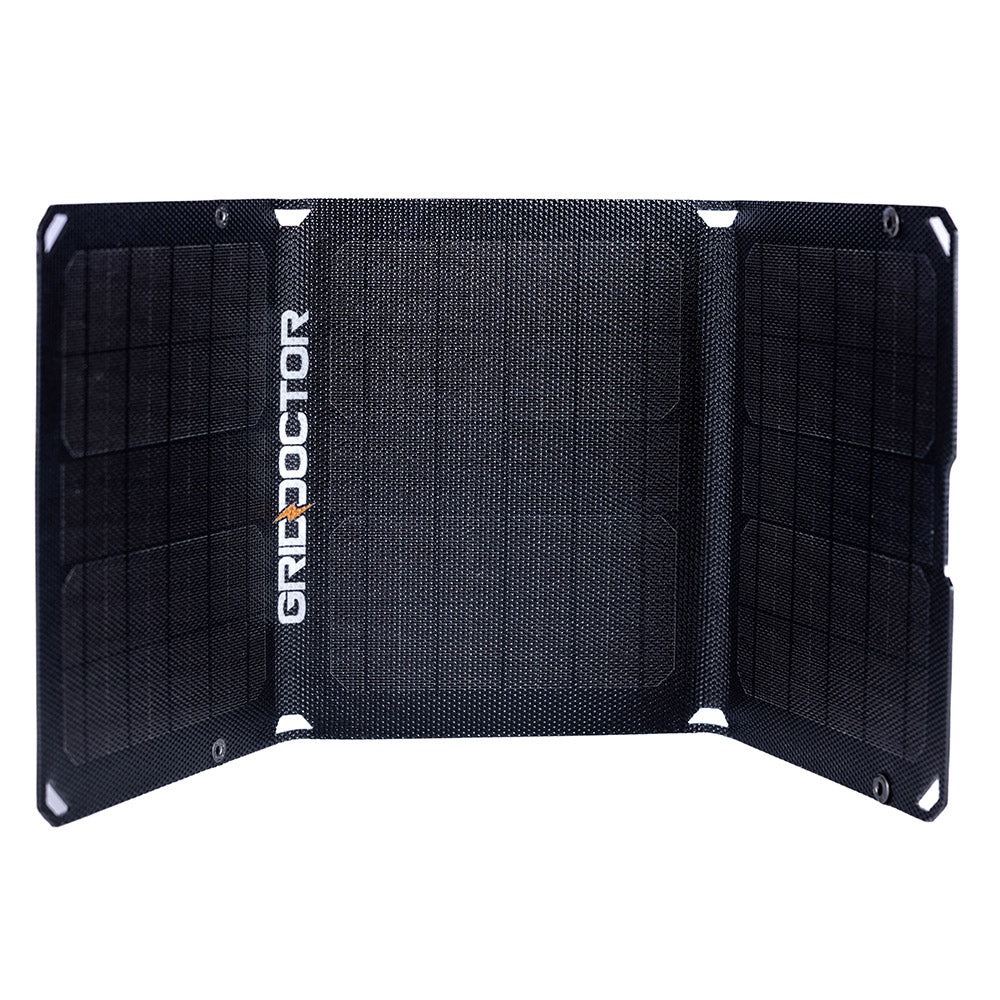
15W Solar Panel by Grid Doctor
- ✓Converts sunlight to 15W peak output (≈10W real-world usable) via photovoltaic silicon cells and integrated charge controller at 85% efficiency
- ✓Produces approximately 8–10 amp-hours per day under 8 hours of direct sunlight; charges a 100Ah battery from 50% to full in roughly 10 days of consistent sun
- ✓Portable design powers backup devices in blackouts, grid failures, or extended camping without noise, fuel, or emissions
- ✓Lightweight and rugged construction handles field conditions better than rigid panels; folds for transport in a 72-hour kit or vehicle emergency kit
- ✓Works with any 12V battery (lead-acid, LiFePO4); pairs with standard PWM charge controllers to prevent overcharging
Calculating Your Solar Power Need: The Load Analysis
Before buying a panel, define what you must power during an outage.
Step 1: List critical devices and their wattage.
Write down every device you need to run. Find the wattage on the device label or manual. Use these typical values as reference:
- LED flashlight or headlamp: 2–5W
- Smartphone charger: 5–15W (during charging)
- Medical device (CPAP, oxygen concentrator): 20–60W
- Laptop or tablet charger: 45–65W
- Portable radio (battery-powered): 2–10W
- Water pump or sump pump: 250–500W (not suitable for 15W panel)
Step 2: Calculate daily energy in watt-hours.
Watt-hours = Watts × Hours of use per day.
Example: A smartphone needs 10W while charging. If you charge it 2 hours per day, that is 10W × 2h = 20 watt-hours. A CPAP machine running 8 hours per night at 40W = 40W × 8h = 320 watt-hours per day.
Add all devices: 20 + 320 = 340 watt-hours per day minimum.
Step 3: Determine required battery capacity.
Watt-hours ÷ 12V system voltage = amp-hours needed.
340 watt-hours ÷ 12V = 28 amp-hours per day.
A 15W panel, under 8 hours of useful sunlight, produces roughly 8–10 amp-hours. To fully recharge a battery that supplied 28 amp-hours, the same panel would need 3–4 full sunny days. In real emergencies—when cloud cover persists or seasonal sun is weak—the timeline extends.
Realistic scenario:
- CPAP user, no other loads: 320Wh/day ÷ 12V = 27Ah needed
- A 100Ah lead-acid battery, discharged to 50% (safe limit), holds 50Ah usable
- A 15W panel recharges 8–10Ah per day
- Full recharge of a 50Ah discharge: 5–6 days of continuous sun
If your area sees frequent cloud cover, a 15W panel alone will not recharge a heavy-use battery fast enough. If your loads are lighter—LED lighting, radio, phone charging—a 15W panel is sufficient.
| Load Type | Daily Need | Days to Recharge 100Ah Battery (50% to full) |
|---|---|---|
| Light (LED, radio, phone) | 15–30Wh | 1–2 days of sun |
| Moderate (CPAP + phone) | 320–350Wh | 5–6 days of sun |
| Heavy (medical + heating/cooling device) | 500+Wh | 7+ days of sun, may not recharge before full discharge |
Real-World Limitations of a 15W Panel
A 15W solar panel is not a replacement for grid power. It works best as part of a layered emergency system, not as a standalone solution.
Weather dependency: Cloud cover reduces output to 20–50% of rated capacity. Winter in northern latitudes produces 30–40% of summer output even on clear days. A 15W panel in Seattle in December outputs roughly 4–6W at peak, not enough to sustain medical devices without battery backup.
Cannot power high-draw devices: Microwave ovens, space heaters, air conditioning, water heaters, and sump pumps pull 500–5,000 watts. A 15W panel cannot start or sustain any of these, even briefly. If your survival plan depends on running a medical device or pump, a single 15W panel is a false sense of security.
Requires battery storage: A 15W panel alone charges nothing without a battery. You must invest in a 12V battery (cost: $100–300 for quality lead-acid or LiFePO4) and a charge controller ($20–50). Total system cost: $200–400, not $30–50 for the panel alone.
Limited mobility in emergencies: Panels work best mounted at a fixed angle and pointed toward the sun. Carrying a 15W panel, a battery, and a controller to a different location during an evacuation adds weight and complexity.
Who should use a 15W panel: People whose emergency loads are low (LED lighting, phone charging, radio), who live in sunny climates, and who can wait 5–7 days for a full recharge of their battery. Those with medical device dependencies, frequent cloud cover, or high energy needs need larger systems.
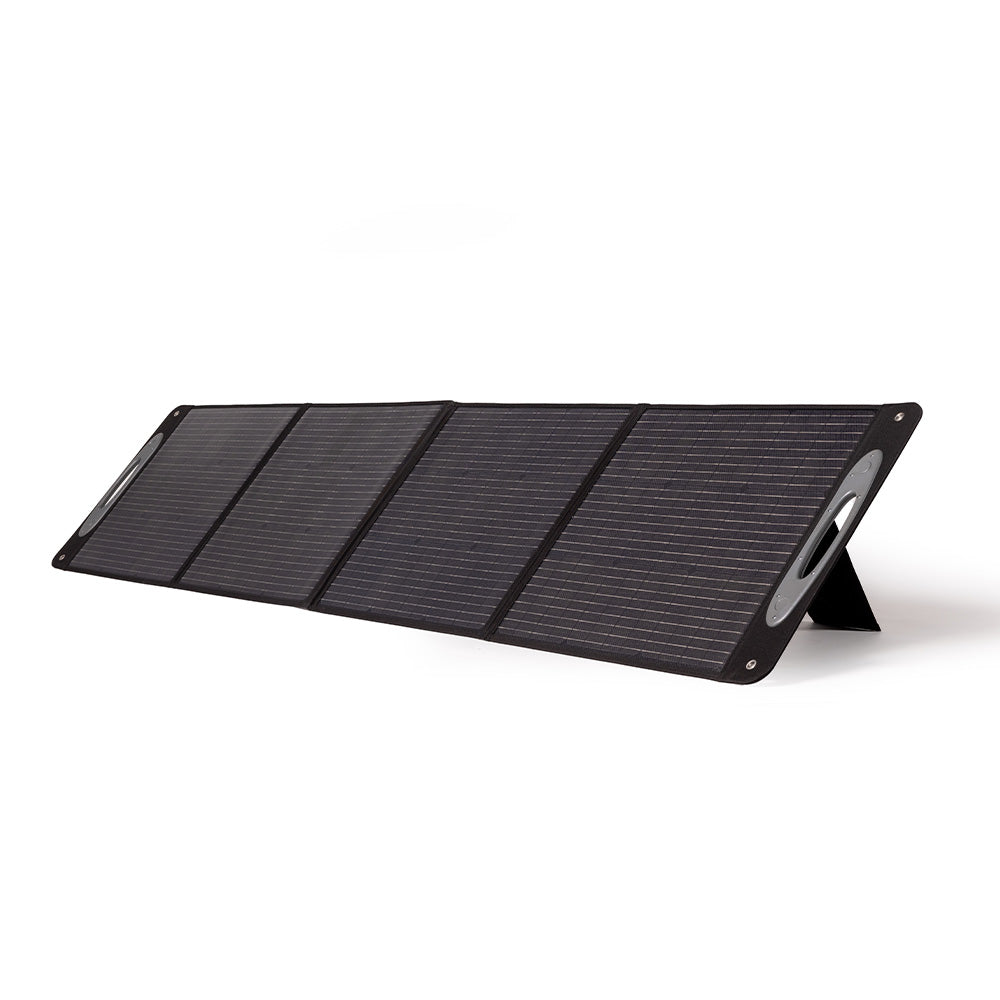
200W Waterproof Solar Panels by Grid Doctor for the 3300 & 2200 Solar Generator Systems
- ✓200W output (≈13x the power of a 15W unit) produces 160–200Ah per day under 8 hours of direct sun, recharging heavy medical or heating loads in 1–2 days instead of 5–6
- ✓Paired with 3300 or 2200Wh systems, eliminates fuel dependency for extended outages; waterproof design withstands field use and storm conditions
- ✓Suitable for family-scale loads (multiple medical devices, refrigeration, water pumping) in multi-day grid failures
- ✓Modularity allows stacking two panels for 400W capacity if energy needs exceed single-panel output
- ✓Fixed mounting hardware for permanent or semi-permanent installation increases reliability over portable panels moved daily
Maximizing a 15W Panel in Your Emergency Plan
If a 15W panel fits your load profile, use it strategically to extend battery life and reduce recharge time.
Use angle and orientation: Mount the panel perpendicular to the sun's rays, not flat or angled away. In winter, tilt the panel toward the south at an angle matching your latitude. In summer, reduce the tilt by 15°. A 30° difference in angle can cut output by 40%. An app like Sun Seeker (free) tells you the exact sun position.
Clean the surface daily: Dust, pollen, bird droppings, and condensation reduce output by 10–30%. A quick wipe with a dry cloth in the morning restores efficiency.
Charge during peak sun hours: The panel produces maximum output between 9 AM and 3 PM. Concentrate your charging tasks—phone, laptop, medical device batteries—during this window.
Size your battery to match: A 15W panel works best with a 20–50Ah battery. A battery much larger than 50Ah will take weeks to recharge; a battery smaller than 20Ah will cycle too frequently and degrade faster.
Pair with a passive load: Run your lights, radio, and small devices directly off the panel during daylight hours (with a charge controller preventing overcharge). Save battery charging for night or cloudy days, reducing the recharge burden.

Large Faraday EMP Bag for the 3300 & 2200 Solar Generators by Grid Doctor (110 Liter)
- ✓Faraday cage construction with multiple grounded layers shields solar generators and 15W panel charge controllers from EMP (electromagnetic pulse) damage, preserving emergency power systems during grid-down scenarios involving solar storms or nuclear detonation
- ✓110-liter capacity stores a complete solar charging setup (panels, controllers, batteries, and cables) in one protected container; keeps equipment safe from moisture and physical damage during storage or transport
- ✓Conductive fabric allows you to ground the bag to metal stakes or a grounding rod, maximizing electromagnetic shielding effectiveness
- ✓Essential if your emergency plan assumes an EMP or solar storm risk; protects irreplaceable electronics that cannot be replaced during a prolonged outage
- ✓Fits in a closet or vehicle; does not require electrical power to maintain shielding, unlike electronic Faraday boxes
Frequently Asked Questions
Q: How many watts of solar power do I need for emergency backup?
A: It depends on your loads. Light loads (LED lighting, radio, phone charging) need 15–30 watt-hours daily; a 15W panel provides sufficient daily production (8–10Ah at 12V = 96–120Wh per day). Medical devices (CPAP, oxygen concentrator) require 300–400Wh daily; a 15W panel takes 5–7 days to recharge a discharged battery, which is too long if the device runs every night. Heavy loads (heating, cooling, pumping) exceed what any single small panel can sustain. Calculate your daily watt-hours, divide by 12V to get amp-hours, then estimate recharge time: a 15W panel produces 8–10Ah per day, so recharge time = battery amp-hours needed ÷ 8.
Q: How long does it take a 15W solar panel to charge a battery?
A: A 15W panel produces roughly 8–10 amp-hours per day under 8 hours of direct sunlight and clear skies. A 100Ah battery discharged to 50% (50 usable amp-hours) takes 5–6 full sunny days to recharge completely. A 50Ah battery takes 5–6 days. In winter, cloudy regions, or seasonal low-sun periods, add 50–100% more time. The formula: recharge days = battery amp-hours needed ÷ average daily amp-hours from panel (8 for a 15W panel). If you have 48 amp-hours to recharge, that is 48 ÷ 8 = 6 days of consistent sun.
Q: Can a 15W solar panel run a refrigerator or medical device?
A: No, not continuously or reliably. A refrigerator draws 150–800W when the compressor is running (typically 8–12 hours per day). A 15W panel peaks at 15W under ideal conditions; its average real-world output is 10W. You cannot run a 150W appliance on 10W of input. A medical device like a CPAP (40–60W for 8 hours) can be powered if the battery is large enough (a 100Ah battery at 12V stores 1,200Wh; a CPAP at 50W for 8h = 400Wh, leaving 800Wh for other loads). However, the 15W panel takes 5–6 days to recharge a battery after the CPAP discharge, creating a gap on day 2 if cloud cover occurs. For medical devices, a larger panel (100W+) or a hybrid system (solar + grid/generator backup) is necessary.
Conclusion
A 15W solar panel is a portable, silent way to extend battery life during blackouts. It works well for light loads and as part of a multi-source emergency power strategy. However, it alone cannot sustain heavy or medical loads, and it requires a battery, charge controller, and realistic expectations about recharge time. Calculate your household's actual daily watt-hour need, match it to a battery size, then add a 15W panel if your loads are light and your climate is sunny. For heavier loads or cloud-prone regions, a larger panel or a hybrid power system is the practical choice.
Frequently Asked Questions
Q: How many watts of solar power do I need for emergency backup?
A: It depends on your loads. Light loads (LED lighting, radio, phone charging) need 15–30 watt-hours daily; a 15W panel provides sufficient daily production (8–10Ah at 12V = 96–120Wh per day). Medical devices (CPAP, oxygen concentrator) require 300–400Wh daily; a 15W panel takes 5–7 days to recharge a discharged battery, which is too long if the device runs every night. Heavy loads (heating, cooling, pumping) exceed what any single small panel can sustain. Calculate your daily watt-hours, divide by 12V to get amp-hours, then estimate recharge time: a 15W panel produces 8–10Ah per day, so recharge time = battery amp-hours needed ÷ 8.
Q: How long does it take a 15W solar panel to charge a battery?
A: A 15W panel produces roughly 8–10 amp-hours per day under 8 hours of direct sunlight and clear skies. A 100Ah battery discharged to 50% (50 usable amp-hours)
Sources & Official Guidance
Authoritative further reading
This guide is for general informational purposes only and is not professional, medical, or safety advice. Always follow official guidance and, in a life-threatening emergency, call your local emergency number (911 in the US).
Mark Sutton, Lead Editor
Mark runs the editorial side of DoomsDayPreps. He digs into the research on emergency prep and survival gear, and checks anything safety-related against FEMA, CDC, and Red Cross guidance before it goes live.