Solar Power for Emergency Preparedness: Charging Math & Real Output
Learn how to calculate solar panel charging time for emergency backup power. Real math for 100W panels, battery capacity, and realistic output in survival scena
A solar panel rated at 100W is not a 100W power source in a blackout. The number describes peak laboratory output under ideal conditions — full sun, zero clouds, panels angled perfectly toward the sun at noon. Understanding the gap between rated watts and actual charging time is the difference between a functional emergency backup and an expensive paperweight mounted on your roof.
This guide teaches you the math to calculate real charging duration, determine whether your solar setup will actually run the devices you need, and build a solar system that delivers power when the grid is down.
How Solar Output Becomes Usable Charging Current
A 100W solar panel generates power in direct sunlight by converting photons into direct current (DC) electricity. The panel's output is expressed as watts — a unit of power — but what matters for charging is amperage, which is current flow. The relationship is simple: watts = volts × amperes.
A typical 100W solar panel outputs approximately 5.5 amps at 18 volts under full-sun peak conditions. That 18V is higher than the 12V needed for most solar battery systems, so the power passes through a charge controller — a device that regulates voltage and current to safely charge your battery without overcharging it. The charge controller converts the panel's output down to the battery voltage (usually 12V, 24V, or 48V depending on system size) and manages the amperage flow.
Here's the critical part: a 100W panel will not deliver 100 watts continuously. Under cloudy conditions, output drops to 20–50W. During morning and late afternoon, when the sun is lower, you get 30–60W. Only at solar noon, with clear skies and the panel perpendicular to incoming rays, does a 100W panel approach its rated output. This is why emergency solar systems require either multiple panels or realistic expectations about charging speed.
Real-World Charging Math for Battery Capacity
To calculate how long it takes a 100W panel to charge a specific battery, you need the battery's amp-hour (Ah) rating — the total current capacity the battery can hold. A 300Wh (watt-hour) battery, for example, stores 300 watts of power for one hour, or 100 watts for three hours. To convert Wh to Ah, divide by the battery voltage: a 300Wh battery at 12V equals 25Ah.
Using average real-world output, not peak specs:
Scenario: Charging a 25Ah battery (300Wh) with a 100W solar panel
- Peak output under ideal sun: 5.5 amps
- Realistic average output (accounting for angle, clouds, seasonal variation): 3–4 amps
- Using 3.5 amps as a working average
To charge from 50% (common starting point in off-grid systems) to 80% capacity:
- Battery capacity to charge: 25Ah × 30% = 7.5Ah
- Time required: 7.5Ah ÷ 3.5A = approximately 2.1 hours of usable sunlight
This assumes a charge controller set for a 12V output and no parasitic losses. Real systems lose 10–15% to controller inefficiency and wiring resistance, so add 15 minutes to the estimate.
On a cloudy day, output drops to 1–2 amps, extending the time to 4–6 hours. In winter or at high latitudes, effective charging hours shrink further.
| Conditions | Average Output | Time to 80% (25Ah from 50%) |
|---|---|---|
| Clear, noon | 4–5 amps | 1.5–2 hours |
| Partly cloudy | 2–3 amps | 3–4 hours |
| Overcast | 1–1.5 amps | 5–7 hours |
| Winter (far north) | 0.5–1 amp | 7–12+ hours |
This is why a single 100W panel works for maintaining a charged battery during normal use but is slow for emergency charging of a depleted system. Two panels (200W) or one 200W panel would halve these times.
What a Charged Battery Actually Powers
Once charged, the battery capacity determines how long you can run devices. Calculating this requires knowing the wattage of each device and the usable battery capacity.
Example load calculation:
A typical emergency kit might include:
- LED lights: 10W each, 2 lights = 20W
- Portable radio: 5W
- Phone charger: 8W
- Small inverter (AC conversion) losses: 10–15%
Total load: ~43W + 5W (inverter loss) = 48W continuous
A 300Wh battery can run a 48W load for: 300Wh ÷ 48W = 6.25 hours
If you double the load to 100W (adding a larger inverter or heating element), the battery provides: 300Wh ÷ 100W = 3 hours
This is the hard trade-off: a compact, portable system stores enough power for essential communication, lighting, and phone charging during a 24-hour outage. It will not run a full-house refrigerator, space heater, or water pump. For those loads, you need a multi-panel array and a larger battery bank—150+ Wh.
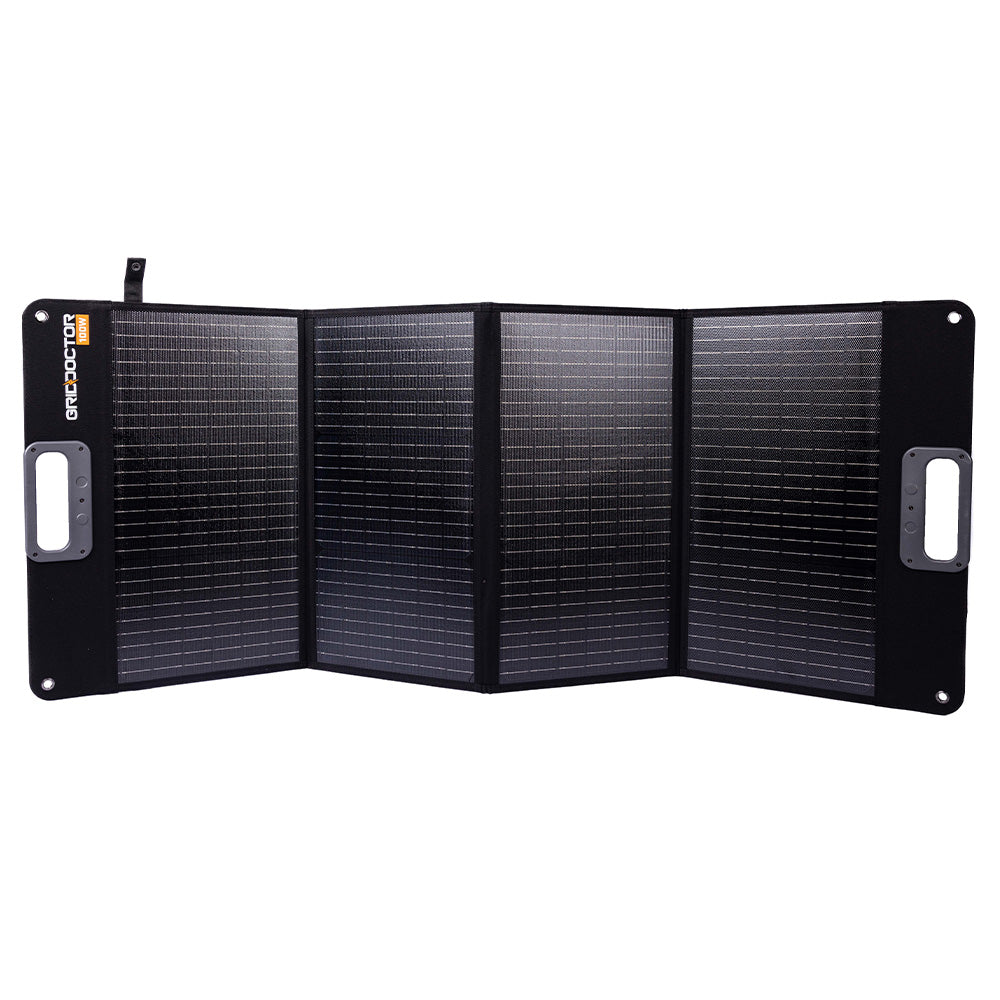
100W Solar Panel for the 300 Solar Generator System by Grid Doctor
- ✓Photovoltaic cells convert 5.5 amps at 18V under peak sunlight, regulated by the charge controller down to safe 12V charging
- ✓100W rated output delivers 3–4 amps of real charging current in average conditions; full charge of 300Wh battery from 50% in approximately 2 hours of midday sun
- ✓Designed for off-grid emergency setups where a single portable panel integrates with the 300 System without additional wiring or controllers
- ✓Folds to compact carrying size—critical for evacuation scenarios where solar must move with you, unlike rooftop installations
- ✓Compatible with the Grid Doctor 300 System's integrated charge regulator; no separate controller purchase required
Planning Panel Count for Realistic Backup Power
A single 100W panel is entry-level emergency preparedness. It solves the "we need to charge batteries and phones" problem. It does not solve "our house loses power for a week and we need continuous power."
Single panel (100W) — best for:
- Topping off batteries and phone charging during power outages up to 48 hours
- Maintaining a charged battery for ongoing backup
- Portable/evacuation scenarios where weight and packability matter
Two to four panels (200–400W) — required for:
- Charging a larger battery bank (600–1,000Wh) to 80% in 4–6 hours
- Running essential AC loads (refrigerator, well pump, small heater) for 12+ hours
- Cloudy-region preparedness where output variance is high
The scaling math: each additional 100W panel cuts charging time roughly in half under identical sun conditions. Two 100W panels (200W total) deliver 7–8 amps average, charging 300Wh from 50% to 80% in ~1 hour at midday.
However, adding panels requires a larger battery bank to justify the investment. A 300Wh system can only absorb so much current before the charge controller reaches full charging capacity and the excess power is wasted. Upgrade the battery, upgrade the panel array.
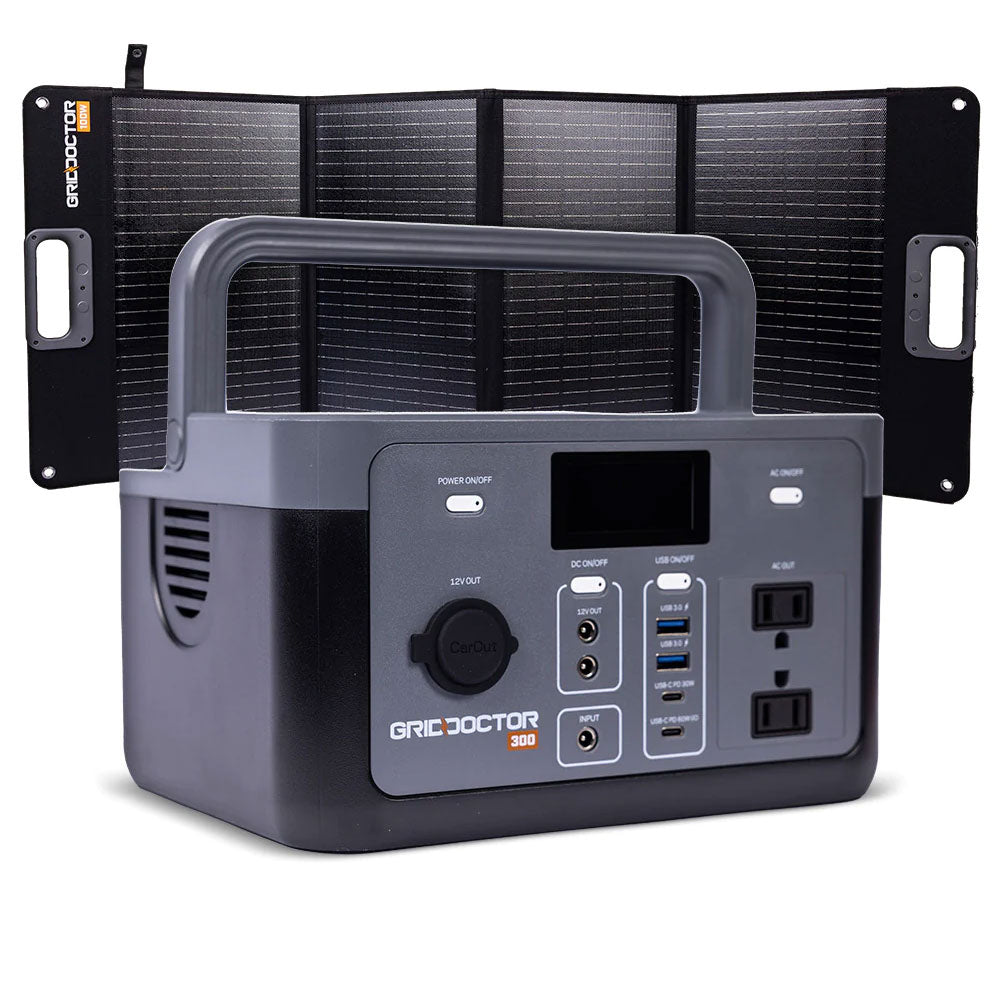
Grid Doctor 300 Solar Generator System + FREE 100W Solar Panel
- ✓Integrated lithium battery (300Wh) + charge controller + inverter in one unit; 100W panel charges it without additional hardware purchases
- ✓300Wh capacity powers LED lights, radios, and device charging for 6–8 hours of moderate use; two full charge cycles per day if solar recharges between use windows
- ✓Portable 27 lbs total weight—solar power that evacuates with you; fits vehicle storage and home emergency kits equally well
- ✓Includes digital display showing real-time watts in, watts out, and state of charge—eliminates guessing about battery status
- ✓Pure sine wave inverter converts battery DC to household AC at 110V; runs sensitive electronics (laptops, CPAP machines) without damage
Honest Limitations of Single-Panel Systems
A 100W solar panel will not run a standard refrigerator. A fridge draws 400–800W when the compressor cycles, far exceeding a 300Wh battery's capacity. Even if you could store enough power, the inverter in a compact system is typically 150–300W rated and will shut down under the inrush load.
Weather dramatically degrades output. A week of rain or heavy snow means a 100W panel produces 10–20% of its rated output or none at all. A single-panel emergency setup assumes you will have at least some clear days during an outage or that the outage is short enough that stored charge covers the gap.
Winter solar charging in northern climates (above 45°N latitude) is substantially slower. The sun sits lower in the sky, and days are shorter. A 100W panel in December in Minnesota delivers 1–2 amps on a clear day—one-third to one-half its summer output. Plan battery capacity and backup charging for winter performance, not summer.
A 100W panel is also not self-aimed. Output is maximized when the panel faces the sun directly at a 90-degree angle. In emergency situations, you may be charging in whatever location is available—the side of a parked car, a rooftop with suboptimal angle, or under partial tree shade. Expect 20–40% output loss from non-optimal mounting.
For these reasons, a single 100W panel is a supplement to stored battery capacity, not a replacement for it. Pair it with a 300Wh battery that is kept charged before an outage begins. Once the grid fails, the solar panel extends the duration of available power—it does not instantly restore full electricity.
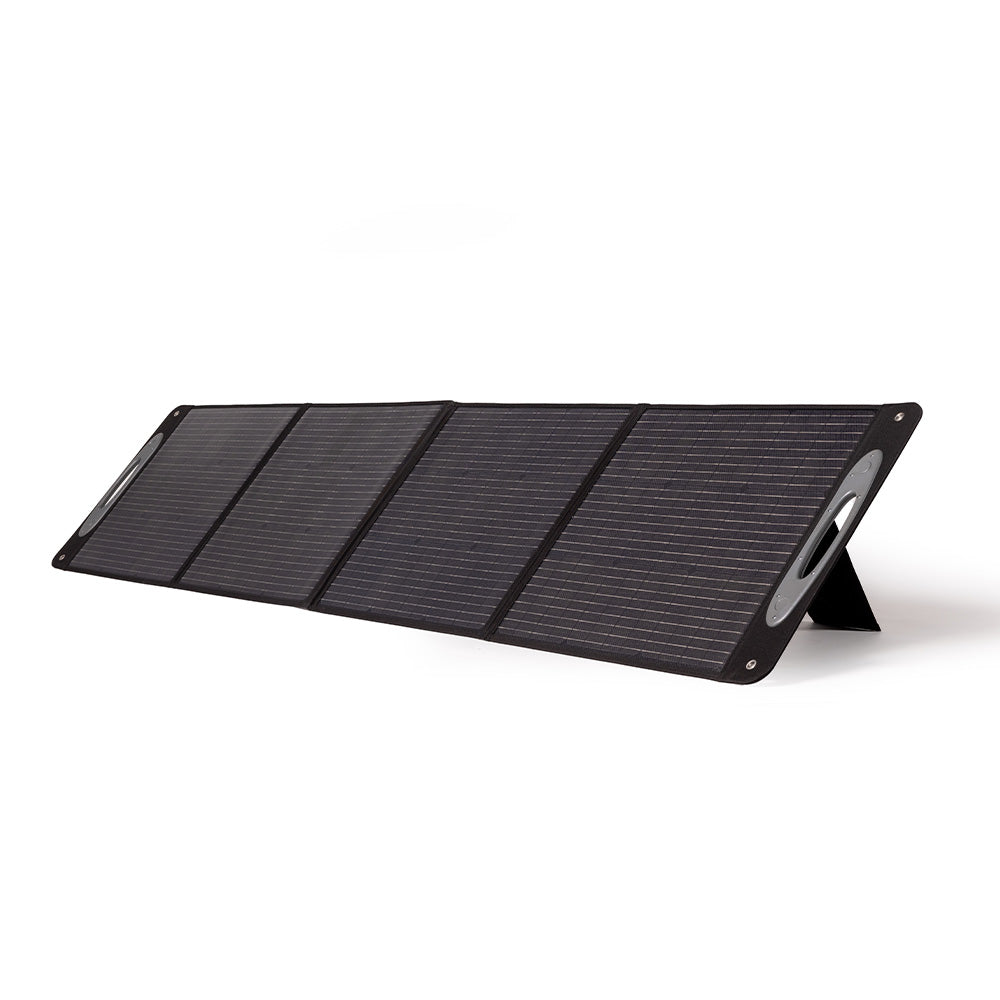
200W Waterproof Solar Panels by Grid Doctor for the 3300 & 2200 Solar Generator Systems
- ✓Doubled wattage delivers 10–11 amps peak, 6–8 amps real-world average—charges larger battery banks (2,200–3,300Wh) from 50% to 80% in approximately 3–4 hours of midday sun
- ✓Waterproof connector and housing rated for outdoor mounting; weatherproof design survives seasonal storage and extended emergency deployments without degradation
- ✓Proportionally matched to larger solar generators; a single 200W panel charges a 3,300Wh system faster than two smaller panels would the 300Wh system
- ✓Realistic for households needing multi-day power continuity—the higher wattage supports full-day recharging cycles of oversized battery banks
- ✓Scalable architecture: add multiple 200W units in parallel (same voltage) to approach 400W, 600W+ arrays for sustained grid-independent operation
Seasonal and Daily Planning: The Real Charging Schedule
To build a practical solar backup system, you must think in terms of available sunlight hours and usable charging hours, not just panel wattage.
Usable charging hours are the hours during a day when your panel outputs meaningfully. During summer at 40°N latitude (northern U.S.), you get approximately 8–10 peak-equivalent hours (the full-sun equivalent translated into actual variable output). In winter, that drops to 2–3 hours. At 50°N (Canada, northern Europe), winter usable hours drop to 1–2.
Daily charging plan, 100W panel, 300Wh battery:
Summer scenario (8 peak-equivalent hours):
- Morning (6am–9am): 1.5 amp average = 4.5Ah charged
- Midday (9am–3pm): 4 amp average = 24Ah charged
- Late afternoon (3pm–6pm): 1.5 amp average = 4.5Ah charged
- Total: ~33Ah, or fully replacing a typical day's use (200–250Wh draw)
Winter scenario (2 peak-equivalent hours):
- Morning (8am–10am): 2 amp average = 4Ah charged
- Midday (10am–12pm): 3 amp average = 6Ah charged
- Total: ~10Ah, or 120Wh charged—maybe 40% of a typical day's draw
In winter, a single 100W panel is insufficient unless you drastically reduce daily consumption (lighting and communication only, no heating or major loads). Plan for stored battery capacity to cover multi-day cloudy stretches, not just overnight.
Frequently Asked Questions
Q: How long does a 100W solar panel take to charge a battery? A: A 100W panel delivers approximately 3–4 amps of real charging current during average sunlight conditions. A typical 300Wh battery (25Ah at 12V) charges from 50% to 80% capacity in roughly 2 hours at solar noon, assuming clear skies. Cloudy days extend this to 4–6 hours. Winter sun can double the time again. The math: usable Ah needed ÷ amps delivered = charging hours. Factor in 10–15% losses from the charge controller and wiring.
Q: Can a 100W solar panel run essential appliances during a power outage? A: A 100W panel does not run appliances continuously—it charges a battery, which then powers appliances. A 300Wh battery paired with the panel supports lighting, phone charging, and small radio operation for 6–8 hours. Major appliances (refrigerators, water pumps, space heaters) require 400+ watts and drain a 300Wh battery in minutes. For those, you need a larger battery bank (1,000+ Wh) and multiple panels (200W+) to keep pace with the draw.
Q: What's the difference between peak wattage and real-world solar output? A: A 100W panel rating is peak output in laboratory conditions: full direct sun, panel angled perfectly at 90 degrees to incoming rays, and no atmospheric dust or cloud cover. Real-world output is 30–60% lower because the sun angle changes throughout the day, clouds diffuse light, and panels are rarely positioned perfectly. Average real-world output is 3–4 amps (36–48W equivalent) instead of 5.5 amps (100W). Build your calculations on realistic output, not peak specs, to avoid underestimating charging time.
Conclusion
Start your solar emergency preparedness with an honest assessment of your outage scenario. If you expect power to return within 48 hours and you need phones charged and lights available, a 100W solar panel paired with a 300Wh battery is practical and affordable. If you must sustain power for a week or run high-draw appliances, invest in multiple panels and a 1,000+ Wh battery bank from the start.
The most common preparedness mistake is purchasing a single small panel and expecting it to solve indefinite outages. It cannot. The honest use case is: a compact, portable solar system designed to extend the duration of stored battery capacity during short outages and to maintain charge during non-emergency times. Calculate your actual daily consumption in watt
Sources & Official Guidance
Authoritative further reading
This guide is for general informational purposes only and is not professional, medical, or safety advice. Always follow official guidance and, in a life-threatening emergency, call your local emergency number (911 in the US).
Mark Sutton, Lead Editor
Mark runs the editorial side of DoomsDayPreps. He digs into the research on emergency prep and survival gear, and checks anything safety-related against FEMA, CDC, and Red Cross guidance before it goes live.