Sprouting Seeds for Emergency Food: 3-Day Harvest Guide
Learn how sprouting seeds provides fresh nutrients in 3-5 days without refrigeration. Grow emergency food on your countertop—no soil needed.
When the electricity fails or supply chains break, fresh food vanishes first. But sprouting seeds offers something unique: nutrient-dense vegetables ready to eat in 3–5 days, no soil, no sunlight, and no refrigeration required. Unlike freeze-dried or canned food, sprouts deliver live enzymes and bioavailable minerals that stored carbs and proteins cannot. This is not a garden project—it's a compressed food production system that fits on your kitchen counter.
How Sprouting Converts Seeds Into Live Food
Sprouting activates dormant seed metabolism. When you soak a seed, water penetrates the seed coat and triggers germination—the plant embryo begins consuming stored starches and proteins to fuel root and shoot growth. This metabolic shift is the mechanism behind sprouting's nutritional advantage.
During germination, several metabolic conversions happen simultaneously:
Enzyme activation. Dormant seeds contain enzyme inhibitors that prevent premature sprouting in soil. Soaking neutralizes these inhibitors and activates enzymes that break down complex carbohydrates and proteins into simpler, more digestible compounds. A sprouted seed becomes 30–40% easier to digest than an unsprouted one.
Vitamin synthesis. As the seed germinates, the embryo synthesizes B vitamins (especially B2, B5, and folate) and vitamin C to fuel rapid growth. Unsprouted seeds contain little vitamin C; sprouted seeds develop measurable levels within 3–4 days.
Mineral bioavailability. Sprouting reduces phytic acid, an antinutrient that binds calcium, iron, zinc, and magnesium in the seed, making them unavailable to your body. A 3-day sprout can reduce phytic acid by 50–80%, meaning minerals are actually absorbed instead of passing through you.
The result: a tiny sprout delivers more usable nutrition per ounce than the unsprouted seed that created it.
The Mathematics of Emergency Sprouting
Sprouting density and rotation are the operational keys. A single 4-tray system produces continuous harvests if you stagger planting.
Per-tray yield. One tray holds approximately 2 tablespoons (about 30 grams) of seeds. Most common sprouting seeds (alfalfa, broccoli, mung beans, lentils) multiply in mass 5–8 times during a 3–5 day sprout cycle. A 30-gram seed load becomes 150–240 grams of fresh sprouts—roughly 1 to 1.5 cups of edible material per tray.
Caloric output. Sprouts are 60–90% water by weight, so they are nutrient-dense but calorie-sparse compared to dried seeds. Fresh broccoli sprouts contain approximately 30 calories per 100-gram serving; mung bean sprouts, 30 calories per 100g. You need sprouts as a nutrient supplement alongside denser calories (grains, legumes, oils), not as a replacement.
Rotation schedule for 4 trays:
| Tray | Day 1 | Day 2 | Day 3 | Day 4 | Day 5 | Day 6 |
|---|---|---|---|---|---|---|
| 1 | Plant | Rinse | Rinse | Harvest | — | — |
| 2 | — | Plant | Rinse | Rinse | Harvest | — |
| 3 | — | — | Plant | Rinse | Rinse | Harvest |
| 4 | — | — | — | Plant | Rinse | Rinse |
Starting on day 6, you harvest one tray every day while maintaining continuous sprout production. Four trays yield roughly 600–950 grams (1.3–2.1 lbs) of fresh sprouts per week on rotation—enough fresh greens for one adult or two children alongside other stored food.
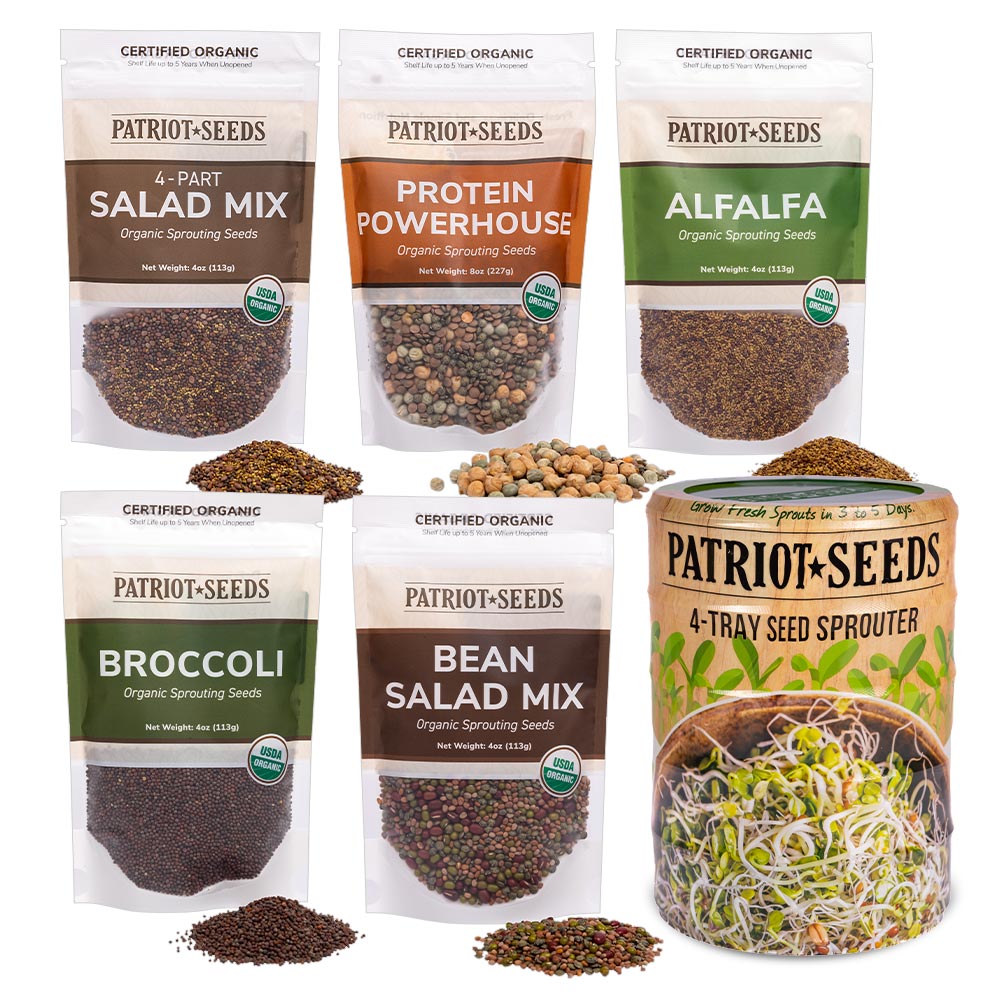
4-Tray Seed Sprouter Set & Sprouting Seeds Starter Kit
- ✓Four stacked trays with drainage holes allow water to flow through sprouting seeds while air circulation prevents mold—passive system requires only daily rinsing with tap water
- ✓5 seed packets included cover 25+ plantings across alfalfa, broccoli, mung bean, and lentil varieties; standard 2-tablespoon load per tray produces 150–240 grams per harvest
- ✓Countertop operation in darkness works indoors during grid-down scenarios; no power, soil, or outdoor space required—fits in a kitchen cabinet or closet
- ✓Stacked design uses 1 square foot of floor space while producing 600–950 grams of fresh sprouts per week on 4-tray rotation
- ✓Each packet contains untreated seed; rotation schedule ensures continuous harvest every 24 hours after day 5
Water Quality and Storage Stability
Sprouting requires only tap water—no treatment necessary. The 3–5 day cycle is too brief for chlorine or sediment to affect germination rates. A 2-inch soak followed by daily 8–12 hour air-dry cycles is the standard rhythm.
Storage stability of sprouting seeds follows the same rules as any dried seed. Keep packets in a cool, dry location: 50–70°F (10–21°C), below 15% humidity. Unopened sprouting seed packets retain viability for 5–10 years if undamaged. Once opened, use within 12 months to ensure germination rates above 80%.
The critical constraint: sprouted seeds must be consumed fresh. Once harvested, refrigerate sprouts in a breathable bag and use within 5–7 days. Without refrigeration (the emergency scenario), consume sprouts on harvest day or dry them for storage—dried sprouts lose enzyme activity but retain some mineral content.
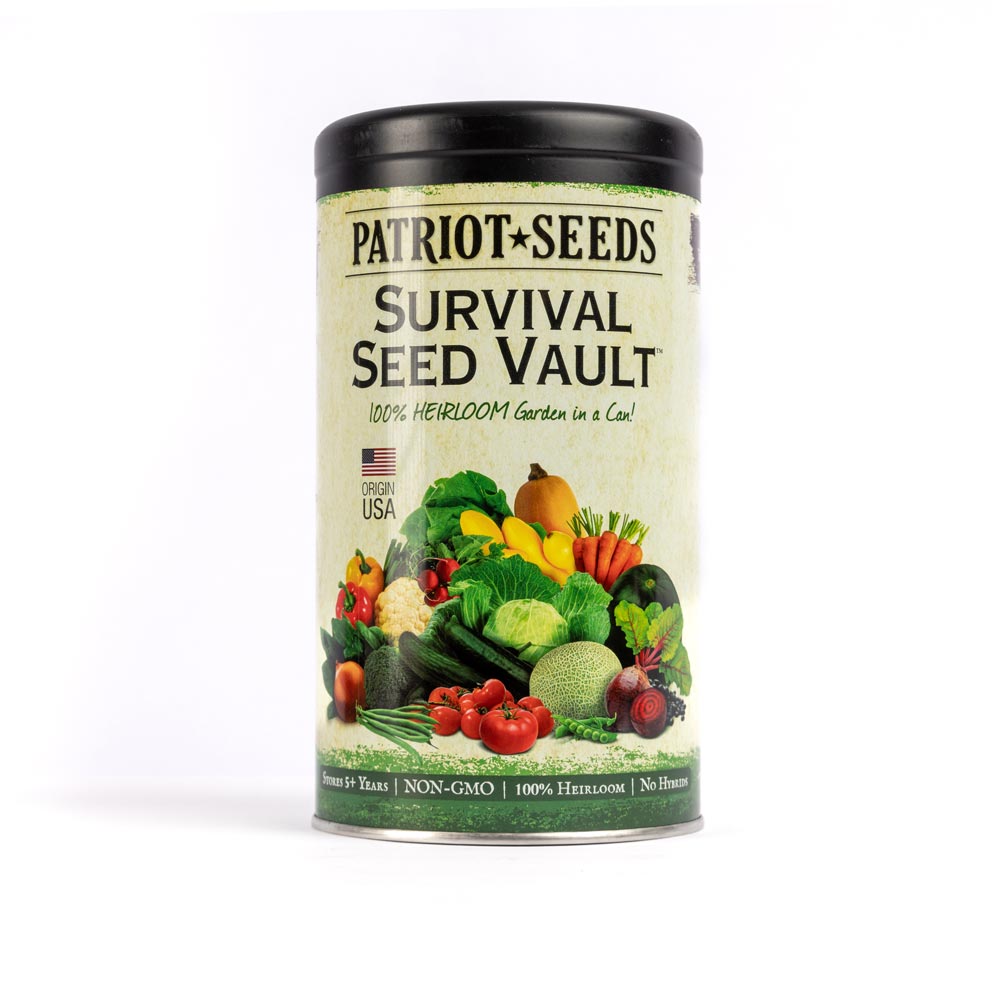
Survival Seed Vault (100% heirloom, 20 varieties) by Patriot Seeds
- ✓100% heirloom, non-hybrid varieties produce viable seeds in the second year—enabling multi-year food production after initial emergency supplies are consumed
- ✓20 vegetable varieties include sproutable types (mung beans, lentils, peas) plus slow-growing varieties for long-term garden recovery
- ✓Vacuum-sealed packets with oxygen absorbers remain viable 10–15 years in cool, dry storage—backup for sprouter seed supply depletion
- ✓Designed for genetic diversity and region-specific adaptation; varieties exclude GMOs and corporate seed patents
- ✓Use sprouting seeds for short-term emergency nutrition while vault seeds establish long-term self-sufficiency
What Sprouting Cannot Do: Honest Limitations
Sprouting supplies fresh micronutrients and enzymes, but not bulk calories or complete protein. A 1-cup serving of mung bean sprouts (100 grams) contains 30 calories and 3 grams of protein. A single adult needs 2,000 calories and 50–60 grams of protein daily—sprouts alone cannot meet this need. Combine sprouting with stored grains (rice, wheat, oats), legumes (dried beans, lentils), and fats (oils, nuts) to build a balanced emergency diet.
Sprouting fails in extreme cold. Germination requires soil temperature above 50°F (10°C); most varieties perform best at 65–75°F (18–24°C). In an unheated house during winter, germination slows or stops. Heat the sprouting tray using passive solar exposure during daylight or locate the system near a heat source.
Not all seeds are created equal for sprouting. Large seeds (corn, squash) and fuzzy-coated seeds (flax) are difficult to sprout at home and prone to mold. Stick to proven varieties: alfalfa, broccoli, mung beans, lentils, chickpeas, and radish. Avoid garden seeds treated with fungicide or pesticide—the packet will state "treated" in fine print.
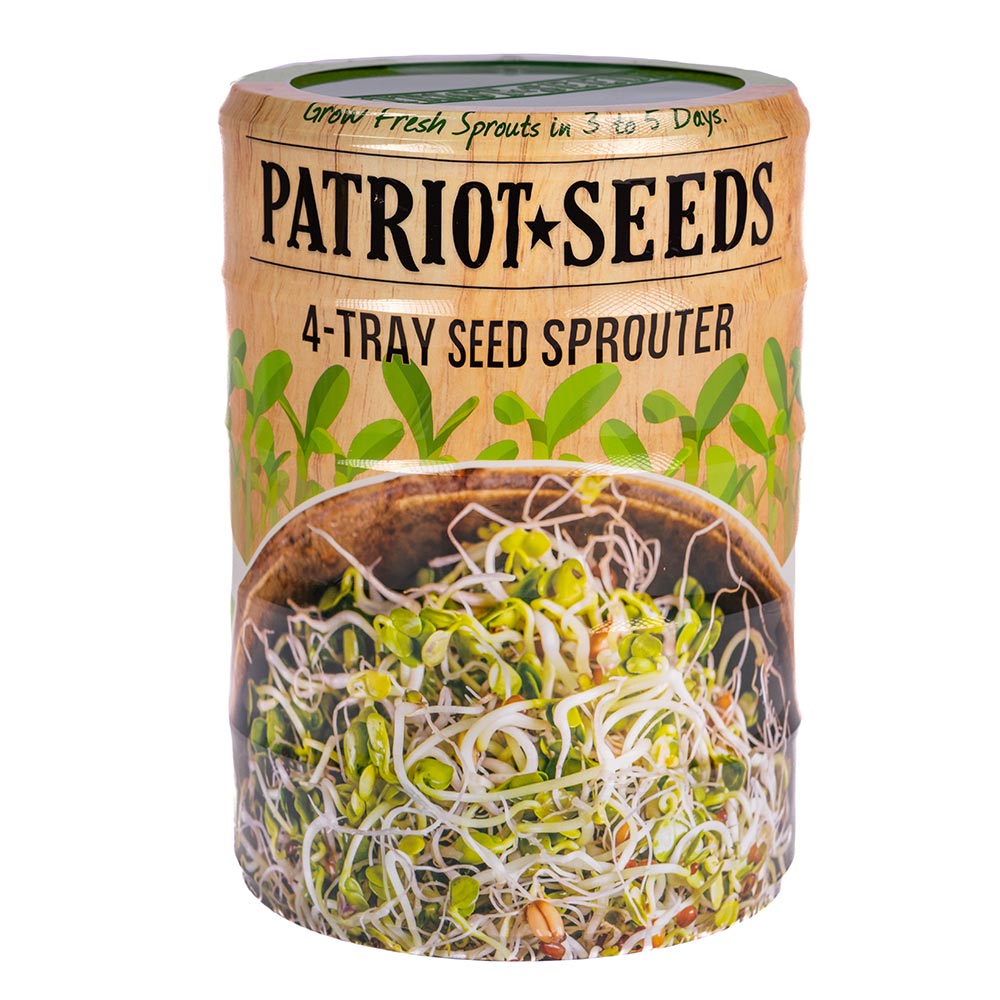
4-Tray Seed Sprouter Set by Patriot Seeds
- ✓Modular stackable design allows expansion from 4 to 8 trays by purchasing additional tray kits without redundant equipment
- ✓Each tray drains independently; unglazed plastic wicks excess water away, reducing mold risk compared to solid container methods
- ✓Dimensions (approximately 10 × 10 inches per tray) fit standard kitchen shelves and cabinet heights—designed for long-term countertop storage
- ✓Zero electricity or plumbing required; passive water gravity and air circulation mean operation continues unchanged during grid failure
- ✓Compatible with any untreated sprouting seeds sold by Patriot or third-party suppliers
Frequently Asked Questions
Q: How many sprouts do you get from one seed packet? A: Sprouting seed packets typically contain 1–2 ounces (28–56 grams). At 2 tablespoons per tray (30 grams), one packet yields 12–18 single-tray plantings. Four trays on rotation consume one packet every 5–7 days. A starter kit with 5 packets supports 8–12 weeks of continuous 4-tray operation before resupply is necessary.
Q: Can sprouts replace fresh vegetables in a long-term emergency? A: No. Sprouts supply micronutrients and live enzymes, but deliver only 25–35 calories per 100-gram serving. A family of four needs 8,000 calories daily—sprouts might contribute 300–400 of those calories plus vitamins C, folate, and minerals that dried food cannot provide. Use sprouting as nutritional supplementation alongside stored grains and legumes, not as a standalone food source.
Q: What's the difference between sprouting seeds and regular garden seeds? A: Sprouting seeds are untreated and tested for high germination rates in 3–5 days at warm indoor temperatures. Garden seeds are often treated with fungicide, bred for soil growth, and lack sprouting genetics. Using garden seeds for sprouting risks mold, slow germination, and ingestion of pesticide residue. Purchase sprouting seeds explicitly—they cost more but work reliably in a sprouting system.
Next Steps for Emergency Nutrition
Start with one 4-tray kit and 5 seed packets. Grow one batch over the next week to test germination rates, taste, and your daily rinsing routine before an emergency forces you to rely on it. A 3-dollar investment in a single packet now costs nothing compared to a failed sprout system when food supply fails.
Store unopened sprouting seed packets in a cool place alongside your backup grains and legumes. Rotate every 18 months to ensure germination rates above 80% when you need them. Keep the sprouter kit accessible on a shelf—not packed away where setup takes thirty minutes.
Sources & Official Guidance
Authoritative further reading
This guide is for general informational purposes only and is not professional, medical, or safety advice. Always follow official guidance and, in a life-threatening emergency, call your local emergency number (911 in the US).
Mark Sutton, Lead Editor
Mark runs the editorial side of DoomsDayPreps. He digs into the research on emergency prep and survival gear, and checks anything safety-related against FEMA, CDC, and Red Cross guidance before it goes live.